Building Modern Browser Extensions with Developer Tools
plasmo and wxt are build tools designed to simplify browser extension development. They handle cross-browser compatibility, bundling, and hot reloading. plasmo acts as a full framework with strong conventions, especially for React. wxt functions as a toolkit built on Vite, offering flexibility for various frontend frameworks.
Npm Package Weekly Downloads Trend
Github Stars Ranking
Stat Detail


Plasmo vs Wxt: Architecture, DX, and Extension Development Compared
Both plasmo and wxt aim to solve the same problem — browser extension development is historically painful. They abstract away manifest management, cross-browser quirks, and bundling complexity. However, they take different approaches to structure and flexibility. Let's compare how they handle real engineering tasks.
⚙️ Project Setup and Configuration
plasmo uses a dedicated config file with strong defaults.
- You define settings in
plasmo.config.ts. - It assumes a React-centric structure but supports others.
// plasmo: plasmo.config.ts
import type { PlasmoConfig } from "plasmo";

const config: PlasmoConfig = {
  manifest: {
    permissions: ["storage", "tabs"]
  }
};

export default config;
wxt uses a Vite-based config with modular entrypoints.
- You define settings in
wxt.config.ts. - It relies on file conventions in the
entrypointsfolder.
// wxt: wxt.config.ts
import { defineConfig } from "wxt";

export default defineConfig({
  manifest: {
    permissions: ["storage", "tabs"]
  }
});
📜 Content Scripts: Mounting and Logic
plasmo treats content scripts as modules with exported config.
- You create a
content.tsfile. - You export a config object to define matches.
- UI mounting often uses helper functions provided by the framework.
// plasmo: content.ts
export const config = {
  matches: ["<all_urls>"]
};

export default async function main() {
  const container = document.createElement("div");
  container.id = "my-app";
  document.body.appendChild(container);
  // Render React/Vue app into container
}
wxt uses a definition function for content scripts.
- You create
entrypoints/content.ts. - You use
defineContentScriptto set matches and logic. - It provides built-in helpers for UI integration.
// wxt: entrypoints/content.ts
import { defineContentScript } from "wxt/sandbox";

export default defineContentScript({
  matches: ["<all_urls>"],
  async main(ctx) {
    const container = document.createElement("div");
    container.id = "my-app";
    document.body.appendChild(container);
    // Render app into container
  }
});
🧠 Background Workers and Service Workers
plasmo uses a dedicated background.ts file.
- It handles service worker lifecycle automatically.
- You write standard TypeScript logic.
// plasmo: background.ts
export default function Background() {
  chrome.tabs.onUpdated.addListener((tabId, changeInfo) => {
    console.log("Tab updated", tabId);
  });
}
wxt uses a definition function in the entrypoints folder.
- You create
entrypoints/background.ts. - You specify the type (module or persistent) explicitly.
// wxt: entrypoints/background.ts
import { defineBackground } from "wxt/sandbox";

export default defineBackground({
  type: "module",
  main() {
    chrome.tabs.onUpdated.addListener((tabId, changeInfo) => {
      console.log("Tab updated", tabId);
    });
  }
});
🖥️ UI Pages: Popups and Options
plasmo uses single-file components for UI surfaces.
- A
popup.tsxfile becomes your extension popup. - It supports React components directly.
// plasmo: popup.tsx
import { useState } from "react";

export default function Popup() {
  const [count, setCount] = useState(0);
  return <button onClick={() => setCount(c => c + 1)}>{count}</button>;
}
wxt separates HTML and logic in the entrypoints folder.
- You create
entrypoints/popup/index.html. - You link a TypeScript entry file for logic.
<!-- wxt: entrypoints/popup/index.html -->
<!DOCTYPE html>
<html>
  <head>
    <meta charset="UTF-8" />
    <title>Popup</title>
  </head>
  <body>
    <div id="app"></div>
    <script type="module" src="./main.ts"></script>
  </body>
</html>
🌐 Cross-Browser Builds
plasmo handles browser targets via command flags.
- You specify the target when building.
- It adjusts the manifest automatically.
# plasmo: Build for Firefox
plasmo build --target=firefox-mv2
wxt handles browser targets via config or flags.
- You specify the browser in the build command.
- It supports Chrome, Firefox, Safari, and Edge.
# wxt: Build for Firefox
wxt build --browser firefox
🤝 Similarities: Shared Ground Between Plasmo and Wxt
While the differences are clear, both tools share many core ideas and capabilities. Here are key overlaps:
1. ⚡ Hot Module Replacement (HMR)
- Both support fast refresh during development.
- Changes reflect instantly without reloading the extension manually.
// Both: Development server handles updates
// No extra config needed for basic HMR
2. 📦 Manifest Management
- Both generate
manifest.jsonautomatically. - You define permissions in config, not in a static file.
// Both: Define permissions in config
// plasmo.config.ts or wxt.config.ts
permissions: ["storage"]
3. 🛠️ TypeScript Support
- Both are built with TypeScript first.
- Full type safety for Chrome APIs and browser events.
// Both: Typed Chrome API
chrome.storage.local.get({ key: "value" }, (result) => {
  // result is typed
});
4. 🔌 Asset Handling
- Both handle images, fonts, and static assets.
- Assets are bundled and referenced correctly in the manifest.
// Both: Import assets directly
import logo from "~/assets/logo.png";
5. 🚀 Deployment Ready
- Both produce zip files ready for store submission.
- Support for multiple build profiles (dev, prod, staging).
# Both: Build for production
plasmo build
wxt build
📊 Summary: Key Similarities
| Feature | Shared by Plasmo and Wxt |
|---|---|
| Core Tech | ⚡ Vite-based bundling |
| Language | 📘 TypeScript first |
| Manifest | 📄 Auto-generated from config |
| Development | 🔄 Hot Module Replacement |
| Assets | 🖼️ Automatic bundling |
| Targets | 🌐 Chrome, Firefox, Edge, Safari |
🆚 Summary: Key Differences
| Feature | plasmo | wxt |
|---|---|---|
| Philosophy | 🏗️ Opinionated Framework | 🧰 Flexible Toolkit |
| Config File | plasmo.config.ts | wxt.config.ts |
| Content Scripts | Export config object | defineContentScript function |
| UI Structure | Single file components | HTML + TS entrypoints |
| Framework Focus | React-first (supports others) | Framework-neutral (Vite plugins) |
| Background | background.ts function | defineBackground function |
💡 The Big Picture
plasmo is like a pre-fabricated house 🏠 — great for teams that want to move fast with React and prefer standard structures. Ideal for startups, marketing extensions, and teams already invested in the React ecosystem.
wxt is like a custom build kit 🛠️ — perfect for teams who want control over every file and use various frameworks. Shines in complex enterprise extensions, multi-framework repos, and projects needing specific Vite plugins.
Final Thought: Despite their different approaches, both tools make extension development significantly easier than the vanilla workflow. Choose based on your team's framework preference and desire for convention versus control.
How to Choose: plasmo vs wxt
- plasmo:
Choose
plasmoif your team uses React heavily and prefers a structured framework with built-in UI components for extension surfaces. It is ideal for projects that benefit from convention over configuration and need a stable, opinionated setup for content scripts and popups. - wxt:
Choose
wxtif you want Vite-based speed, support for multiple frameworks like Vue or Svelte, and fine-grained control over entrypoints. It is suitable for teams that value modular architecture and want to leverage the wider Vite plugin ecosystem.
Popular Comparisons
README for plasmo






English | 简体中文 | Tiếng Việt | Deutsch | French | Indonesian | Русский | Turkish | 日本語 | 한국어
Production Cloud: We've built a cloud offering for browser extensions called Itero. Check it out if you want instant beta testing and more awesome features.
Plasmo Framework
The Plasmo Framework is a battery-packed browser extension SDK made by hackers for hackers. Build your product and stop worrying about config files and the odd peculiarities of building browser extensions.
It's like Next.js for browser extensions!
Highlighted Features
- First-class React + Typescript Support
- Declarative Development
- Content Scripts UI
- Tab Pages
- Live-reloading + React HMR
.env*files- Storage API
- Messaging API
- Remote code bundling (e.g., for Google Analytics)
- Targeting multiple browser and manifest pairs
- Automated deployment via BPP
- Optional support for Svelte and Vue
And many, many more! 🚀
System Requirements
- Node.js 16.x or later
- MacOS, Windows, or Linux
- (Strongly Recommended) pnpm
Examples
We have examples showcasing how one can use Plasmo with Firebase Authentication, Redux, Supabase authentication, Tailwind, and many more. To check them out, visit our examples repository.
Documentation
Check out the documentation to get a more in-depth view into the Plasmo Framework.
Browser Extensions Book
For a more in-depth view into how browser extensions work, and how to develop them, we highly recommend Matt Frisbie's new book "Building Browser Extensions"
Usage
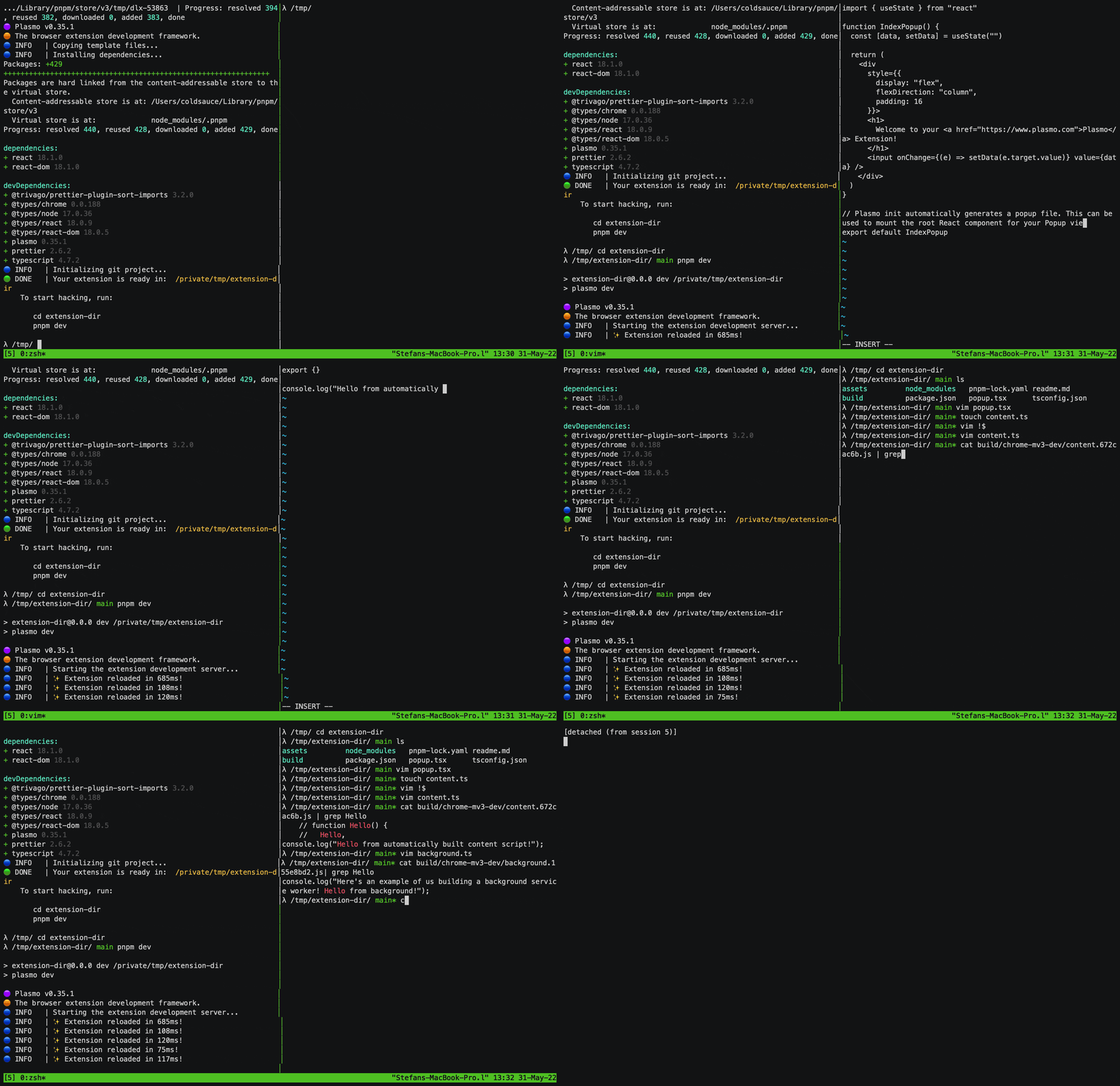
pnpm create plasmo example-dir
cd example-dir
pnpm dev
The road ahead is filled with many turns.
- Popup changes go in
popup.tsx - Options page changes go in
options.tsx - Content script changes go in
content.ts - Background service worker changes go in
background.ts
Directories
You can also organize these files in their own directories:
ext-dir
├───assets
|   └───icon.png
├───popup
|   ├───index.tsx
|   └───button.tsx
├───options
|   ├───index.tsx
|   ├───utils.ts
|   └───input.tsx
├───contents
|   ├───site-one.ts
|   ├───site-two.ts
|   └───site-three.ts
...
Finally, you can also avoid putting source code in your root directory by putting them in a src sub-directory, following this guide. Note that assets and other config files will still need to be in the root directory.
Supported Browsers
To see a list of supported browser targets, please refer to our documentation here.
Community
The Plasmo community can be found on Discord. This is the appropriate channel to get help with using the Plasmo Framework.
Our Code of Conduct applies to all Plasmo community channels.
Contributing
Please see the contributing guidelines to learn more.
A big thanks to all of our amazing contributors ❤️
Feel free to join the fun and send a PR!
Plasmo Framework
Plasmo Examples
Plasmo Storage
Browser Platform Publisher
Disclaimer
Plasmo is currently alpha software, and some things might change from version to version, so please be mindful and use it at your own risk.