Choosing the Right JavaScript Testing Framework for Frontend Architecture
ava, jasmine, jest, and mocha are core testing tools used to verify JavaScript code behavior, but they serve different roles in the ecosystem. jest is a complete platform built by Meta, offering built-in assertions, mocking, and snapshot testing with minimal setup. mocha is a flexible test runner that pairs with external libraries for assertions and mocking, giving developers full control over their stack. ava focuses on speed and simplicity, running tests concurrently by default with explicit async handling. jasmine is a standalone behavior-driven framework that requires no external dependencies, often found in legacy Angular projects or simple setups.
Npm Package Weekly Downloads Trend
Github Stars Ranking
Stat Detail


Ava vs Jasmine vs Jest vs Mocha: Architecture and DX Compared
ava, jasmine, jest, and mocha are all designed to verify JavaScript code, but they handle test execution, assertions, and setup in very different ways. Let's break down how they tackle common engineering problems so you can pick the right tool for your stack.
🗂️ Test Structure & Syntax
jest uses test or it blocks with a global expect function.
- Tests are defined clearly with strings for names.
- Setup and teardown are handled via
beforeEachorbeforeAll.
// jest: Basic test structure
test('adds 1 + 2 to equal 3', () => {
  expect(1 + 2).toBe(3);
});
mocha uses describe and it blocks but lacks built-in assertions.
- You must import an assertion library like Node's
assertorchai. - Structure is flexible and nested via
describe.
// mocha: Basic test structure
const assert = require('assert');

describe('Math', () => {
  it('adds 1 + 2 to equal 3', () => {
    assert.equal(1 + 2, 3);
  });
});
ava uses test blocks where the assertion object t is passed in.
- Tests must return a promise or be async if asynchronous.
- No global state; everything is passed explicitly.
// ava: Basic test structure
import test from 'ava';

test('adds 1 + 2 to equal 3', t => {
  t.is(1 + 2, 3);
});
jasmine uses describe and it with built-in expect.
- Similar syntax to Jest but without the extra tooling.
- Often used without a separate test runner.
// jasmine: Basic test structure
describe('Math', () => {
  it('adds 1 + 2 to equal 3', () => {
    expect(1 + 2).toBe(3);
  });
});
📥 Assertions & Expectations
jest provides a rich expect API built into the core.
- Chains matchers like
toBe,toEqual,toContain. - No extra imports needed for standard checks.
// jest: Assertions
expect(user.name).toBe('Alice');
expect(items).toContain('item1');
mocha relies on external libraries for assertions.
- Using Node's
assertis common for simple checks. - Using
chaiadds chainable language like Jest.
// mocha: Assertions (using Node assert)
const assert = require('assert');
assert.strictEqual(user.name, 'Alice');
ava uses assertions attached to the t context object.
- Methods like
t.is,t.deepEqual,t.true. - Clear and explicit without chaining.
// ava: Assertions
t.is(user.name, 'Alice');
t.true(items.includes('item1'));
jasmine includes a built-in expect similar to Jest.
- Supports matchers like
toBe,toEqual,toHaveBeenCalled. - Standalone without needing extra packages.
// jasmine: Assertions
expect(user.name).toBe('Alice');
expect(items).toContain('item1');
🔄 Handling Async Code
jest handles promises and async functions automatically.
- Just return the promise or use
async/await. - Can also use
donecallback for older patterns.
// jest: Async test
test('fetches data', async () => {
  const data = await fetchData();
  expect(data).toBeDefined();
});
mocha supports promises, async functions, or done callbacks.
- You must return the promise or call
done(). - Fails if neither is used correctly in async tests.
// mocha: Async test
it('fetches data', async () => {
  const data = await fetchData();
  assert.ok(data);
});
ava treats any returned promise as an async test.
- Explicit async handling ensures tests don't end early.
- Uses
t.plan()if you need to assert a specific count.
// ava: Async test
test('fetches data', async t => {
  const data = await fetchData();
  t.truthy(data);
});
jasmine supports async/await and promises natively.
- Also supports
donecallback for compatibility. - Waits for the promise to resolve before finishing.
// jasmine: Async test
it('fetches data', async () => {
  const data = await fetchData();
  expect(data).toBeDefined();
});
🧩 Mocking & Dependencies
jest has a powerful mocking system built in.
- Use
jest.fn()for functions andjest.mock()for modules. - Automatically hoists mocks to the top of the file.
// jest: Mocking
const mockFn = jest.fn();
mockFn('hello');
expect(mockFn).toHaveBeenCalledWith('hello');
mocha does not include mocking; you need a library like Sinon.
- Use
sinon.stub()orsinon.spy(). - Gives you control over which mocking tool to use.
// mocha: Mocking (with Sinon)
const sinon = require('sinon');
const stub = sinon.stub(module, 'func');
ava does not include mocking; pairs well with Sinon or Test Double.
- You must install and import the mocking library yourself.
- Keeps the core runner lightweight.
// ava: Mocking (with Sinon)
import sinon from 'sinon';
const stub = sinon.stub(module, 'func');
jasmine includes built-in spying and mocking capabilities.
- Use
spyOn()for existing methods orcreateSpy(). - No need for external libraries for basic mocks.
// jasmine: Mocking
spyOn(object, 'method');
object.method();
expect(object.method).toHaveBeenCalled();
📸 Snapshot Testing
jest supports snapshot testing out of the box.
- Use
toMatchSnapshot()to save UI output. - Great for React components or large objects.
// jest: Snapshots
expect(component).toMatchSnapshot();
mocha requires a plugin for snapshot testing.
- No built-in support; must configure external tool.
- Adds setup complexity compared to Jest.
// mocha: Snapshots (with plugin)
// Requires jest-snapshot or similar plugin
expect(value).toMatchSnapshot();
ava requires a plugin for snapshot testing.
- Use
ava-plugin-snapshotto enable features. - Not part of the core installation.
// ava: Snapshots (with plugin)
// Requires configuration and plugin
t.snapshot(value);
jasmine requires a plugin for snapshot testing.
- No native support in the core framework.
- Typically used with
jasmine-snapshot-reporter.
// jasmine: Snapshots (with plugin)
// Requires external reporter or plugin
expect(value).toMatchSnapshot();
⚡ Test Concurrency
jest runs tests in parallel by default using workers.
- Isolates tests to prevent state leakage.
- Can be configured to run serially if needed.
// jest: Config (jest.config.js)
module.exports = {
  workers: 4 // Runs tests in parallel
};
mocha runs tests serially by default.
- Ensures order but can be slower for large suites.
- Parallel mode exists but requires specific setup.
// mocha: Config (.mocharc.json)
{
  "parallel": false // Default is serial
}
ava runs tests concurrently by default in isolated processes.
- Maximizes speed on multi-core machines.
- Forces tests to be independent.
// ava: Config (ava.config.js)
export default {
  concurrency: 5 // Runs tests concurrently
};
jasmine runs tests serially by default.
- Simple execution flow.
- Parallel execution requires additional runners.
// jasmine: Config (jasmine.json)
{
  "random": true // Order can be random, but execution is serial
}
🤝 Similarities: Shared Ground Between Tools
While the differences are clear, all four tools share core testing concepts.
1. 🧪 Basic Test Blocks
- All use
describeortestto group logic. - All support
beforeEachandafterEachhooks.
// Shared hook usage
beforeEach(() => {
  // Reset state before each test
});
2. 🌐 Async Support
- All handle Promises and
async/await. - All support callback-based
donepatterns for legacy code.
// Shared async pattern
it('works', async () => {
  await doWork();
});
3. ✅ Reporting
- All provide pass/fail output in the terminal.
- All support custom reporters for CI integration.
// Shared CI output
// ✓ adds 1 + 2 to equal 3
// ✗ fails when input is null
4. 🛠️ Configuration
- All allow config files to customize behavior.
- All support ignoring files via patterns.
// Shared ignore pattern
// testPathIgnorePatterns: ['/node_modules/']
📊 Summary: Key Similarities
| Feature | Shared by All Four |
|---|---|
| Core Structure | 🧪 Describe/It blocks |
| Async | 🌐 Promises & Async/Await |
| Hooks | 🔄 BeforeEach/AfterEach |
| CI Ready | ✅ Terminal output & Exit codes |
| Config | 🛠️ Customizable via files |
🆚 Summary: Key Differences
| Feature | jest | mocha | ava | jasmine |
|---|---|---|---|---|
| Assertions | ✅ Built-in expect | ❌ Needs chai or assert | ✅ Built-in t.is | ✅ Built-in expect |
| Mocking | ✅ Built-in jest.fn | ❌ Needs sinon | ❌ Needs sinon | ✅ Built-in spyOn |
| Snapshots | ✅ Built-in | ❌ Needs plugin | ❌ Needs plugin | ❌ Needs plugin |
| Concurrency | ⚡ Parallel (workers) | 🐢 Serial (default) | ⚡ Concurrent (isolated) | 🐢 Serial (default) |
| Setup | 🔋 Batteries included | 🧩 Flexible stack | 🚀 Fast & minimal | 📦 Standalone |
💡 The Big Picture
jest is like a fully stocked workshop 🔨—it gives you everything you need immediately. Ideal for React, Vue, or general frontend projects where speed of setup and rich features matter most.
mocha is like a custom build kit 🛠️—perfect for teams who want to choose their own tools for assertions and mocking. Shines in complex Node.js backends where flexibility is key.
ava is like a speed-focused engine 🏎️—great for projects where test execution time is a bottleneck and isolation is critical. Best for teams willing to write explicit async code for better reliability.
jasmine is like a reliable classic car 🚗—still functional and standalone, but less common in new modern frontend stacks. Suitable for legacy Angular apps or simple scripts where adding heavy deps is not an option.
Final Thought: For most modern frontend teams, jest offers the best balance of features and ease of use. However, if you need specific control over your testing stack or maximum speed, mocha and ava remain strong choices.
How to Choose: ava vs jasmine vs jest vs mocha
- ava:
Choose
avaif you want fast test execution through concurrent runs and prefer a minimal configuration setup. It is ideal for projects where test isolation is critical and you want explicit control over async flows without hidden magic. This tool works well for teams that value speed and simplicity over a large plugin ecosystem. - jasmine:
Choose
jasmineif you need a standalone framework with no external dependencies for assertions or mocking. It is suitable for legacy Angular projects or simple environments where adding a heavy tool like Jest is unnecessary. However, for modern React or Vue projects, other tools often provide better developer experience and community support. - jest:
Choose
jestif you want a batteries-included solution that works out of the box with React, Vue, or Node.js projects. It is the best fit for teams that need built-in snapshot testing, code coverage, and mocking without configuring multiple libraries. This framework is widely adopted and offers the smoothest experience for most frontend architectures. - mocha:
Choose
mochaif you prefer to pick and choose your own assertion and mocking libraries rather than using built-in defaults. It is ideal for complex Node.js backends or projects requiring highly custom reporting and test organization. This runner offers maximum flexibility but requires more initial setup than integrated solutions.
Popular Comparisons
README for ava
Please support our friend Vadim Demedes and the people in Ukraine.

AVA is a test runner for Node.js with a concise API, detailed error output, embrace of new language features and thread isolation that lets you develop with confidence 🚀
Watch this repository and follow the Discussions for updates.
Read our contributing guide if you're looking to contribute (issues / PRs / etc).
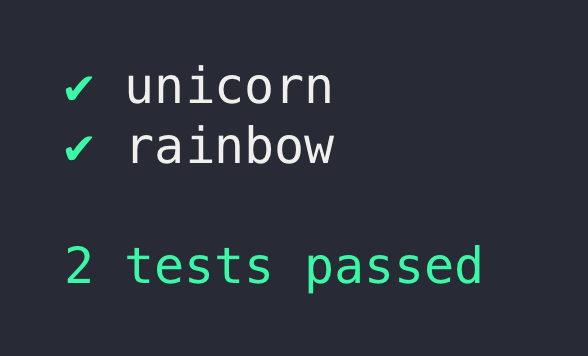
Translations: Español, Français, Italiano, 日本語, 한국어, Português, Русский, 简体中文
Why AVA?
- Minimal and fast
- Simple test syntax
- Runs tests concurrently
- Enforces writing atomic tests
- No implicit globals
- Includes TypeScript definitions
- Magic assert
- Isolated environment for each test file
- Promise support
- Async function support
- Observable support
- Enhanced assertion messages
- Automatic parallel test runs in CI
- TAP reporter
Usage
To install and set up AVA, run:
npm init ava
Your package.json will then look like this (exact version notwithstanding):
{
	"name": "awesome-package",
	"type": "module",
	"scripts": {
		"test": "ava"
	},
	"devDependencies": {
		"ava": "^5.0.0"
	}
}
Or if you prefer using Yarn:
yarn add ava --dev
Alternatively you can install ava manually:
npm install --save-dev ava
Make sure to install AVA locally. AVA cannot be run globally.
Don't forget to configure the test script in your package.json as per above.
Create your test file
Create a file named test.js in the project root directory.
Note that AVA's documentation assumes you're using ES modules.
import test from 'ava';

test('foo', t => {
	t.pass();
});

test('bar', async t => {
	const bar = Promise.resolve('bar');
	t.is(await bar, 'bar');
});
Running your tests
npm test
Or with npx:
npx ava
Run with the --watch flag to enable AVA's watch mode:
npx ava --watch
Supported Node.js versions
AVA supports the latest release of any major version that is supported by Node.js itself. Read more in our support statement.
Highlights
Magic assert
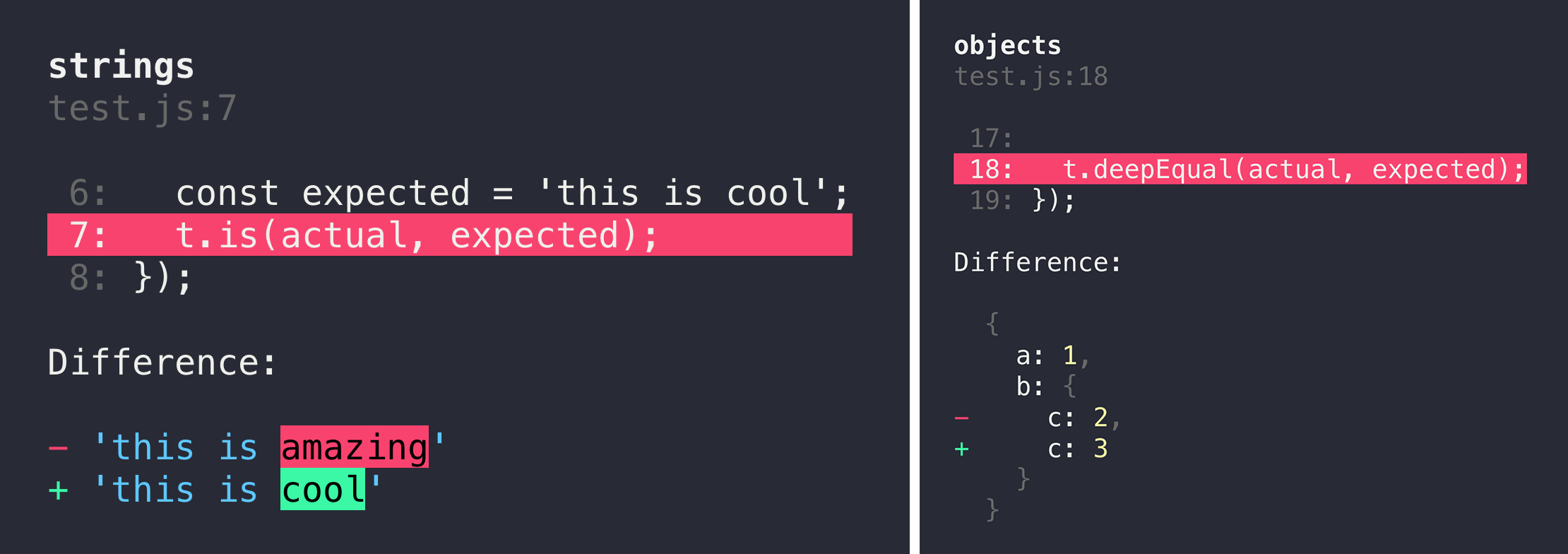
AVA adds code excerpts and clean diffs for actual and expected values. If values in the assertion are objects or arrays, only a diff is displayed, to remove the noise and focus on the problem. The diff is syntax-highlighted too! If you are comparing strings, both single and multi line, AVA displays a different kind of output, highlighting the added or missing characters.
Clean stack traces
AVA automatically removes unrelated lines in stack traces, allowing you to find the source of an error much faster, as seen above.
Parallel runs in CI
AVA automatically detects whether your CI environment supports parallel builds. Each build will run a subset of all test files, while still making sure all tests get executed. See the ci-parallel-vars package for a list of supported CI environments.
Documentation
Please see the files in the docs directory:
- Writing tests
- Execution context
- Assertions
- Snapshot testing
- Command line (CLI)
- Configuration
- Test timeouts
Common pitfalls
We have a growing list of common pitfalls you may experience while using AVA. If you encounter any issues you think are common, comment in this issue.
Recipes
- Test setup
- TypeScript
- Shared workers
- Watch mode
- When to use
t.plan() - Passing arguments to your test files
- Splitting tests in CI
- Code coverage
- Endpoint testing
- Browser testing
- Testing Vue.js components
- Debugging tests with Chrome DevTools
- Debugging tests with VSCode
- Debugging tests with WebStorm
- Isolated MongoDB integration tests
- Testing web apps using Puppeteer
- Testing web apps using Selenium WebDriverJS
FAQ
How is the name written and pronounced?
AVA, not Ava or ava. Pronounced /ˈeɪvə/: Ay (face, made) V (vie, have) A (comma, ago)
What is the header background?
It's the Andromeda galaxy.
What is the difference between concurrency and parallelism?
Concurrency is not parallelism. It enables parallelism.
Support
Related
- eslint-plugin-ava — Lint rules for AVA tests
- @ava/typescript — Test TypeScript projects
- @ava/cooperate — Low-level primitives to enable cooperation between test files
- @ava/get-port — Reserve a port while testing
Links
Team
 |  |
|---|---|
| Mark Wubben | Sindre Sorhus |
Former