Choosing the Right Redis Client for Node.js Applications
ioredis and redis are the two leading Redis client libraries for Node.js, enabling applications to interact with Redis databases for caching, session management, and real-time data processing. ioredis is a robust, feature-rich client known for its strong support of Redis Cluster and Sentinel, offering a promise-based interface out of the box. redis (often referred to as node-redis) is the official Redis client, which underwent a major overhaul in version 4 to provide a modern, promise-based API with improved performance and TypeScript support. Both libraries allow developers to execute Redis commands, manage connections, and handle pub/sub messaging, but they differ in their architectural focus and default configurations.
Npm Package Weekly Downloads Trend
Github Stars Ranking
Stat Detail


ioredis vs redis: A Technical Deep Dive for Node.js Architects
When integrating Redis into a Node.js backend, the choice of client library impacts everything from connection stability to code maintainability. ioredis and redis are the dominant players in this space. While both allow you to run commands like GET and SET, their underlying architectures handle connection pooling, clustering, and command execution differently. Let's break down the technical realities.
🔌 Connection Management and Lifecycle
How you initialize and manage the connection is the first major divergence. ioredis creates a connection immediately upon instantiation, while redis v4 requires an explicit connect call or waits for the first command.
ioredis connects automatically when you create the instance. It emits events like connect and error that you can listen to immediately.
// ioredis: Auto-connect on instantiation
const Redis = require('ioredis');
const redis = new Redis({ host: 'localhost', port: 6379 });

redis.on('connect', () => {
  console.log('Connected to Redis');
});

// Ready to use immediately
await redis.set('foo', 'bar');
redis (v4+) creates a client that must be explicitly connected before issuing commands, giving you more control over the startup sequence.
// redis: Explicit connect required
const { createClient } = require('redis');
const client = createClient({ url: 'redis://localhost:6379' });

client.on('connect', () => {
  console.log('Connected to Redis');
});

await client.connect();
await client.set('foo', 'bar');
🗄️ Cluster and Sentinel Support
For enterprise-grade applications, high availability is non-negotiable. This is where ioredis has historically held a strong advantage.
ioredis has built-in, first-class support for Redis Cluster and Sentinel. You can instantiate a cluster client directly without additional wrappers.
// ioredis: Native Cluster support
const Redis = require('ioredis');
const cluster = new Redis.Cluster([
  { port: 6380, host: '127.0.0.1' },
  { port: 6381, host: '127.0.0.1' }
]);

await cluster.set('key', 'value');
redis added Cluster support in version 4, but it is often considered less mature than ioredis in complex sharding scenarios. It requires specific configuration to enable cluster mode.
// redis: Cluster support via configuration
const { createClient } = require('redis');
// Note: Cluster implementation exists but ioredis is often preferred for complex topologies
const client = createClient({
  url: 'redis://localhost:6379'
  // Cluster mode requires specific root nodes configuration in newer versions
});

await client.connect();
⚡ Command Execution and API Style
Both libraries now support Promises natively, but their API structures differ slightly in how they handle arguments and return values.
ioredis allows you to call commands directly as methods on the instance. It handles argument casting automatically.
// ioredis: Direct method calls
const Redis = require('ioredis');
const redis = new Redis();

// Arguments are passed as separate parameters
await redis.set('user:1', 'Alice');
const name = await redis.get('user:1');

// Complex commands like HMSET work naturally
await redis.hset('profile', 'name', 'John', 'age', '30');
redis organizes commands under namespaces in some versions or uses a generic send method, though v4 simplifies this to direct methods similar to ioredis. However, it is stricter about argument types.
// redis: Direct method calls (v4+)
const { createClient } = require('redis');
const client = createClient();
await client.connect();

// Arguments passed similarly
await client.set('user:1', 'Alice');
const name = await client.get('user:1');

// Hash commands are also direct methods
await client.hSet('profile', { name: 'John', age: '30' });
📡 Pub/Sub Messaging
Real-time features often rely on Redis Pub/Sub. The implementation details vary significantly between the two.
ioredis uses the same instance for Pub/Sub or allows creating a dedicated subscriber. It handles the subscription state internally.
// ioredis: Subscriber on same or new instance
const Redis = require('ioredis');
const sub = new Redis();

sub.subscribe('news', (err, count) => {
  if (err) console.error(err);
});

sub.on('message', (channel, message) => {
  console.log(`Received: ${message}`);
});
redis v4 introduces a dedicated duplicate() method or separate client for subscribers, as a single client cannot block on subscription while sending commands.
// redis: Dedicated subscriber client
const { createClient } = require('redis');
const publisher = createClient();
const subscriber = publisher.duplicate();

await subscriber.connect();
await subscriber.subscribe('news', (message) => {
  console.log(`Received: ${message}`);
});
🛠️ Error Handling and Reconnection
Production systems must handle network blips gracefully. Both clients offer reconnection logic, but the configuration differs.
ioredis provides extensive retry strategies out of the box. You can configure retry delays and maximum attempts directly in the constructor.
// ioredis: Configurable retry strategy
const Redis = require('ioredis');
const redis = new Redis({
  retryStrategy: (times) => {
    if (times > 10) return null; // Stop retrying
    return Math.min(times * 50, 2000); // Delay in ms
  }
});
redis handles reconnection internally with default settings. Customizing retry logic often requires listening to error events and manually managing the client lifecycle in older patterns, though v4 improved this.
// redis: Error event handling
const { createClient } = require('redis');
const client = createClient();

client.on('error', (err) => {
  console.log('Redis Client Error', err);
  // Reconnection is automatic by default in v4
});
🧩 Similarities: Shared Ground
Despite their differences, both libraries solve the same core problems effectively.
1. Promise-Based APIs
Both ioredis and redis (v4+) use Promises, allowing for clean async/await syntax without callback hell.
// Both support async/await
async function getData() {
  const val = await client.get('key');
  return val;
}
2. TypeScript Support
Both packages ship with TypeScript definitions, enabling type-safe development in modern IDEs.
// Both allow typed Redis interactions
import { createClient } from 'redis';
// or
import Redis from 'ioredis';
3. Pipeline Support
Both allow batching commands to reduce network round-trips, crucial for performance.
// ioredis pipeline
const pipeline = redis.pipeline();
pipeline.set('foo', 'bar');
pipeline.get('foo');
await pipeline.exec();

// redis pipeline
const pipeline = client.multi();
pipeline.set('foo', 'bar');
pipeline.get('foo');
await pipeline.exec();
📊 Summary: Key Differences
| Feature | ioredis | redis |
|---|---|---|
| Connection | Auto-connects on new | Explicit .connect() call |
| Cluster | Native, mature support | Supported, but newer implementation |
| Pub/Sub | Flexible instance usage | Requires duplicate client for sub |
| Retry Logic | Configurable strategy function | Default automatic reconnection |
| Maintenance | Community-driven | Official Redis Organization |
💡 The Big Picture
ioredis is the battle-tested choice for complex, high-availability architectures. If your system depends on Redis Cluster or requires fine-grained control over reconnection logic, it remains the industry standard for Node.js. It feels like a robust tool designed for heavy lifting.
redis is the modern, official standard. With version 4, it closed the gap significantly. If you are starting a new project and want a client that aligns directly with Redis documentation and official support, this is the logical choice. It feels like a clean, modern library designed for developer experience.
Final Thought: For most standard caching needs, either works well. For distributed systems with sharding, ioredis still holds the edge. For new greenfield projects prioritizing official support, redis v4 is compelling.
How to Choose: ioredis vs redis
- ioredis:
Choose
ioredisif you are building a complex distributed system that relies heavily on Redis Cluster or Sentinel for high availability. It is also the better choice if you need built-in support for features like automatic reconnection with backoff strategies, pipeline batching, or if you are maintaining a legacy codebase that already depends on its specific API shape. Its stability in production environments with sharded data makes it a standard for large-scale architectures. - redis:
Choose
redisif you want the official client maintained by the Redis organization with a modern, clean API design introduced in version 4. It is ideal for new projects that prioritize TypeScript integration, standard compliance, and a lightweight footprint without the extra features of Cluster management unless explicitly needed. If you prefer a client that closely mirrors the official Redis documentation and commands without abstraction layers, this is the preferred option.
Popular Comparisons
README for ioredis









A robust, performance-focused and full-featured Redis client for Node.js.
Supports Redis >= 2.6.12. Completely compatible with Redis 7.x.
ioredis is a stable project and maintenance is done on a best-effort basis for relevant issues (contributions to ioredis will still be evaluated, reviewed, and merged when they benefit the project). For new projects, node-redis is the recommended client library. node-redis is the open-source (MIT license) Redis JavaScript client library redesigned from the ground up and actively maintained. node-redis supports new (hash-field expiration) and future commands and the capabilities available in Redis Stack and Redis 8 (search, JSON, time-series, probabilistic data structures).
Features
ioredis is a robust, full-featured Redis client that is used in the world's biggest online commerce company Alibaba and many other awesome companies.
- Full-featured. It supports Cluster, Sentinel, Streams, Pipelining, and of course Lua scripting, Redis Functions, Pub/Sub (with the support of binary messages).
- High performance 🚀.
- Delightful API 😄. It works with Node callbacks and Native promises.
- Transformation of command arguments and replies.
- Transparent key prefixing.
- Abstraction for Lua scripting, allowing you to define custom commands.
- Supports binary data.
- Supports TLS 🔒.
- Supports offline queue and ready checking.
- Supports ES6 types, such as
MapandSet. - Supports GEO commands 📍.
- Supports Redis ACL.
- Sophisticated error handling strategy.
- Supports NAT mapping.
- Supports autopipelining.
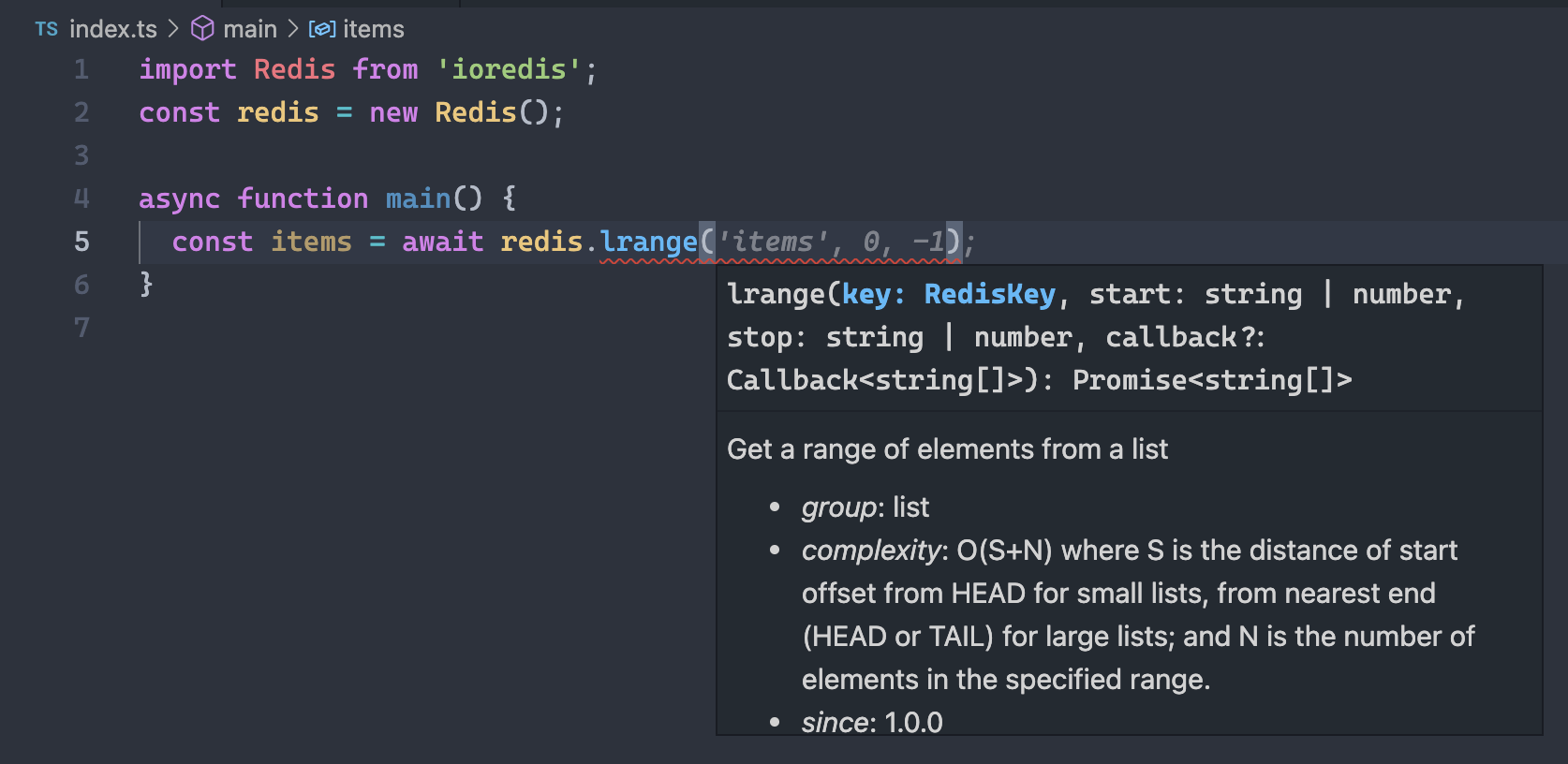
100% written in TypeScript and official declarations are provided:
Versions
| Version | Branch | Node.js Version | Redis Version |
|---|---|---|---|
| 5.x.x (latest) | main | >= 12 | 2.6.12 ~ latest |
| 4.x.x | v4 | >= 8 | 2.6.12 ~ 7 |
Refer to CHANGELOG.md for features and bug fixes introduced in v5.
Links
Quick Start
Install
npm install ioredis
In a TypeScript project, you may want to add TypeScript declarations for Node.js:
npm install --save-dev @types/node
Basic Usage
// Import ioredis.
// You can also use `import { Redis } from "ioredis"`
// if your project is a TypeScript project,
// Note that `import Redis from "ioredis"` is still supported,
// but will be deprecated in the next major version.
const Redis = require("ioredis");

// Create a Redis instance.
// By default, it will connect to localhost:6379.
// We are going to cover how to specify connection options soon.
const redis = new Redis();

redis.set("mykey", "value"); // Returns a promise which resolves to "OK" when the command succeeds.

// ioredis supports the node.js callback style
redis.get("mykey", (err, result) => {
  if (err) {
    console.error(err);
  } else {
    console.log(result); // Prints "value"
  }
});

// Or ioredis returns a promise if the last argument isn't a function
redis.get("mykey").then((result) => {
  console.log(result); // Prints "value"
});

redis.zadd("sortedSet", 1, "one", 2, "dos", 4, "quatro", 3, "three");
redis.zrange("sortedSet", 0, 2, "WITHSCORES").then((elements) => {
  // ["one", "1", "dos", "2", "three", "3"] as if the command was `redis> ZRANGE sortedSet 0 2 WITHSCORES`
  console.log(elements);
});

// All arguments are passed directly to the redis server,
// so technically ioredis supports all Redis commands.
// The format is: redis[SOME_REDIS_COMMAND_IN_LOWERCASE](https://github.com/luin/ioredis/blob/HEAD/ARGUMENTS_ARE_JOINED_INTO_COMMAND_STRING)
// so the following statement is equivalent to the CLI: `redis> SET mykey hello EX 10`
redis.set("mykey", "hello", "EX", 10);
See the examples/ folder for more examples. For example:
- TTL
- Strings
- Hashes
- Lists
- Sets
- Sorted Sets
- Streams
- Redis Modules e.g. RedisJSON
All Redis commands are supported. See the documentation for details.
Connect to Redis
When a new Redis instance is created,
a connection to Redis will be created at the same time.
You can specify which Redis to connect to by:
new Redis(); // Connect to 127.0.0.1:6379
new Redis(6380); // 127.0.0.1:6380
new Redis(6379, "192.168.1.1"); // 192.168.1.1:6379
new Redis("/tmp/redis.sock");
new Redis({
  port: 6379, // Redis port
  host: "127.0.0.1", // Redis host
  username: "default", // needs Redis >= 6
  password: "my-top-secret",
  db: 0, // Defaults to 0
});
You can also specify connection options as a redis:// URL or rediss:// URL when using TLS encryption:
// Connect to 127.0.0.1:6380, db 4, using password "authpassword":
new Redis("redis://:authpassword@127.0.0.1:6380/4");

// Username can also be passed via URI.
new Redis("redis://username:authpassword@127.0.0.1:6380/4");
See API Documentation for all available options.
Pub/Sub
Redis provides several commands for developers to implement the Publish–subscribe pattern. There are two roles in this pattern: publisher and subscriber. Publishers are not programmed to send their messages to specific subscribers. Rather, published messages are characterized into channels, without knowledge of what (if any) subscribers there may be.
By leveraging Node.js's built-in events module, ioredis makes pub/sub very straightforward to use. Below is a simple example that consists of two files, one is publisher.js that publishes messages to a channel, the other is subscriber.js that listens for messages on specific channels.
// publisher.js

const Redis = require("ioredis");
const redis = new Redis();

setInterval(() => {
  const message = { foo: Math.random() };
  // Publish to my-channel-1 or my-channel-2 randomly.
  const channel = `my-channel-${1 + Math.round(Math.random())}`;

  // Message can be either a string or a buffer
  redis.publish(channel, JSON.stringify(message));
  console.log("Published %s to %s", message, channel);
}, 1000);
// subscriber.js

const Redis = require("ioredis");
const redis = new Redis();

redis.subscribe("my-channel-1", "my-channel-2", (err, count) => {
  if (err) {
    // Just like other commands, subscribe() can fail for some reasons,
    // ex network issues.
    console.error("Failed to subscribe: %s", err.message);
  } else {
    // `count` represents the number of channels this client are currently subscribed to.
    console.log(
      `Subscribed successfully! This client is currently subscribed to ${count} channels.`
    );
  }
});

redis.on("message", (channel, message) => {
  console.log(`Received ${message} from ${channel}`);
});

// There's also an event called 'messageBuffer', which is the same as 'message' except
// it returns buffers instead of strings.
// It's useful when the messages are binary data.
redis.on("messageBuffer", (channel, message) => {
  // Both `channel` and `message` are buffers.
  console.log(channel, message);
});
It's worth noticing that a connection (aka a Redis instance) can't play both roles at the same time. More specifically, when a client issues subscribe() or psubscribe(), it enters the "subscriber" mode. From that point, only commands that modify the subscription set are valid. Namely, they are: subscribe, psubscribe, unsubscribe, punsubscribe, ping, and quit. When the subscription set is empty (via unsubscribe/punsubscribe), the connection is put back into the regular mode.
If you want to do pub/sub in the same file/process, you should create a separate connection:
const Redis = require("ioredis");
const sub = new Redis();
const pub = new Redis();

sub.subscribe(/* ... */); // From now, `sub` enters the subscriber mode.
sub.on("message" /* ... */);

setInterval(() => {
  // `pub` can be used to publish messages, or send other regular commands (e.g. `hgetall`)
  // because it's not in the subscriber mode.
  pub.publish(/* ... */);
}, 1000);
PSUBSCRIBE is also supported in a similar way when you want to subscribe all channels whose name matches a pattern:
redis.psubscribe("pat?ern", (err, count) => {});

// Event names are "pmessage"/"pmessageBuffer" instead of "message/messageBuffer".
redis.on("pmessage", (pattern, channel, message) => {});
redis.on("pmessageBuffer", (pattern, channel, message) => {});
Streams
Redis v5 introduces a new data type called streams. It doubles as a communication channel for building streaming architectures and as a log-like data structure for persisting data. With ioredis, the usage can be pretty straightforward. Say we have a producer publishes messages to a stream with redis.xadd("mystream", "*", "randomValue", Math.random()) (You may find the official documentation of Streams as a starter to understand the parameters used), to consume the messages, we'll have a consumer with the following code:
const Redis = require("ioredis");
const redis = new Redis();

const processMessage = (message) => {
  console.log("Id: %s. Data: %O", message[0], message[1]);
};

async function listenForMessage(lastId = "$") {
  // `results` is an array, each element of which corresponds to a key.
  // Because we only listen to one key (mystream) here, `results` only contains
  // a single element. See more: https://redis.io/commands/xread#return-value
  const results = await redis.xread("BLOCK", 0, "STREAMS", "mystream", lastId);
  const [key, messages] = results[0]; // `key` equals to "mystream"

  messages.forEach(processMessage);

  // Pass the last id of the results to the next round.
  await listenForMessage(messages[messages.length - 1][0]);
}

listenForMessage();
Expiration
Redis can set a timeout to expire your key, after the timeout has expired the key will be automatically deleted. (You can find the official Expire documentation to understand better the different parameters you can use), to set your key to expire in 60 seconds, we will have the following code:
redis.set("key", "data", "EX", 60);
// Equivalent to redis command "SET key data EX 60", because on ioredis set method,
// all arguments are passed directly to the redis server.
Handle Binary Data
Binary data support is out of the box. Pass buffers to send binary data:
redis.set("foo", Buffer.from([0x62, 0x75, 0x66]));
Every command that returns a bulk string
has a variant command with a Buffer suffix. The variant command returns a buffer instead of a UTF-8 string:
const result = await redis.getBuffer("foo");
// result is `<Buffer 62 75 66>`
It's worth noticing that you don't need the Buffer suffix variant in order to send binary data. That means
in most case you should just use redis.set() instead of redis.setBuffer() unless you want to get the old value
with the GET parameter:
const result = await redis.setBuffer("foo", "new value", "GET");
// result is `<Buffer 62 75 66>` as `GET` indicates returning the old value.
Pipelining
If you want to send a batch of commands (e.g. > 5), you can use pipelining to queue the commands in memory and then send them to Redis all at once. This way the performance improves by 50%~300% (See benchmark section).
redis.pipeline() creates a Pipeline instance. You can call any Redis
commands on it just like the Redis instance. The commands are queued in memory
and flushed to Redis by calling the exec method:
const pipeline = redis.pipeline();
pipeline.set("foo", "bar");
pipeline.del("cc");
pipeline.exec((err, results) => {
  // `err` is always null, and `results` is an array of responses
  // corresponding to the sequence of queued commands.
  // Each response follows the format `[err, result]`.
});

// You can even chain the commands:
redis
  .pipeline()
  .set("foo", "bar")
  .del("cc")
  .exec((err, results) => {});

// `exec` also returns a Promise:
const promise = redis.pipeline().set("foo", "bar").get("foo").exec();
promise.then((result) => {
  // result === [[null, 'OK'], [null, 'bar']]
});
Each chained command can also have a callback, which will be invoked when the command gets a reply:
redis
  .pipeline()
  .set("foo", "bar")
  .get("foo", (err, result) => {
    // result === 'bar'
  })
  .exec((err, result) => {
    // result[1][1] === 'bar'
  });
In addition to adding commands to the pipeline queue individually, you can also pass an array of commands and arguments to the constructor:
redis
  .pipeline([
    ["set", "foo", "bar"],
    ["get", "foo"],
  ])
  .exec(() => {
    /* ... */
  });
#length property shows how many commands in the pipeline:
const length = redis.pipeline().set("foo", "bar").get("foo").length;
// length === 2
Transaction
Most of the time, the transaction commands multi & exec are used together with pipeline.
Therefore, when multi is called, a Pipeline instance is created automatically by default,
so you can use multi just like pipeline:
redis
  .multi()
  .set("foo", "bar")
  .get("foo")
  .exec((err, results) => {
    // results === [[null, 'OK'], [null, 'bar']]
  });
If there's a syntax error in the transaction's command chain (e.g. wrong number of arguments, wrong command name, etc), then none of the commands would be executed, and an error is returned:
redis
  .multi()
  .set("foo")
  .set("foo", "new value")
  .exec((err, results) => {
    // err:
    //  { [ReplyError: EXECABORT Transaction discarded because of previous errors.]
    //    name: 'ReplyError',
    //    message: 'EXECABORT Transaction discarded because of previous errors.',
    //    command: { name: 'exec', args: [] },
    //    previousErrors:
    //     [ { [ReplyError: ERR wrong number of arguments for 'set' command]
    //         name: 'ReplyError',
    //         message: 'ERR wrong number of arguments for \'set\' command',
    //         command: [Object] } ] }
  });
In terms of the interface, multi differs from pipeline in that when specifying a callback
to each chained command, the queueing state is passed to the callback instead of the result of the command:
redis
  .multi()
  .set("foo", "bar", (err, result) => {
    // result === 'QUEUED'
  })
  .exec(/* ... */);
If you want to use transaction without pipeline, pass { pipeline: false } to multi,
and every command will be sent to Redis immediately without waiting for an exec invocation:
redis.multi({ pipeline: false });
redis.set("foo", "bar");
redis.get("foo");
redis.exec((err, result) => {
  // result === [[null, 'OK'], [null, 'bar']]
});
The constructor of multi also accepts a batch of commands:
redis
  .multi([
    ["set", "foo", "bar"],
    ["get", "foo"],
  ])
  .exec(() => {
    /* ... */
  });
Inline transactions are supported by pipeline, which means you can group a subset of commands in the pipeline into a transaction:
redis
  .pipeline()
  .get("foo")
  .multi()
  .set("foo", "bar")
  .get("foo")
  .exec()
  .get("foo")
  .exec();
Lua Scripting
ioredis supports all of the scripting commands such as EVAL, EVALSHA and SCRIPT.
However, it's tedious to use in real world scenarios since developers have to take
care of script caching and to detect when to use EVAL and when to use EVALSHA.
ioredis exposes a defineCommand method to make scripting much easier to use:
const redis = new Redis();

// This will define a command myecho:
redis.defineCommand("myecho", {
  numberOfKeys: 2,
  lua: "return {KEYS[1],KEYS[2],ARGV[1],ARGV[2]}",
});

// Now `myecho` can be used just like any other ordinary command,
// and ioredis will try to use `EVALSHA` internally when possible for better performance.
redis.myecho("k1", "k2", "a1", "a2", (err, result) => {
  // result === ['k1', 'k2', 'a1', 'a2']
});

// `myechoBuffer` is also defined automatically to return buffers instead of strings:
redis.myechoBuffer("k1", "k2", "a1", "a2", (err, result) => {
  // result[0] equals to Buffer.from('k1');
});

// And of course it works with pipeline:
redis.pipeline().set("foo", "bar").myecho("k1", "k2", "a1", "a2").exec();
Dynamic Keys
If the number of keys can't be determined when defining a command, you can
omit the numberOfKeys property and pass the number of keys as the first argument
when you call the command:
redis.defineCommand("echoDynamicKeyNumber", {
  lua: "return {KEYS[1],KEYS[2],ARGV[1],ARGV[2]}",
});

// Now you have to pass the number of keys as the first argument every time
// you invoke the `echoDynamicKeyNumber` command:
redis.echoDynamicKeyNumber(2, "k1", "k2", "a1", "a2", (err, result) => {
  // result === ['k1', 'k2', 'a1', 'a2']
});
As Constructor Options
Besides defineCommand(), you can also define custom commands with the scripts constructor option:
const redis = new Redis({
  scripts: {
    myecho: {
      numberOfKeys: 2,
      lua: "return {KEYS[1],KEYS[2],ARGV[1],ARGV[2]}",
    },
  },
});
TypeScript Usages
You can refer to the example for how to declare your custom commands.
Transparent Key Prefixing
This feature allows you to specify a string that will automatically be prepended to all the keys in a command, which makes it easier to manage your key namespaces.
Warning This feature won't apply to commands like KEYS and SCAN that take patterns rather than actual keys(#239), and this feature also won't apply to the replies of commands even if they are key names (#325).
const fooRedis = new Redis({ keyPrefix: "foo:" });
fooRedis.set("bar", "baz"); // Actually sends SET foo:bar baz

fooRedis.defineCommand("myecho", {
  numberOfKeys: 2,
  lua: "return {KEYS[1],KEYS[2],ARGV[1],ARGV[2]}",
});

// Works well with pipelining/transaction
fooRedis
  .pipeline()
  // Sends SORT foo:list BY foo:weight_*->fieldname
  .sort("list", "BY", "weight_*->fieldname")
  // Supports custom commands
  // Sends EVALSHA xxx foo:k1 foo:k2 a1 a2
  .myecho("k1", "k2", "a1", "a2")
  .exec();
Transforming Arguments & Replies
Most Redis commands take one or more Strings as arguments,
and replies are sent back as a single String or an Array of Strings. However, sometimes
you may want something different. For instance, it would be more convenient if the HGETALL
command returns a hash (e.g. { key: val1, key2: v2 }) rather than an array of key values (e.g. [key1, val1, key2, val2]).
ioredis has a flexible system for transforming arguments and replies. There are two types of transformers, argument transformer and reply transformer:
const Redis = require("ioredis");

// Here's the built-in argument transformer converting
// hmset('key', { k1: 'v1', k2: 'v2' })
// or
// hmset('key', new Map([['k1', 'v1'], ['k2', 'v2']]))
// into
// hmset('key', 'k1', 'v1', 'k2', 'v2')
Redis.Command.setArgumentTransformer("hmset", (args) => {
  if (args.length === 2) {
    if (args[1] instanceof Map) {
      // utils is a internal module of ioredis
      return [args[0], ...utils.convertMapToArray(args[1])];
    }
    if (typeof args[1] === "object" && args[1] !== null) {
      return [args[0], ...utils.convertObjectToArray(args[1])];
    }
  }
  return args;
});

// Here's the built-in reply transformer converting the HGETALL reply
// ['k1', 'v1', 'k2', 'v2']
// into
// { k1: 'v1', 'k2': 'v2' }
Redis.Command.setReplyTransformer("hgetall", (result) => {
  if (Array.isArray(result)) {
    const obj = {};
    for (let i = 0; i < result.length; i += 2) {
      obj[result[i]] = result[i + 1];
    }
    return obj;
  }
  return result;
});
There are three built-in transformers, two argument transformers for hmset & mset and
a reply transformer for hgetall. Transformers for hmset and hgetall were mentioned
above, and the transformer for mset is similar to the one for hmset:
redis.mset({ k1: "v1", k2: "v2" });
redis.get("k1", (err, result) => {
  // result === 'v1';
});

redis.mset(
  new Map([
    ["k3", "v3"],
    ["k4", "v4"],
  ])
);
redis.get("k3", (err, result) => {
  // result === 'v3';
});
Another useful example of a reply transformer is one that changes hgetall to return array of arrays instead of objects which avoids an unwanted conversation of hash keys to strings when dealing with binary hash keys:
Redis.Command.setReplyTransformer("hgetall", (result) => {
  const arr = [];
  for (let i = 0; i < result.length; i += 2) {
    arr.push([result[i], result[i + 1]]);
  }
  return arr;
});
redis.hset("h1", Buffer.from([0x01]), Buffer.from([0x02]));
redis.hset("h1", Buffer.from([0x03]), Buffer.from([0x04]));
redis.hgetallBuffer("h1", (err, result) => {
  // result === [ [ <Buffer 01>, <Buffer 02> ], [ <Buffer 03>, <Buffer 04> ] ];
});
Monitor
Redis supports the MONITOR command, which lets you see all commands received by the Redis server across all client connections, including from other client libraries and other computers.
The monitor method returns a monitor instance.
After you send the MONITOR command, no other commands are valid on that connection. ioredis will emit a monitor event for every new monitor message that comes across.
The callback for the monitor event takes a timestamp from the Redis server and an array of command arguments.
Here is a simple example:
redis.monitor((err, monitor) => {
  monitor.on("monitor", (time, args, source, database) => {});
});
Here is another example illustrating an async function and monitor.disconnect():
async () => {
  const monitor = await redis.monitor();
  monitor.on("monitor", console.log);
  // Any other tasks
  monitor.disconnect();
};
Streamify Scanning
Redis 2.8 added the SCAN command to incrementally iterate through the keys in the database. It's different from KEYS in that
SCAN only returns a small number of elements each call, so it can be used in production without the downside
of blocking the server for a long time. However, it requires recording the cursor on the client side each time
the SCAN command is called in order to iterate through all the keys correctly. Since it's a relatively common use case, ioredis
provides a streaming interface for the SCAN command to make things much easier. A readable stream can be created by calling scanStream:
const redis = new Redis();
// Create a readable stream (object mode)
const stream = redis.scanStream();
stream.on("data", (resultKeys) => {
  // `resultKeys` is an array of strings representing key names.
  // Note that resultKeys may contain 0 keys, and that it will sometimes
  // contain duplicates due to SCAN's implementation in Redis.
  for (let i = 0; i < resultKeys.length; i++) {
    console.log(resultKeys[i]);
  }
});
stream.on("end", () => {
  console.log("all keys have been visited");
});
scanStream accepts an option, with which you can specify the MATCH pattern, the TYPE filter, and the COUNT argument:
const stream = redis.scanStream({
  // only returns keys following the pattern of `user:*`
  match: "user:*",
  // only return objects that match a given type,
  // (requires Redis >= 6.0)
  type: "zset",
  // returns approximately 100 elements per call
  count: 100,
});
Just like other commands, scanStream has a binary version scanBufferStream, which returns an array of buffers. It's useful when
the key names are not utf8 strings.
There are also hscanStream, zscanStream and sscanStream to iterate through elements in a hash, zset and set. The interface of each is
similar to scanStream except the first argument is the key name:
const stream = redis.zscanStream("myhash", {
  match: "age:??",
});
The hscanStream also accepts the noValues option to specify whether Redis should return only the keys in the hash table without their corresponding values.
const stream = redis.hscanStream("myhash", {
  match: "age:??",
  noValues: true,
});
You can learn more from the Redis documentation.
Useful Tips
It's pretty common that doing an async task in the data handler. We'd like the scanning process to be paused until the async task to be finished. Stream#pause() and Stream#resume() do the trick. For example if we want to migrate data in Redis to MySQL:
const stream = redis.scanStream();
stream.on("data", (resultKeys) => {
  // Pause the stream from scanning more keys until we've migrated the current keys.
  stream.pause();

  Promise.all(resultKeys.map(migrateKeyToMySQL)).then(() => {
    // Resume the stream here.
    stream.resume();
  });
});

stream.on("end", () => {
  console.log("done migration");
});
Auto-reconnect
By default, ioredis will try to reconnect when the connection to Redis is lost
except when the connection is closed manually by redis.disconnect() or redis.quit().
It's very flexible to control how long to wait to reconnect after disconnection
using the retryStrategy option:
const redis = new Redis({
  // This is the default value of `retryStrategy`
  retryStrategy(times) {
    const delay = Math.min(times * 50, 2000);
    return delay;
  },
});
retryStrategy is a function that will be called when the connection is lost.
The argument times means this is the nth reconnection being made and
the return value represents how long (in ms) to wait to reconnect. When the
return value isn't a number, ioredis will stop trying to reconnect, and the connection
will be lost forever if the user doesn't call redis.connect() manually.
When reconnected, the client will auto subscribe to channels that the previous connection subscribed to.
This behavior can be disabled by setting the autoResubscribe option to false.
And if the previous connection has some unfulfilled commands (most likely blocking commands such as brpop and blpop),
the client will resend them when reconnected. This behavior can be disabled by setting the autoResendUnfulfilledCommands option to false.
By default, all pending commands will be flushed with an error every 20 retry attempts. That makes sure commands won't wait forever when the connection is down. You can change this behavior by setting maxRetriesPerRequest:
const redis = new Redis({
  maxRetriesPerRequest: 1,
});
Set maxRetriesPerRequest to null to disable this behavior, and every command will wait forever until the connection is alive again (which is the default behavior before ioredis v4).
Blocking Command Timeout
ioredis can apply a client-side timeout to blocking commands (such as blpop, brpop, bzpopmin, bzmpop, blmpop, xread, xreadgroup, etc.). This protects against scenarios where the TCP connection becomes a zombie (e.g., due to a silent network failure like a Docker network disconnect) and Redis never replies.
This feature is opt-in. It is disabled by default and is only enabled
when blockingTimeout is set to a positive number of milliseconds. If
blockingTimeout is omitted, 0, or negative (for example -1), ioredis
does not arm any client-side timeouts for blocking commands and their
behavior matches Redis exactly.
const redis = new Redis({
  blockingTimeout: 30000, // Enable blocking timeout protection
});
When enabled:
- For commands with a finite timeout (e.g.,
blpop("key", 5)), ioredis sets a client-side deadline based on the command's timeout plus a small grace period (blockingTimeoutGrace, default 100ms). If no reply arrives before the deadline, the command resolves withnull—the same value Redis returns when a blocking command times out normally. - For commands that block forever (e.g.,
timeout = 0orBLOCK 0), theblockingTimeoutvalue is used as a safety net.
Reconnect on Error
Besides auto-reconnect when the connection is closed, ioredis supports reconnecting on certain Redis errors using the reconnectOnError option. Here's an example that will reconnect when receiving READONLY error:
const redis = new Redis({
  reconnectOnError(err) {
    const targetError = "READONLY";
    if (err.message.includes(targetError)) {
      // Only reconnect when the error contains "READONLY"
      return true; // or `return 1;`
    }
  },
});
This feature is useful when using Amazon ElastiCache instances with Auto-failover disabled. On these instances, test your reconnectOnError handler by manually promoting the replica node to the primary role using the AWS console. The following writes fail with the error READONLY. Using reconnectOnError, we can force the connection to reconnect on this error in order to connect to the new master. Furthermore, if the reconnectOnError returns 2, ioredis will resend the failed command after reconnecting.
On ElastiCache instances with Auto-failover enabled, reconnectOnError does not execute. Instead of returning a Redis error, AWS closes all connections to the master endpoint until the new primary node is ready. ioredis reconnects via retryStrategy instead of reconnectOnError after about a minute. On ElastiCache instances with Auto-failover enabled, test failover events with the Failover primary option in the AWS console.
Connection Events
The Redis instance will emit some events about the state of the connection to the Redis server.
| Event | Description |
|---|---|
| connect | emits when a connection is established to the Redis server. |
| ready | If enableReadyCheck is true, client will emit ready when the server reports that it is ready to receive commands (e.g. finish loading data from disk).Otherwise, ready will be emitted immediately right after the connect event. |
| error | emits when an error occurs while connecting. However, ioredis emits all error events silently (only emits when there's at least one listener) so that your application won't crash if you're not listening to the error event.When redis.connect() is explicitly called the error will also be rejected from the returned promise, in addition to emitting it. If redis.connect() is not called explicitly and lazyConnect is true, ioredis will try to connect automatically on the first command and emit the error event silently. |
| close | emits when an established Redis server connection has closed. |
| reconnecting | emits after close when a reconnection will be made. The argument of the event is the time (in ms) before reconnecting. |
| end | emits after close when no more reconnections will be made, or the connection is failed to establish. |
| wait | emits when lazyConnect is set and will wait for the first command to be called before connecting. |
You can also check out the Redis#status property to get the current connection status.
Besides the above connection events, there are several other custom events:
| Event | Description |
|---|---|
| select | emits when the database changed. The argument is the new db number. |
Diagnostics Channel
ioredis publishes telemetry through Node.js diagnostics_channel, allowing APM tools and custom instrumentation to observe commands, connections, and batch operations without modifying application code.
These channels use TracingChannel#tracePromise() and emit start, end, asyncStart, asyncEnd, and error sub-events. Requires Node.js >= 18.19.0; on older versions the channels are silently unavailable (zero overhead). Subscribe via tracing:<name>:<event>:
import dc from "node:diagnostics_channel";

dc.subscribe("tracing:ioredis:command:start", ({ command, args }) => {
  console.log(`> ${command}`, args);
});

dc.subscribe("tracing:ioredis:command:asyncEnd", ({ command }) => {
  console.log(`${command} settled`);
});

dc.subscribe("tracing:ioredis:command:error", ({ command, error }) => {
  console.error(`${command} failed:`, error);
});
| Channel name | Payload | Description |
|---|---|---|
ioredis:command | CommandTraceContext | Individual command (standalone, pipeline, or within MULTI) |
ioredis:batch | BatchOperationContext | MULTI transaction as a whole |
ioredis:connect | ConnectTraceContext | Socket connection attempt |
Command arguments are sanitized before emission using rules adapted from @opentelemetry/redis-common. Sensitive values (e.g. values in SET, AUTH passwords) are replaced with ?, while read-only commands like GET and DEL retain all arguments. This is safe by default: unlisted or custom commands have all arguments redacted.
Context types (CommandTraceContext, BatchOperationContext, ConnectTraceContext) are exported from ioredis.
Offline Queue
When a command can't be processed by Redis (being sent before the ready event), by default, it's added to the offline queue and will be
executed when it can be processed. You can disable this feature by setting the enableOfflineQueue
option to false:
const redis = new Redis({ enableOfflineQueue: false });
TLS Options
Redis doesn't support TLS natively, however if the redis server you want to connect to is hosted behind a TLS proxy (e.g. stunnel) or is offered by a PaaS service that supports TLS connection (e.g. Redis.com), you can set the tls option:
const redis = new Redis({
  host: "localhost",
  tls: {
    // Refer to `tls.connect()` section in
    // https://nodejs.org/api/tls.html
    // for all supported options
    ca: fs.readFileSync("cert.pem"),
  },
});
Alternatively, specify the connection through a rediss:// URL.
const redis = new Redis("rediss://redis.my-service.com");
If you do not want to use a connection string, you can also specify an empty tls: {} object:
const redis = new Redis({
  host: "redis.my-service.com",
  tls: {},
});
TLS Profiles
Warning TLS profiles described in this section are going to be deprecated in the next major version. Please provide TLS options explicitly.
To make it easier to configure we provide a few pre-configured TLS profiles that can be specified by setting the tls option to the profile's name or specifying a tls.profile option in case you need to customize some values of the profile.
Profiles:
RedisCloudFixed: Contains the CA for Redis.com Cloud fixed subscriptionsRedisCloudFlexible: Contains the CA for Redis.com Cloud flexible subscriptions
const redis = new Redis({
  host: "localhost",
  tls: "RedisCloudFixed",
});

const redisWithClientCertificate = new Redis({
  host: "localhost",
  tls: {
    profile: "RedisCloudFixed",
    key: "123",
  },
});
Sentinel
ioredis supports Sentinel out of the box. It works transparently as all features that work when you connect to a single node also work when you connect to a sentinel group. Make sure to run Redis >= 2.8.12 if you want to use this feature. Sentinels have a default port of 26379.
To connect using Sentinel, use:
const redis = new Redis({
  sentinels: [
    { host: "localhost", port: 26379 },
    { host: "localhost", port: 26380 },
  ],
  name: "mymaster",
});

redis.set("foo", "bar");
The arguments passed to the constructor are different from the ones you use to connect to a single node, where:
nameidentifies a group of Redis instances composed of a master and one or more slaves (mymasterin the example);sentinelPassword(optional) password for Sentinel instances.sentinelsare a list of sentinels to connect to. The list does not need to enumerate all your sentinel instances, but a few so that if one is down the client will try the next one.role(optional) with a value ofslavewill return a random slave from the Sentinel group.preferredSlaves(optional) can be used to prefer a particular slave or set of slaves based on priority. It accepts a function or array.enableTLSForSentinelMode(optional) set to true if connecting to sentinel instances that are encrypted
ioredis guarantees that the node you connected to is always a master even after a failover. When a failover happens, instead of trying to reconnect to the failed node (which will be demoted to slave when it's available again), ioredis will ask sentinels for the new master node and connect to it. All commands sent during the failover are queued and will be executed when the new connection is established so that none of the commands will be lost.
It's possible to connect to a slave instead of a master by specifying the option role with the value of slave and ioredis will try to connect to a random slave of the specified master, with the guarantee that the connected node is always a slave. If the current node is promoted to master due to a failover, ioredis will disconnect from it and ask the sentinels for another slave node to connect to.
If you specify the option preferredSlaves along with role: 'slave' ioredis will attempt to use this value when selecting the slave from the pool of available slaves. The value of preferredSlaves should either be a function that accepts an array of available slaves and returns a single result, or an array of slave values priorities by the lowest prio value first with a default value of 1.
// available slaves format
const availableSlaves = [{ ip: "127.0.0.1", port: "31231", flags: "slave" }];

// preferredSlaves array format
let preferredSlaves = [
  { ip: "127.0.0.1", port: "31231", prio: 1 },
  { ip: "127.0.0.1", port: "31232", prio: 2 },
];

// preferredSlaves function format
preferredSlaves = function (availableSlaves) {
  for (let i = 0; i < availableSlaves.length; i++) {
    const slave = availableSlaves[i];
    if (slave.ip === "127.0.0.1") {
      if (slave.port === "31234") {
        return slave;
      }
    }
  }
  // if no preferred slaves are available a random one is used
  return false;
};

const redis = new Redis({
  sentinels: [
    { host: "127.0.0.1", port: 26379 },
    { host: "127.0.0.1", port: 26380 },
  ],
  name: "mymaster",
  role: "slave",
  preferredSlaves: preferredSlaves,
});
Besides the retryStrategy option, there's also a sentinelRetryStrategy in Sentinel mode which will be invoked when all the sentinel nodes are unreachable during connecting. If sentinelRetryStrategy returns a valid delay time, ioredis will try to reconnect from scratch. The default value of sentinelRetryStrategy is:
function (times) {
  const delay = Math.min(times * 10, 1000);
  return delay;
}
Cluster
Redis Cluster provides a way to run a Redis installation where data is automatically sharded across multiple Redis nodes. You can connect to a Redis Cluster like this:
const Redis = require("ioredis");

const cluster = new Redis.Cluster([
  {
    port: 6380,
    host: "127.0.0.1",
  },
  {
    port: 6381,
    host: "127.0.0.1",
  },
]);

cluster.set("foo", "bar");
cluster.get("foo", (err, res) => {
  // res === 'bar'
});
Cluster constructor accepts two arguments, where:
-
The first argument is a list of nodes of the cluster you want to connect to. Just like Sentinel, the list does not need to enumerate all your cluster nodes, but a few so that if one is unreachable the client will try the next one, and the client will discover other nodes automatically when at least one node is connected.
-
The second argument is the options, where:
-
clusterRetryStrategy: When none of the startup nodes are reachable,clusterRetryStrategywill be invoked. When a number is returned, ioredis will try to reconnect to the startup nodes from scratch after the specified delay (in ms). Otherwise, an error of "None of startup nodes is available" will be returned. The default value of this option is:function (times) { const delay = Math.min(100 + times * 2, 2000); return delay; }It's possible to modify the
startupNodesproperty in order to switch to another set of nodes here:function (times) { this.startupNodes = [{ port: 6790, host: '127.0.0.1' }]; return Math.min(100 + times * 2, 2000); } -
clusterNodeRetryStrategy: Per-node retry strategy. By default, ioredis won't try to reconnect to a lost node and just waits for aMOVEDerror to refresh slots. If you pass a function here, it's used as theretryStrategyfor each node — return a number to reconnect after that many ms, or anything else to drop the node from the pool. Handy for replica nodes that restart without slot changes (e.g. maintenance). Example:function (times) { return Math.min(100 * times, 2000); } -
dnsLookup: Alternative DNS lookup function (dns.lookup()is used by default). It may be useful to override this in special cases, such as when AWS ElastiCache used with TLS enabled. -
enableOfflineQueue: Similar to theenableOfflineQueueoption ofRedisclass. -
enableReadyCheck: When enabled, "ready" event will only be emitted whenCLUSTER INFOcommand reporting the cluster is ready for handling commands. Otherwise, it will be emitted immediately after "connect" is emitted. -
scaleReads: Config where to send the read queries. See below for more details. -
maxRedirections: When a cluster related error (e.g.MOVED,ASKandCLUSTERDOWNetc.) is received, the client will redirect the command to another node. This option limits the max redirections allowed when sending a command. The default value is16. -
retryDelayOnFailover: If the target node is disconnected when sending a command, ioredis will retry after the specified delay. The default value is100. You should make sureretryDelayOnFailover * maxRedirections > cluster-node-timeoutto insure that no command will fail during a failover. -
retryDelayOnClusterDown: When a cluster is down, all commands will be rejected with the error ofCLUSTERDOWN. If this option is a number (by default, it is100), the client will resend the commands after the specified time (in ms). -
retryDelayOnTryAgain: If this option is a number (by default, it is100), the client will resend the commands rejected withTRYAGAINerror after the specified time (in ms). -
retryDelayOnMoved: By default, this value is0(in ms), which means when aMOVEDerror is received, the client will resend the command instantly to the node returned together with theMOVEDerror. However, sometimes it takes time for a cluster to become state stabilized after a failover, so adding a delay before resending can prevent a ping pong effect. -
redisOptions: Default options passed to the constructor ofRediswhen connecting to a node. -
slotsRefreshTimeout: Milliseconds before a timeout occurs while refreshing slots from the cluster (default1000). -
slotsRefreshInterval: Milliseconds between every automatic slots refresh (by default, it is disabled).
-
Read-Write Splitting
A typical redis cluster contains three or more masters and several slaves for each master. It's possible to scale out redis cluster by sending read queries to slaves and write queries to masters by setting the scaleReads option.
scaleReads is "master" by default, which means ioredis will never send any queries to slaves. There are other three available options:
- "all": Send write queries to masters and read queries to masters or slaves randomly.
- "slave": Send write queries to masters and read queries to slaves.
- a custom
function(nodes, command): node: Will choose the custom function to select to which node to send read queries (write queries keep being sent to master). The first node innodesis always the master serving the relevant slots. If the function returns an array of nodes, a random node of that list will be selected.
For example:
const cluster = new Redis.Cluster(
  [
    /* nodes */
  ],
  {
    scaleReads: "slave",
  }
);
cluster.set("foo", "bar"); // This query will be sent to one of the masters.
cluster.get("foo", (err, res) => {
  // This query will be sent to one of the slaves.
});
NB In the code snippet above, the res may not be equal to "bar" because of the lag of replication between the master and slaves.
Running Commands to Multiple Nodes
Every command will be sent to exactly one node. For commands containing keys, (e.g. GET, SET and HGETALL), ioredis sends them to the node that serving the keys, and for other commands not containing keys, (e.g. INFO, KEYS and FLUSHDB), ioredis sends them to a random node.
Sometimes you may want to send a command to multiple nodes (masters or slaves) of the cluster, you can get the nodes via Cluster#nodes() method.
Cluster#nodes() accepts a parameter role, which can be "master", "slave" and "all" (default), and returns an array of Redis instance. For example:
// Send `FLUSHDB` command to all slaves:
const slaves = cluster.nodes("slave");
Promise.all(slaves.map((node) => node.flushdb()));

// Get keys of all the masters:
const masters = cluster.nodes("master");
Promise.all(
  masters
    .map((node) => node.keys())
    .then((keys) => {
      // keys: [['key1', 'key2'], ['key3', 'key4']]
    })
);
NAT Mapping
Sometimes the cluster is hosted within a internal network that can only be accessed via a NAT (Network Address Translation) instance. See Accessing ElastiCache from outside AWS as an example.
You can specify nat mapping rules via natMap option:
const cluster = new Redis.Cluster(
  [
    {
      host: "203.0.113.73",
      port: 30001,
    },
  ],
  {
    natMap: {
      "10.0.1.230:30001": { host: "203.0.113.73", port: 30001 },
      "10.0.1.231:30001": { host: "203.0.113.73", port: 30002 },
      "10.0.1.232:30001": { host: "203.0.113.73", port: 30003 },
    },
  }
);
Or you can specify this parameter through function:
const cluster = new Redis.Cluster(
  [
    {
      host: "203.0.113.73",
      port: 30001,
    },
  ],
  {
    natMap: (key) => {
      if (key.includes("30001")) {
        return { host: "203.0.113.73", port: 30001 };
      }

      return null;
    },
  }
);
This option is also useful when the cluster is running inside a Docker container. Also it works for Clusters in cloud infrastructure where cluster nodes connected through dedicated subnet.
Specifying through may be useful if you don't know concrete internal host and know only node port.
Transaction and Pipeline in Cluster Mode
Almost all features that are supported by Redis are also supported by Redis.Cluster, e.g. custom commands, transaction and pipeline.
However there are some differences when using transaction and pipeline in Cluster mode:
- All keys in a pipeline should belong to slots served by the same node, since ioredis sends all commands in a pipeline to the same node.
- You can't use
multiwithout pipeline (akacluster.multi({ pipeline: false })). This is because when you callcluster.multi({ pipeline: false }), ioredis doesn't know which node themulticommand should be sent to.
When any commands in a pipeline receives a MOVED or ASK error, ioredis will resend the whole pipeline to the specified node automatically if all of the following conditions are satisfied:
- All errors received in the pipeline are the same. For example, we won't resend the pipeline if we got two
MOVEDerrors pointing to different nodes. - All commands executed successfully are readonly commands. This makes sure that resending the pipeline won't have side effects.
Pub/Sub
Pub/Sub in cluster mode works exactly as the same as in standalone mode. Internally, when a node of the cluster receives a message, it will broadcast the message to the other nodes. ioredis makes sure that each message will only be received once by strictly subscribing one node at the same time.
const nodes = [
  /* nodes */
];
const pub = new Redis.Cluster(nodes);
const sub = new Redis.Cluster(nodes);
sub.on("message", (channel, message) => {
  console.log(channel, message);
});

sub.subscribe("news", () => {
  pub.publish("news", "highlights");
});
Sharded Pub/Sub
For sharded Pub/Sub, use the spublish and ssubscribe commands instead of the traditional publish and subscribe. With the old commands, the Redis cluster handles message propagation behind the scenes, allowing you to publish or subscribe to any node without considering sharding. However, this approach has scalability limitations that are addressed with sharded Pub/Sub. Here’s what you need to know:
- Instead of a single subscriber connection, there is now one subscriber connection per shard. Because of the potential overhead, you can enable or disable the use of the cluster subscriber group with the
shardedSubscribersoption. By default, this option is set tofalse, meaning sharded subscriptions are disabled. You should enable this option when establishing your cluster connection before usingssubscribe. - All channel names that you pass to a single
ssubscribeneed to map to the same hash slot. You can callssubscribemultiple times on the same cluster client instance to subscribe to channels across slots. The cluster's subscriber group takes care of forwarding thessubscribecommand to the shard that is responsible for the channels.
The following basic example shows you how to use sharded Pub/Sub:
const cluster: Cluster = new Cluster([{ host: host, port: port }], {
  shardedSubscribers: true,
});

//Register the callback
cluster.on("smessage", (channel, message) => {
  console.log(message);
});

//Subscribe to the channels on the same slot
cluster
  .ssubscribe("channel{my}:1", "channel{my}:2")
  .then((count: number) => {
    console.log(count);
  })
  .catch((err) => {
    console.log(err);
  });

//Publish a message
cluster
  .spublish("channel{my}:1", "This is a test message to my first channel.")
  .then((value: number) => {
    console.log("Published a message to channel{my}:1");
  });
Events
| Event | Description |
|---|---|
| connect | emits when a connection is established to the Redis server. |
| ready | emits when CLUSTER INFO reporting the cluster is able to receive commands (if enableReadyCheck is true) or immediately after connect event (if enableReadyCheck is false). |
| error | emits when an error occurs while connecting with a property of lastNodeError representing the last node error received. This event is emitted silently (only emitting if there's at least one listener). |
| close | emits when an established Redis server connection has closed. |
| reconnecting | emits after close when a reconnection will be made. The argument of the event is the time (in ms) before reconnecting. |
| end | emits after close when no more reconnections will be made. |
| +node | emits when a new node is connected. |
| -node | emits when a node is disconnected. |
| node error | emits when an error occurs when connecting to a node. The second argument indicates the address of the node. |
Password
Setting the password option to access password-protected clusters:
const Redis = require("ioredis");
const cluster = new Redis.Cluster(nodes, {
  redisOptions: {
    password: "your-cluster-password",
  },
});
If some of nodes in the cluster using a different password, you should specify them in the first parameter:
const Redis = require("ioredis");
const cluster = new Redis.Cluster(
  [
    // Use password "password-for-30001" for 30001
    { port: 30001, password: "password-for-30001" },
    // Don't use password when accessing 30002
    { port: 30002, password: null },
    // Other nodes will use "fallback-password"
  ],
  {
    redisOptions: {
      password: "fallback-password",
    },
  }
);
Special Note: Aws Elasticache Clusters with TLS
AWS ElastiCache for Redis (Clustered Mode) supports TLS encryption. If you use
this, you may encounter errors with invalid certificates. To resolve this
issue, construct the Cluster with the dnsLookup option as follows:
const cluster = new Redis.Cluster(
  [
    {
      host: "clustercfg.myCluster.abcdefg.xyz.cache.amazonaws.com",
      port: 6379,
    },
  ],
  {
    dnsLookup: (address, callback) => callback(null, address),
    redisOptions: {
      tls: {},
    },
  }
);
Autopipelining
In standard mode, when you issue multiple commands, ioredis sends them to the server one by one. As described in Redis pipeline documentation, this is a suboptimal use of the network link, especially when such link is not very performant.
The TCP and network overhead negatively affects performance. Commands are stuck in the send queue until the previous ones are correctly delivered to the server. This is a problem known as Head-Of-Line blocking (HOL).
ioredis supports a feature called “auto pipelining”. It can be enabled by setting the option enableAutoPipelining to true. No other code change is necessary.
In auto pipelining mode, all commands issued during an event loop are enqueued in a pipeline automatically managed by ioredis. At the end of the iteration, the pipeline is executed and thus all commands are sent to the server at the same time.
This feature can dramatically improve throughput and avoids HOL blocking. In our benchmarks, the improvement was between 35% and 50%.
While an automatic pipeline is executing, all new commands will be enqueued in a new pipeline which will be executed as soon as the previous finishes.
When using Redis Cluster, one pipeline per node is created. Commands are assigned to pipelines according to which node serves the slot.
A pipeline will thus contain commands using different slots but that ultimately are assigned to the same node.
Note that the same slot limitation within a single command still holds, as it is a Redis limitation.
Example of Automatic Pipeline Enqueuing
This sample code uses ioredis with automatic pipeline enabled.
const Redis = require("./built");
const http = require("http");

const db = new Redis({ enableAutoPipelining: true });

const server = http.createServer((request, response) => {
  const key = new URL(request.url, "https://localhost:3000/").searchParams.get(
    "key"
  );

  db.get(key, (err, value) => {
    response.writeHead(200, { "Content-Type": "text/plain" });
    response.end(value);
  });
});

server.listen(3000);
When Node receives requests, it schedules them to be processed in one or more iterations of the events loop.
All commands issued by requests processing during one iteration of the loop will be wrapped in a pipeline automatically created by ioredis.
In the example above, the pipeline will have the following contents:
GET key1
GET key2
GET key3
...
GET keyN
When all events in the current loop have been processed, the pipeline is executed and thus all commands are sent to the server at the same time.
While waiting for pipeline response from Redis, Node will still be able to process requests. All commands issued by request handler will be enqueued in a new automatically created pipeline. This pipeline will not be sent to the server yet.
As soon as a previous automatic pipeline has received all responses from the server, the new pipeline is immediately sent without waiting for the events loop iteration to finish.
This approach increases the utilization of the network link, reduces the TCP overhead and idle times and therefore improves throughput.
Benchmarks
Here's some of the results of our tests for a single node.
Each iteration of the test runs 1000 random commands on the server.
| Samples | Result | Tolerance | |
|---|---|---|---|
| default | 1000 | 174.62 op/sec | ± 0.45 % |
| enableAutoPipelining=true | 1500 | 233.33 op/sec | ± 0.88 % |
And here's the same test for a cluster of 3 masters and 3 replicas:
| Samples | Result | Tolerance | |
|---|---|---|---|
| default | 1000 | 164.05 op/sec | ± 0.42 % |
| enableAutoPipelining=true | 3000 | 235.31 op/sec | ± 0.94 % |
Error Handling
All the errors returned by the Redis server are instances of ReplyError, which can be accessed via Redis:
const Redis = require("ioredis");
const redis = new Redis();
// This command causes a reply error since the SET command requires two arguments.
redis.set("foo", (err) => {
  err instanceof Redis.ReplyError;
});
This is the error stack of the ReplyError:
ReplyError: ERR wrong number of arguments for 'set' command
    at ReplyParser._parseResult (/app/node_modules/ioredis/lib/parsers/javascript.js:60:14)
    at ReplyParser.execute (/app/node_modules/ioredis/lib/parsers/javascript.js:178:20)
    at Socket.<anonymous> (/app/node_modules/ioredis/lib/redis/event_handler.js:99:22)
    at Socket.emit (events.js:97:17)
    at readableAddChunk (_stream_readable.js:143:16)
    at Socket.Readable.push (_stream_readable.js:106:10)
    at TCP.onread (net.js:509:20)
By default, the error stack doesn't make any sense because the whole stack happens in the ioredis
module itself, not in your code. So it's not easy to find out where the error happens in your code.
ioredis provides an option showFriendlyErrorStack to solve the problem. When you enable
showFriendlyErrorStack, ioredis will optimize the error stack for you:
const Redis = require("ioredis");
const redis = new Redis({ showFriendlyErrorStack: true });
redis.set("foo");
And the output will be:
ReplyError: ERR wrong number of arguments for 'set' command
    at Object.<anonymous> (/app/index.js:3:7)
    at Module._compile (module.js:446:26)
    at Object.Module._extensions..js (module.js:464:10)
    at Module.load (module.js:341:32)
    at Function.Module._load (module.js:296:12)
    at Function.Module.runMain (module.js:487:10)
    at startup (node.js:111:16)
    at node.js:799:3
This time the stack tells you that the error happens on the third line in your code. Pretty sweet! However, it would decrease the performance significantly to optimize the error stack. So by default, this option is disabled and can only be used for debugging purposes. You shouldn't use this feature in a production environment.
Running tests
Start a Redis server on 127.0.0.1:6379, and then:
npm test
FLUSH ALL will be invoked after each test, so make sure there's no valuable data in it before running tests.
If your testing environment does not let you spin up a Redis server ioredis-mock is a drop-in replacement you can use in your tests. It aims to behave identically to ioredis connected to a Redis server so that your integration tests is easier to write and of better quality.
Debug
You can set the DEBUG env to ioredis:* to print debug info:
$ DEBUG=ioredis:* node app.js
Join in!
I'm happy to receive bug reports, fixes, documentation enhancements, and any other improvements.
And since I'm not a native English speaker, if you find any grammar mistakes in the documentation, please also let me know. :)
Contributors
This project exists thanks to all the people who contribute:

License
MIT