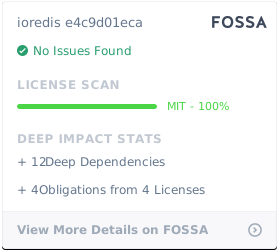
Node.js における Redis クライアントライブラリの選定
ioredis と redis(node-redis)は、Node.js 環境から Redis データベースに接続するための代表的なクライアントライブラリです。両者とも Redis の全コマンドをサポートし、非同期処理に対応していますが、設計思想と機能の重点に違いがあります。redis は Redis 公式がメンテナンスを行う標準クライアントで、シンプルさと公式サポートを重視しています。一方、ioredis はコミュニティによって開発され、クラスタリングやパイプライン処理など、より高度な機能と柔軟な設定を得意としています。
npmのダウンロードトレンド
GitHub Starsランキング
統計詳細


ioredis vs redis: Node.js における Redis クライアントの深層比較
Node.js で Redis を利用する際、ioredis と redis(node-redis)のどちらを選ぶかは、プロジェクトの規模や要件に直結する重要な決定です。両者とも成熟したライブラリですが、内部の動作原理や提供される API の設計思想には明確な違いがあります。ここでは、実開発の現場で直面する具体的なシナリオに基づき、両者の技術的な差異を解説します。
🔌 接続と初期化:自動接続 vs 明示的接続
ライブラリの使い始めにまず違うのが、コネクションの確立方法です。
ioredis は、インスタンス生成時に自動的に接続を試みます。コンストラクタでオプションを渡すだけでよく、準備が整うまで待機する処理がシンプルです。
// ioredis: 自動接続
const Redis = require('ioredis');
const redis = new Redis({ host: 'localhost', port: 6379 });

// 接続準備ができたらイベントが発火されます
redis.on('connect', () => {
  console.log('Connected to Redis');
});

// すぐにコマンドを実行可能(キューイングされる)
await redis.set('foo', 'bar');
redis(v4 以降)は、クライアント作成後に明示的に connect() を呼ぶ必要があります。これにより、接続が確立される前にコマンドが送られることを防ぎ、エラーハンドリングを明確にできます。
// redis: 明示的接続
const { createClient } = require('redis');
const client = createClient({ url: 'redis://localhost:6379' });

client.on('error', (err) => console.log('Redis Client Error', err));

await client.connect();

// 接続後にコマンド実行可能
await client.set('foo', 'bar');
⚡ コマンド実行:Promise とエラーハンドリング
両者とも現代の JavaScript 標準である Promise と async/await をサポートしていますが、エラーの伝播方法に違いがあります。
ioredis は、コマンド実行が失敗した場合に Promise が reject されます。従来のコールバックスタイルもサポートしていますが、Promise がデファクトです。
// ioredis: Promise based
try {
  const value = await redis.get('key');
  console.log(value);
} catch (error) {
  // 接続エラーやコマンドエラーをキャッチ
  console.error('Command failed:', error);
}
redis も同様に Promise を返しますが、v4 からはより厳密な型定義とエラー処理が強化されています。接続切断時の挙動などが細かく制御可能です。
// redis: Promise based
try {
  const value = await client.get('key');
  console.log(value);
} catch (error) {
  // 接続エラーやコマンドエラーをキャッチ
  console.error('Command failed:', error);
}
📡 Pub/Sub:専用コネクションの管理
Redis の Pub/Sub 機能を使う際、サブスクライブ中は通常のコネクションで他のコマンドを送れなくなるという制約があります。この扱いが両者で異なります。
ioredis は、Pub/Sub 用に専用のサブスクライバーインスタンスを作成するアプローチを推奨しています。これにより、通常のコネクションと混在させずに済みます。
// ioredis: 専用サブスクライバー
const subscriber = new Redis();
const publisher = new Redis();

await subscriber.subscribe('news', (err, count) => {
  if (err) return;
  console.log(`Subscribed to ${count} channels`);
});

subscriber.on('message', (channel, message) => {
  console.log(`Received: ${message}`);
});

await publisher.publish('news', 'Hello World');
redis(v4 以降)は、duplicate() メソッドを使ってコネクションを複製し、Pub/Sub 専用クライアントとして使うパターンが一般的です。内部でコネクションを分離して管理します。
// redis: コネクションの複製
const subscriber = client.duplicate();
await subscriber.connect();

await subscriber.subscribe('news', (message) => {
  console.log(`Received: ${message}`);
});

await client.publish('news', 'Hello World');
🗂️ クラスタリング:ネイティブサポートの差
複数の Redis ノードで構成されるクラスタ環境では、ライブラリのサポート状況が重要になります。
ioredis は、クラスタリングサポートが非常に強力です。コンストラクタでノードのリストを渡すだけで、スロットの管理やリダイレクトを自動で処理してくれます。大規模システムでよく選ばれる理由の一つです。
// ioredis: クラスタ構成
const { Cluster } = require('ioredis');

const cluster = new Cluster([
  { host: '127.0.0.1', port: '7000' },
  { host: '127.0.0.1', port: '7001' }
]);

// 通常のコネクションと同じように使える
await cluster.set('foo', 'bar');
redis もクラスタモードをサポートしていますが、設定がやや明示的です。createClient にクラスタオプションを渡す必要があります。機能は同等ですが、ioredis の方が歴史的にクラスタ環境での安定性に定評があります。
// redis: クラスタ構成
const { createCluster } = require('redis');

const cluster = createCluster({
  rootNodes: [
    { url: 'redis://127.0.0.1:7000' },
    { url: 'redis://127.0.0.1:7001' }
  ]
});

await cluster.connect();
await cluster.set('foo', 'bar');
🛠️ 型安全性:TypeScript 対応
現代のフロントエンド・バックエンド開発において、TypeScript のサポートは必須要件です。
ioredis は、ライブラリ本体に TypeScript 定義ファイルが含まれています。追加のパッケージをインストールせずに、すぐに型チェックの恩恵を受けられます。
// ioredis: 型定義込み
import { Redis } from 'ioredis';

const redis = new Redis();
// 型推論が効く
const val: string | null = await redis.get('key');
redis(v4 以降)も、本体に TypeScript 定義を含んでいます。以前は @types/redis が必要でしたが、現在は不要です。型定義の精度はどちらも高いレベルにあります。
// redis: 型定義込み
import { createClient } from 'redis';

const client = createClient();
// 型推論が効く
const val: string | null = await client.get('key');
🔄 類似点:共通する基本機能
違いに目が行きがちですが、両者には多くの共通点もあります。基本的な Redis 操作において、どちらを選んでも支障はありません。
1. 📦 基本コマンドの完全サポート
- 両者とも Redis の全コマンド(String, Hash, List, Set, Zset など)に対応。
- 引数の順序や戻り値の形式は Redis 仕様に準拠しています。
// どちらでも同じように使える基本操作
await redis.hSet('user:1', 'name', 'Alice');
const name = await redis.hGet('user:1', 'name');
2. 🚀 パイプライン処理
- 複数のコマンドをまとめて送信し、ネットワーク往復を減らす機能。
- 両者とも
pipelineまたはmultiメソッドを提供。
// ioredis
const pipeline = redis.pipeline();
pipeline.set('foo', 'bar');
pipeline.incr('counter');
await pipeline.exec();

// redis
const pipeline = client.multi();
pipeline.set('foo', 'bar');
pipeline.incr('counter');
await pipeline.exec();
3. 🔐 認証とセキュリティ
- パスワード認証、TLS/SSL 接続、ソケットオプションの設定が可能。
- 環境変数やシークレット管理ツールとの連携も同様に行えます。
// 両者ともパスワード設定が可能
// ioredis
new Redis({ password: 'secret' });

// redis
createClient({ password: 'secret' });
4. 📊 イベント駆動アーキテクチャ
- 接続状態(connect, close, error)や、リトライ試行などのイベントを発行。
- 監視ツールやロギングシステムとの統合が容易。
// 両者ともイベントリスナーを持つ
redis.on('error', (err) => logError(err));
client.on('error', (err) => logError(err));
📊 比較サマリー
| 機能 | ioredis | redis |
|---|---|---|
| 接続方式 | 自動接続(コンストラクタ) | 明示的接続(connect) |
| クラスタリング | 非常に強力、自動リダイレクト | サポートあり、設定が必要 |
| Pub/Sub | 専用インスタンス推奨 | 複製(duplicate)推奨 |
| TypeScript | 本体に同梱 | 本体に同梱(v4+) |
| メンテナンス | コミュニティ主導 | Redis 公式主導 |
| パフォーマンス | 高速、パイプライン最適化 | 高速、v4 で大幅改善 |
💡 結論:どちらを選ぶべきか
ioredis は、機能の豊富さと安定性を求める場合に最適です。特に、クラスタ環境での運用や、複雑なコネクション管理が必要な大規模アプリケーションでは、その設計の堅牢さが光ります。コミュニティでの利用歴が長く、トラブルシューティングの情報も多いのも安心材料です。
redis は、公式サポートとシンプルさを重視する場合に適しています。Redis 公式がメンテナンスしているため、新しい Redis 機能への対応が早く、ドキュメントも公式と整合性が取れています。標準的なキャッシュやセッション管理用途であれば、これで十分すぎる性能を提供します。
最終的には、チームの慣れや、既存のコードベースとの整合性を考慮して選定することが重要です。どちらを選んでも、適切に設定・運用すれば、高性能な Redis 連携を実現できます。
選び方: ioredis vs redis
- ioredis:
複雑なクラスタ構成や、高度なパイプライン処理、トランザクション管理が必要な場合は
ioredisを選定してください。また、コネクションの安定性や、Redis 固有の機能(例:Lua スクリプトの自動ロード)を深く制御したい場合にも適しています。コミュニティでの採用実績が長く、安定した動作が求められる基幹システムでもよく選ばれます。 - redis:
公式サポートを重視し、標準的な KVS 利用やキャッシュ用途がメインの場合は
redisを選定してください。バージョン 4 以降はモダンな Promise/Async Await に対応しており、シンプルな構成で導入コストを抑えたいプロジェクトに向いています。Redis 公式の開発チームによってメンテナンスされているため、新機能への追従が早い点も利点です。
人気の比較
ioredis のREADME









A robust, performance-focused and full-featured Redis client for Node.js.
Supports Redis >= 2.6.12. Completely compatible with Redis 7.x.
ioredis is a stable project and maintenance is done on a best-effort basis for relevant issues (contributions to ioredis will still be evaluated, reviewed, and merged when they benefit the project). For new projects, node-redis is the recommended client library. node-redis is the open-source (MIT license) Redis JavaScript client library redesigned from the ground up and actively maintained. node-redis supports new (hash-field expiration) and future commands and the capabilities available in Redis Stack and Redis 8 (search, JSON, time-series, probabilistic data structures).
Features
ioredis is a robust, full-featured Redis client that is used in the world's biggest online commerce company Alibaba and many other awesome companies.
- Full-featured. It supports Cluster, Sentinel, Streams, Pipelining, and of course Lua scripting, Redis Functions, Pub/Sub (with the support of binary messages).
- High performance 🚀.
- Delightful API 😄. It works with Node callbacks and Native promises.
- Transformation of command arguments and replies.
- Transparent key prefixing.
- Abstraction for Lua scripting, allowing you to define custom commands.
- Supports binary data.
- Supports TLS 🔒.
- Supports offline queue and ready checking.
- Supports ES6 types, such as
MapandSet. - Supports GEO commands 📍.
- Supports Redis ACL.
- Sophisticated error handling strategy.
- Supports NAT mapping.
- Supports autopipelining.
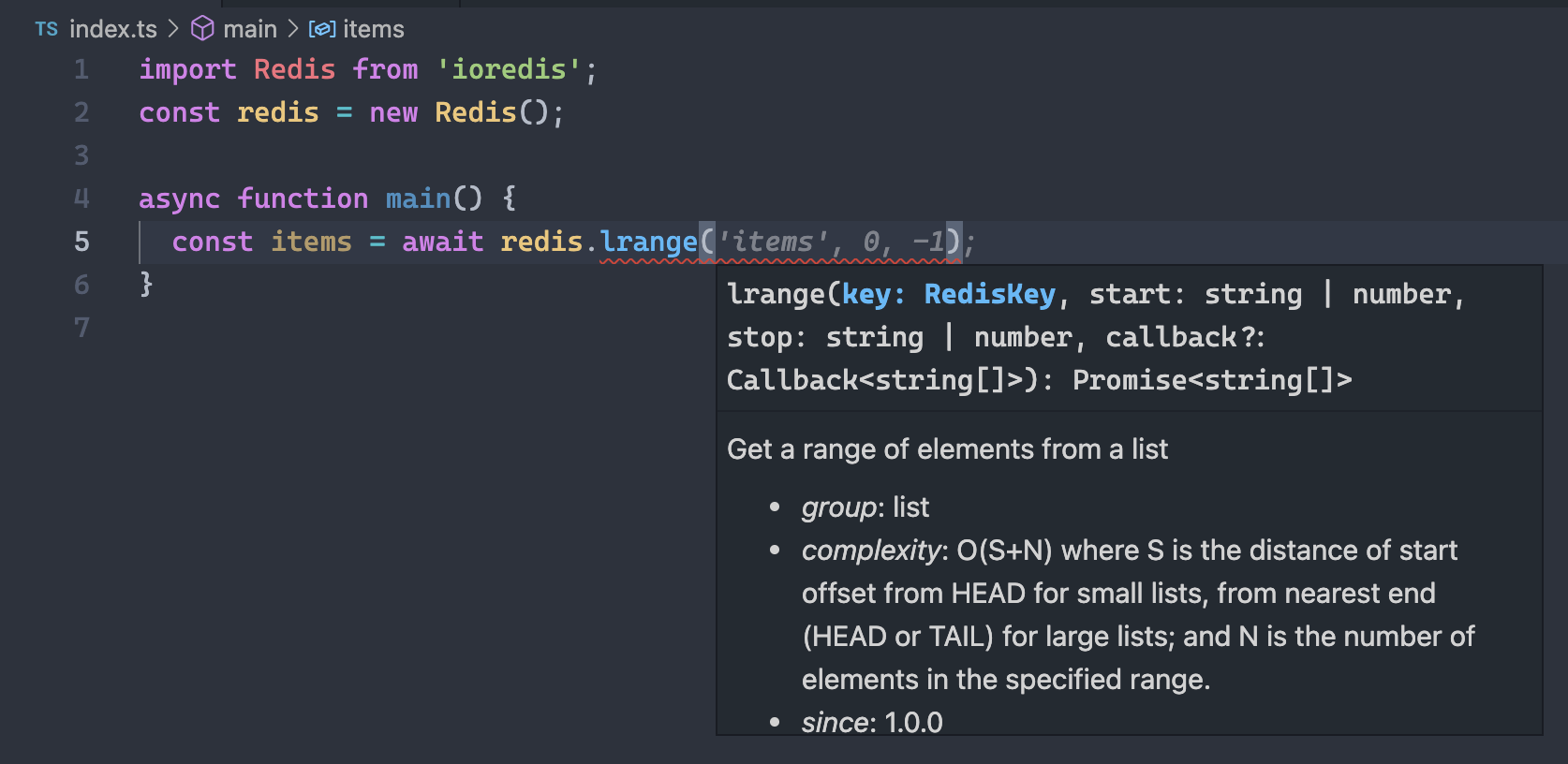
100% written in TypeScript and official declarations are provided:
Versions
| Version | Branch | Node.js Version | Redis Version |
|---|---|---|---|
| 5.x.x (latest) | main | >= 12 | 2.6.12 ~ latest |
| 4.x.x | v4 | >= 8 | 2.6.12 ~ 7 |
Refer to CHANGELOG.md for features and bug fixes introduced in v5.
Links
Quick Start
Install
npm install ioredis
In a TypeScript project, you may want to add TypeScript declarations for Node.js:
npm install --save-dev @types/node
Basic Usage
// Import ioredis.
// You can also use `import { Redis } from "ioredis"`
// if your project is a TypeScript project,
// Note that `import Redis from "ioredis"` is still supported,
// but will be deprecated in the next major version.
const Redis = require("ioredis");

// Create a Redis instance.
// By default, it will connect to localhost:6379.
// We are going to cover how to specify connection options soon.
const redis = new Redis();

redis.set("mykey", "value"); // Returns a promise which resolves to "OK" when the command succeeds.

// ioredis supports the node.js callback style
redis.get("mykey", (err, result) => {
  if (err) {
    console.error(err);
  } else {
    console.log(result); // Prints "value"
  }
});

// Or ioredis returns a promise if the last argument isn't a function
redis.get("mykey").then((result) => {
  console.log(result); // Prints "value"
});

redis.zadd("sortedSet", 1, "one", 2, "dos", 4, "quatro", 3, "three");
redis.zrange("sortedSet", 0, 2, "WITHSCORES").then((elements) => {
  // ["one", "1", "dos", "2", "three", "3"] as if the command was `redis> ZRANGE sortedSet 0 2 WITHSCORES`
  console.log(elements);
});

// All arguments are passed directly to the redis server,
// so technically ioredis supports all Redis commands.
// The format is: redis[SOME_REDIS_COMMAND_IN_LOWERCASE](https://github.com/luin/ioredis/blob/HEAD/ARGUMENTS_ARE_JOINED_INTO_COMMAND_STRING)
// so the following statement is equivalent to the CLI: `redis> SET mykey hello EX 10`
redis.set("mykey", "hello", "EX", 10);
See the examples/ folder for more examples. For example:
- TTL
- Strings
- Hashes
- Lists
- Sets
- Sorted Sets
- Streams
- Redis Modules e.g. RedisJSON
All Redis commands are supported. See the documentation for details.
Connect to Redis
When a new Redis instance is created,
a connection to Redis will be created at the same time.
You can specify which Redis to connect to by:
new Redis(); // Connect to 127.0.0.1:6379
new Redis(6380); // 127.0.0.1:6380
new Redis(6379, "192.168.1.1"); // 192.168.1.1:6379
new Redis("/tmp/redis.sock");
new Redis({
  port: 6379, // Redis port
  host: "127.0.0.1", // Redis host
  username: "default", // needs Redis >= 6
  password: "my-top-secret",
  db: 0, // Defaults to 0
});
You can also specify connection options as a redis:// URL or rediss:// URL when using TLS encryption:
// Connect to 127.0.0.1:6380, db 4, using password "authpassword":
new Redis("redis://:authpassword@127.0.0.1:6380/4");

// Username can also be passed via URI.
new Redis("redis://username:authpassword@127.0.0.1:6380/4");
See API Documentation for all available options.
Pub/Sub
Redis provides several commands for developers to implement the Publish–subscribe pattern. There are two roles in this pattern: publisher and subscriber. Publishers are not programmed to send their messages to specific subscribers. Rather, published messages are characterized into channels, without knowledge of what (if any) subscribers there may be.
By leveraging Node.js's built-in events module, ioredis makes pub/sub very straightforward to use. Below is a simple example that consists of two files, one is publisher.js that publishes messages to a channel, the other is subscriber.js that listens for messages on specific channels.
// publisher.js

const Redis = require("ioredis");
const redis = new Redis();

setInterval(() => {
  const message = { foo: Math.random() };
  // Publish to my-channel-1 or my-channel-2 randomly.
  const channel = `my-channel-${1 + Math.round(Math.random())}`;

  // Message can be either a string or a buffer
  redis.publish(channel, JSON.stringify(message));
  console.log("Published %s to %s", message, channel);
}, 1000);
// subscriber.js

const Redis = require("ioredis");
const redis = new Redis();

redis.subscribe("my-channel-1", "my-channel-2", (err, count) => {
  if (err) {
    // Just like other commands, subscribe() can fail for some reasons,
    // ex network issues.
    console.error("Failed to subscribe: %s", err.message);
  } else {
    // `count` represents the number of channels this client are currently subscribed to.
    console.log(
      `Subscribed successfully! This client is currently subscribed to ${count} channels.`
    );
  }
});

redis.on("message", (channel, message) => {
  console.log(`Received ${message} from ${channel}`);
});

// There's also an event called 'messageBuffer', which is the same as 'message' except
// it returns buffers instead of strings.
// It's useful when the messages are binary data.
redis.on("messageBuffer", (channel, message) => {
  // Both `channel` and `message` are buffers.
  console.log(channel, message);
});
It's worth noticing that a connection (aka a Redis instance) can't play both roles at the same time. More specifically, when a client issues subscribe() or psubscribe(), it enters the "subscriber" mode. From that point, only commands that modify the subscription set are valid. Namely, they are: subscribe, psubscribe, unsubscribe, punsubscribe, ping, and quit. When the subscription set is empty (via unsubscribe/punsubscribe), the connection is put back into the regular mode.
If you want to do pub/sub in the same file/process, you should create a separate connection:
const Redis = require("ioredis");
const sub = new Redis();
const pub = new Redis();

sub.subscribe(/* ... */); // From now, `sub` enters the subscriber mode.
sub.on("message" /* ... */);

setInterval(() => {
  // `pub` can be used to publish messages, or send other regular commands (e.g. `hgetall`)
  // because it's not in the subscriber mode.
  pub.publish(/* ... */);
}, 1000);
PSUBSCRIBE is also supported in a similar way when you want to subscribe all channels whose name matches a pattern:
redis.psubscribe("pat?ern", (err, count) => {});

// Event names are "pmessage"/"pmessageBuffer" instead of "message/messageBuffer".
redis.on("pmessage", (pattern, channel, message) => {});
redis.on("pmessageBuffer", (pattern, channel, message) => {});
Streams
Redis v5 introduces a new data type called streams. It doubles as a communication channel for building streaming architectures and as a log-like data structure for persisting data. With ioredis, the usage can be pretty straightforward. Say we have a producer publishes messages to a stream with redis.xadd("mystream", "*", "randomValue", Math.random()) (You may find the official documentation of Streams as a starter to understand the parameters used), to consume the messages, we'll have a consumer with the following code:
const Redis = require("ioredis");
const redis = new Redis();

const processMessage = (message) => {
  console.log("Id: %s. Data: %O", message[0], message[1]);
};

async function listenForMessage(lastId = "$") {
  // `results` is an array, each element of which corresponds to a key.
  // Because we only listen to one key (mystream) here, `results` only contains
  // a single element. See more: https://redis.io/commands/xread#return-value
  const results = await redis.xread("BLOCK", 0, "STREAMS", "mystream", lastId);
  const [key, messages] = results[0]; // `key` equals to "mystream"

  messages.forEach(processMessage);

  // Pass the last id of the results to the next round.
  await listenForMessage(messages[messages.length - 1][0]);
}

listenForMessage();
Expiration
Redis can set a timeout to expire your key, after the timeout has expired the key will be automatically deleted. (You can find the official Expire documentation to understand better the different parameters you can use), to set your key to expire in 60 seconds, we will have the following code:
redis.set("key", "data", "EX", 60);
// Equivalent to redis command "SET key data EX 60", because on ioredis set method,
// all arguments are passed directly to the redis server.
Handle Binary Data
Binary data support is out of the box. Pass buffers to send binary data:
redis.set("foo", Buffer.from([0x62, 0x75, 0x66]));
Every command that returns a bulk string
has a variant command with a Buffer suffix. The variant command returns a buffer instead of a UTF-8 string:
const result = await redis.getBuffer("foo");
// result is `<Buffer 62 75 66>`
It's worth noticing that you don't need the Buffer suffix variant in order to send binary data. That means
in most case you should just use redis.set() instead of redis.setBuffer() unless you want to get the old value
with the GET parameter:
const result = await redis.setBuffer("foo", "new value", "GET");
// result is `<Buffer 62 75 66>` as `GET` indicates returning the old value.
Pipelining
If you want to send a batch of commands (e.g. > 5), you can use pipelining to queue the commands in memory and then send them to Redis all at once. This way the performance improves by 50%~300% (See benchmark section).
redis.pipeline() creates a Pipeline instance. You can call any Redis
commands on it just like the Redis instance. The commands are queued in memory
and flushed to Redis by calling the exec method:
const pipeline = redis.pipeline();
pipeline.set("foo", "bar");
pipeline.del("cc");
pipeline.exec((err, results) => {
  // `err` is always null, and `results` is an array of responses
  // corresponding to the sequence of queued commands.
  // Each response follows the format `[err, result]`.
});

// You can even chain the commands:
redis
  .pipeline()
  .set("foo", "bar")
  .del("cc")
  .exec((err, results) => {});

// `exec` also returns a Promise:
const promise = redis.pipeline().set("foo", "bar").get("foo").exec();
promise.then((result) => {
  // result === [[null, 'OK'], [null, 'bar']]
});
Each chained command can also have a callback, which will be invoked when the command gets a reply:
redis
  .pipeline()
  .set("foo", "bar")
  .get("foo", (err, result) => {
    // result === 'bar'
  })
  .exec((err, result) => {
    // result[1][1] === 'bar'
  });
In addition to adding commands to the pipeline queue individually, you can also pass an array of commands and arguments to the constructor:
redis
  .pipeline([
    ["set", "foo", "bar"],
    ["get", "foo"],
  ])
  .exec(() => {
    /* ... */
  });
#length property shows how many commands in the pipeline:
const length = redis.pipeline().set("foo", "bar").get("foo").length;
// length === 2
Transaction
Most of the time, the transaction commands multi & exec are used together with pipeline.
Therefore, when multi is called, a Pipeline instance is created automatically by default,
so you can use multi just like pipeline:
redis
  .multi()
  .set("foo", "bar")
  .get("foo")
  .exec((err, results) => {
    // results === [[null, 'OK'], [null, 'bar']]
  });
If there's a syntax error in the transaction's command chain (e.g. wrong number of arguments, wrong command name, etc), then none of the commands would be executed, and an error is returned:
redis
  .multi()
  .set("foo")
  .set("foo", "new value")
  .exec((err, results) => {
    // err:
    //  { [ReplyError: EXECABORT Transaction discarded because of previous errors.]
    //    name: 'ReplyError',
    //    message: 'EXECABORT Transaction discarded because of previous errors.',
    //    command: { name: 'exec', args: [] },
    //    previousErrors:
    //     [ { [ReplyError: ERR wrong number of arguments for 'set' command]
    //         name: 'ReplyError',
    //         message: 'ERR wrong number of arguments for \'set\' command',
    //         command: [Object] } ] }
  });
In terms of the interface, multi differs from pipeline in that when specifying a callback
to each chained command, the queueing state is passed to the callback instead of the result of the command:
redis
  .multi()
  .set("foo", "bar", (err, result) => {
    // result === 'QUEUED'
  })
  .exec(/* ... */);
If you want to use transaction without pipeline, pass { pipeline: false } to multi,
and every command will be sent to Redis immediately without waiting for an exec invocation:
redis.multi({ pipeline: false });
redis.set("foo", "bar");
redis.get("foo");
redis.exec((err, result) => {
  // result === [[null, 'OK'], [null, 'bar']]
});
The constructor of multi also accepts a batch of commands:
redis
  .multi([
    ["set", "foo", "bar"],
    ["get", "foo"],
  ])
  .exec(() => {
    /* ... */
  });
Inline transactions are supported by pipeline, which means you can group a subset of commands in the pipeline into a transaction:
redis
  .pipeline()
  .get("foo")
  .multi()
  .set("foo", "bar")
  .get("foo")
  .exec()
  .get("foo")
  .exec();
Lua Scripting
ioredis supports all of the scripting commands such as EVAL, EVALSHA and SCRIPT.
However, it's tedious to use in real world scenarios since developers have to take
care of script caching and to detect when to use EVAL and when to use EVALSHA.
ioredis exposes a defineCommand method to make scripting much easier to use:
const redis = new Redis();

// This will define a command myecho:
redis.defineCommand("myecho", {
  numberOfKeys: 2,
  lua: "return {KEYS[1],KEYS[2],ARGV[1],ARGV[2]}",
});

// Now `myecho` can be used just like any other ordinary command,
// and ioredis will try to use `EVALSHA` internally when possible for better performance.
redis.myecho("k1", "k2", "a1", "a2", (err, result) => {
  // result === ['k1', 'k2', 'a1', 'a2']
});

// `myechoBuffer` is also defined automatically to return buffers instead of strings:
redis.myechoBuffer("k1", "k2", "a1", "a2", (err, result) => {
  // result[0] equals to Buffer.from('k1');
});

// And of course it works with pipeline:
redis.pipeline().set("foo", "bar").myecho("k1", "k2", "a1", "a2").exec();
Dynamic Keys
If the number of keys can't be determined when defining a command, you can
omit the numberOfKeys property and pass the number of keys as the first argument
when you call the command:
redis.defineCommand("echoDynamicKeyNumber", {
  lua: "return {KEYS[1],KEYS[2],ARGV[1],ARGV[2]}",
});

// Now you have to pass the number of keys as the first argument every time
// you invoke the `echoDynamicKeyNumber` command:
redis.echoDynamicKeyNumber(2, "k1", "k2", "a1", "a2", (err, result) => {
  // result === ['k1', 'k2', 'a1', 'a2']
});
As Constructor Options
Besides defineCommand(), you can also define custom commands with the scripts constructor option:
const redis = new Redis({
  scripts: {
    myecho: {
      numberOfKeys: 2,
      lua: "return {KEYS[1],KEYS[2],ARGV[1],ARGV[2]}",
    },
  },
});
TypeScript Usages
You can refer to the example for how to declare your custom commands.
Transparent Key Prefixing
This feature allows you to specify a string that will automatically be prepended to all the keys in a command, which makes it easier to manage your key namespaces.
Warning This feature won't apply to commands like KEYS and SCAN that take patterns rather than actual keys(#239), and this feature also won't apply to the replies of commands even if they are key names (#325).
const fooRedis = new Redis({ keyPrefix: "foo:" });
fooRedis.set("bar", "baz"); // Actually sends SET foo:bar baz

fooRedis.defineCommand("myecho", {
  numberOfKeys: 2,
  lua: "return {KEYS[1],KEYS[2],ARGV[1],ARGV[2]}",
});

// Works well with pipelining/transaction
fooRedis
  .pipeline()
  // Sends SORT foo:list BY foo:weight_*->fieldname
  .sort("list", "BY", "weight_*->fieldname")
  // Supports custom commands
  // Sends EVALSHA xxx foo:k1 foo:k2 a1 a2
  .myecho("k1", "k2", "a1", "a2")
  .exec();
Transforming Arguments & Replies
Most Redis commands take one or more Strings as arguments,
and replies are sent back as a single String or an Array of Strings. However, sometimes
you may want something different. For instance, it would be more convenient if the HGETALL
command returns a hash (e.g. { key: val1, key2: v2 }) rather than an array of key values (e.g. [key1, val1, key2, val2]).
ioredis has a flexible system for transforming arguments and replies. There are two types of transformers, argument transformer and reply transformer:
const Redis = require("ioredis");

// Here's the built-in argument transformer converting
// hmset('key', { k1: 'v1', k2: 'v2' })
// or
// hmset('key', new Map([['k1', 'v1'], ['k2', 'v2']]))
// into
// hmset('key', 'k1', 'v1', 'k2', 'v2')
Redis.Command.setArgumentTransformer("hmset", (args) => {
  if (args.length === 2) {
    if (args[1] instanceof Map) {
      // utils is a internal module of ioredis
      return [args[0], ...utils.convertMapToArray(args[1])];
    }
    if (typeof args[1] === "object" && args[1] !== null) {
      return [args[0], ...utils.convertObjectToArray(args[1])];
    }
  }
  return args;
});

// Here's the built-in reply transformer converting the HGETALL reply
// ['k1', 'v1', 'k2', 'v2']
// into
// { k1: 'v1', 'k2': 'v2' }
Redis.Command.setReplyTransformer("hgetall", (result) => {
  if (Array.isArray(result)) {
    const obj = {};
    for (let i = 0; i < result.length; i += 2) {
      obj[result[i]] = result[i + 1];
    }
    return obj;
  }
  return result;
});
There are three built-in transformers, two argument transformers for hmset & mset and
a reply transformer for hgetall. Transformers for hmset and hgetall were mentioned
above, and the transformer for mset is similar to the one for hmset:
redis.mset({ k1: "v1", k2: "v2" });
redis.get("k1", (err, result) => {
  // result === 'v1';
});

redis.mset(
  new Map([
    ["k3", "v3"],
    ["k4", "v4"],
  ])
);
redis.get("k3", (err, result) => {
  // result === 'v3';
});
Another useful example of a reply transformer is one that changes hgetall to return array of arrays instead of objects which avoids an unwanted conversation of hash keys to strings when dealing with binary hash keys:
Redis.Command.setReplyTransformer("hgetall", (result) => {
  const arr = [];
  for (let i = 0; i < result.length; i += 2) {
    arr.push([result[i], result[i + 1]]);
  }
  return arr;
});
redis.hset("h1", Buffer.from([0x01]), Buffer.from([0x02]));
redis.hset("h1", Buffer.from([0x03]), Buffer.from([0x04]));
redis.hgetallBuffer("h1", (err, result) => {
  // result === [ [ <Buffer 01>, <Buffer 02> ], [ <Buffer 03>, <Buffer 04> ] ];
});
Monitor
Redis supports the MONITOR command, which lets you see all commands received by the Redis server across all client connections, including from other client libraries and other computers.
The monitor method returns a monitor instance.
After you send the MONITOR command, no other commands are valid on that connection. ioredis will emit a monitor event for every new monitor message that comes across.
The callback for the monitor event takes a timestamp from the Redis server and an array of command arguments.
Here is a simple example:
redis.monitor((err, monitor) => {
  monitor.on("monitor", (time, args, source, database) => {});
});
Here is another example illustrating an async function and monitor.disconnect():
async () => {
  const monitor = await redis.monitor();
  monitor.on("monitor", console.log);
  // Any other tasks
  monitor.disconnect();
};
Streamify Scanning
Redis 2.8 added the SCAN command to incrementally iterate through the keys in the database. It's different from KEYS in that
SCAN only returns a small number of elements each call, so it can be used in production without the downside
of blocking the server for a long time. However, it requires recording the cursor on the client side each time
the SCAN command is called in order to iterate through all the keys correctly. Since it's a relatively common use case, ioredis
provides a streaming interface for the SCAN command to make things much easier. A readable stream can be created by calling scanStream:
const redis = new Redis();
// Create a readable stream (object mode)
const stream = redis.scanStream();
stream.on("data", (resultKeys) => {
  // `resultKeys` is an array of strings representing key names.
  // Note that resultKeys may contain 0 keys, and that it will sometimes
  // contain duplicates due to SCAN's implementation in Redis.
  for (let i = 0; i < resultKeys.length; i++) {
    console.log(resultKeys[i]);
  }
});
stream.on("end", () => {
  console.log("all keys have been visited");
});
scanStream accepts an option, with which you can specify the MATCH pattern, the TYPE filter, and the COUNT argument:
const stream = redis.scanStream({
  // only returns keys following the pattern of `user:*`
  match: "user:*",
  // only return objects that match a given type,
  // (requires Redis >= 6.0)
  type: "zset",
  // returns approximately 100 elements per call
  count: 100,
});
Just like other commands, scanStream has a binary version scanBufferStream, which returns an array of buffers. It's useful when
the key names are not utf8 strings.
There are also hscanStream, zscanStream and sscanStream to iterate through elements in a hash, zset and set. The interface of each is
similar to scanStream except the first argument is the key name:
const stream = redis.zscanStream("myhash", {
  match: "age:??",
});
The hscanStream also accepts the noValues option to specify whether Redis should return only the keys in the hash table without their corresponding values.
const stream = redis.hscanStream("myhash", {
  match: "age:??",
  noValues: true,
});
You can learn more from the Redis documentation.
Useful Tips
It's pretty common that doing an async task in the data handler. We'd like the scanning process to be paused until the async task to be finished. Stream#pause() and Stream#resume() do the trick. For example if we want to migrate data in Redis to MySQL:
const stream = redis.scanStream();
stream.on("data", (resultKeys) => {
  // Pause the stream from scanning more keys until we've migrated the current keys.
  stream.pause();

  Promise.all(resultKeys.map(migrateKeyToMySQL)).then(() => {
    // Resume the stream here.
    stream.resume();
  });
});

stream.on("end", () => {
  console.log("done migration");
});
Auto-reconnect
By default, ioredis will try to reconnect when the connection to Redis is lost
except when the connection is closed manually by redis.disconnect() or redis.quit().
It's very flexible to control how long to wait to reconnect after disconnection
using the retryStrategy option:
const redis = new Redis({
  // This is the default value of `retryStrategy`
  retryStrategy(times) {
    const delay = Math.min(times * 50, 2000);
    return delay;
  },
});
retryStrategy is a function that will be called when the connection is lost.
The argument times means this is the nth reconnection being made and
the return value represents how long (in ms) to wait to reconnect. When the
return value isn't a number, ioredis will stop trying to reconnect, and the connection
will be lost forever if the user doesn't call redis.connect() manually.
When reconnected, the client will auto subscribe to channels that the previous connection subscribed to.
This behavior can be disabled by setting the autoResubscribe option to false.
And if the previous connection has some unfulfilled commands (most likely blocking commands such as brpop and blpop),
the client will resend them when reconnected. This behavior can be disabled by setting the autoResendUnfulfilledCommands option to false.
By default, all pending commands will be flushed with an error every 20 retry attempts. That makes sure commands won't wait forever when the connection is down. You can change this behavior by setting maxRetriesPerRequest:
const redis = new Redis({
  maxRetriesPerRequest: 1,
});
Set maxRetriesPerRequest to null to disable this behavior, and every command will wait forever until the connection is alive again (which is the default behavior before ioredis v4).
Blocking Command Timeout
ioredis can apply a client-side timeout to blocking commands (such as blpop, brpop, bzpopmin, bzmpop, blmpop, xread, xreadgroup, etc.). This protects against scenarios where the TCP connection becomes a zombie (e.g., due to a silent network failure like a Docker network disconnect) and Redis never replies.
This feature is opt-in. It is disabled by default and is only enabled
when blockingTimeout is set to a positive number of milliseconds. If
blockingTimeout is omitted, 0, or negative (for example -1), ioredis
does not arm any client-side timeouts for blocking commands and their
behavior matches Redis exactly.
const redis = new Redis({
  blockingTimeout: 30000, // Enable blocking timeout protection
});
When enabled:
- For commands with a finite timeout (e.g.,
blpop("key", 5)), ioredis sets a client-side deadline based on the command's timeout plus a small grace period (blockingTimeoutGrace, default 100ms). If no reply arrives before the deadline, the command resolves withnull—the same value Redis returns when a blocking command times out normally. - For commands that block forever (e.g.,
timeout = 0orBLOCK 0), theblockingTimeoutvalue is used as a safety net.
Reconnect on Error
Besides auto-reconnect when the connection is closed, ioredis supports reconnecting on certain Redis errors using the reconnectOnError option. Here's an example that will reconnect when receiving READONLY error:
const redis = new Redis({
  reconnectOnError(err) {
    const targetError = "READONLY";
    if (err.message.includes(targetError)) {
      // Only reconnect when the error contains "READONLY"
      return true; // or `return 1;`
    }
  },
});
This feature is useful when using Amazon ElastiCache instances with Auto-failover disabled. On these instances, test your reconnectOnError handler by manually promoting the replica node to the primary role using the AWS console. The following writes fail with the error READONLY. Using reconnectOnError, we can force the connection to reconnect on this error in order to connect to the new master. Furthermore, if the reconnectOnError returns 2, ioredis will resend the failed command after reconnecting.
On ElastiCache instances with Auto-failover enabled, reconnectOnError does not execute. Instead of returning a Redis error, AWS closes all connections to the master endpoint until the new primary node is ready. ioredis reconnects via retryStrategy instead of reconnectOnError after about a minute. On ElastiCache instances with Auto-failover enabled, test failover events with the Failover primary option in the AWS console.
Connection Events
The Redis instance will emit some events about the state of the connection to the Redis server.
| Event | Description |
|---|---|
| connect | emits when a connection is established to the Redis server. |
| ready | If enableReadyCheck is true, client will emit ready when the server reports that it is ready to receive commands (e.g. finish loading data from disk).Otherwise, ready will be emitted immediately right after the connect event. |
| error | emits when an error occurs while connecting. However, ioredis emits all error events silently (only emits when there's at least one listener) so that your application won't crash if you're not listening to the error event.When redis.connect() is explicitly called the error will also be rejected from the returned promise, in addition to emitting it. If redis.connect() is not called explicitly and lazyConnect is true, ioredis will try to connect automatically on the first command and emit the error event silently. |
| close | emits when an established Redis server connection has closed. |
| reconnecting | emits after close when a reconnection will be made. The argument of the event is the time (in ms) before reconnecting. |
| end | emits after close when no more reconnections will be made, or the connection is failed to establish. |
| wait | emits when lazyConnect is set and will wait for the first command to be called before connecting. |
You can also check out the Redis#status property to get the current connection status.
Besides the above connection events, there are several other custom events:
| Event | Description |
|---|---|
| select | emits when the database changed. The argument is the new db number. |
Offline Queue
When a command can't be processed by Redis (being sent before the ready event), by default, it's added to the offline queue and will be
executed when it can be processed. You can disable this feature by setting the enableOfflineQueue
option to false:
const redis = new Redis({ enableOfflineQueue: false });
TLS Options
Redis doesn't support TLS natively, however if the redis server you want to connect to is hosted behind a TLS proxy (e.g. stunnel) or is offered by a PaaS service that supports TLS connection (e.g. Redis.com), you can set the tls option:
const redis = new Redis({
  host: "localhost",
  tls: {
    // Refer to `tls.connect()` section in
    // https://nodejs.org/api/tls.html
    // for all supported options
    ca: fs.readFileSync("cert.pem"),
  },
});
Alternatively, specify the connection through a rediss:// URL.
const redis = new Redis("rediss://redis.my-service.com");
If you do not want to use a connection string, you can also specify an empty tls: {} object:
const redis = new Redis({
  host: "redis.my-service.com",
  tls: {},
});
TLS Profiles
Warning TLS profiles described in this section are going to be deprecated in the next major version. Please provide TLS options explicitly.
To make it easier to configure we provide a few pre-configured TLS profiles that can be specified by setting the tls option to the profile's name or specifying a tls.profile option in case you need to customize some values of the profile.
Profiles:
RedisCloudFixed: Contains the CA for Redis.com Cloud fixed subscriptionsRedisCloudFlexible: Contains the CA for Redis.com Cloud flexible subscriptions
const redis = new Redis({
  host: "localhost",
  tls: "RedisCloudFixed",
});

const redisWithClientCertificate = new Redis({
  host: "localhost",
  tls: {
    profile: "RedisCloudFixed",
    key: "123",
  },
});
Sentinel
ioredis supports Sentinel out of the box. It works transparently as all features that work when you connect to a single node also work when you connect to a sentinel group. Make sure to run Redis >= 2.8.12 if you want to use this feature. Sentinels have a default port of 26379.
To connect using Sentinel, use:
const redis = new Redis({
  sentinels: [
    { host: "localhost", port: 26379 },
    { host: "localhost", port: 26380 },
  ],
  name: "mymaster",
});

redis.set("foo", "bar");
The arguments passed to the constructor are different from the ones you use to connect to a single node, where:
nameidentifies a group of Redis instances composed of a master and one or more slaves (mymasterin the example);sentinelPassword(optional) password for Sentinel instances.sentinelsare a list of sentinels to connect to. The list does not need to enumerate all your sentinel instances, but a few so that if one is down the client will try the next one.role(optional) with a value ofslavewill return a random slave from the Sentinel group.preferredSlaves(optional) can be used to prefer a particular slave or set of slaves based on priority. It accepts a function or array.enableTLSForSentinelMode(optional) set to true if connecting to sentinel instances that are encrypted
ioredis guarantees that the node you connected to is always a master even after a failover. When a failover happens, instead of trying to reconnect to the failed node (which will be demoted to slave when it's available again), ioredis will ask sentinels for the new master node and connect to it. All commands sent during the failover are queued and will be executed when the new connection is established so that none of the commands will be lost.
It's possible to connect to a slave instead of a master by specifying the option role with the value of slave and ioredis will try to connect to a random slave of the specified master, with the guarantee that the connected node is always a slave. If the current node is promoted to master due to a failover, ioredis will disconnect from it and ask the sentinels for another slave node to connect to.
If you specify the option preferredSlaves along with role: 'slave' ioredis will attempt to use this value when selecting the slave from the pool of available slaves. The value of preferredSlaves should either be a function that accepts an array of available slaves and returns a single result, or an array of slave values priorities by the lowest prio value first with a default value of 1.
// available slaves format
const availableSlaves = [{ ip: "127.0.0.1", port: "31231", flags: "slave" }];

// preferredSlaves array format
let preferredSlaves = [
  { ip: "127.0.0.1", port: "31231", prio: 1 },
  { ip: "127.0.0.1", port: "31232", prio: 2 },
];

// preferredSlaves function format
preferredSlaves = function (availableSlaves) {
  for (let i = 0; i < availableSlaves.length; i++) {
    const slave = availableSlaves[i];
    if (slave.ip === "127.0.0.1") {
      if (slave.port === "31234") {
        return slave;
      }
    }
  }
  // if no preferred slaves are available a random one is used
  return false;
};

const redis = new Redis({
  sentinels: [
    { host: "127.0.0.1", port: 26379 },
    { host: "127.0.0.1", port: 26380 },
  ],
  name: "mymaster",
  role: "slave",
  preferredSlaves: preferredSlaves,
});
Besides the retryStrategy option, there's also a sentinelRetryStrategy in Sentinel mode which will be invoked when all the sentinel nodes are unreachable during connecting. If sentinelRetryStrategy returns a valid delay time, ioredis will try to reconnect from scratch. The default value of sentinelRetryStrategy is:
function (times) {
  const delay = Math.min(times * 10, 1000);
  return delay;
}
Cluster
Redis Cluster provides a way to run a Redis installation where data is automatically sharded across multiple Redis nodes. You can connect to a Redis Cluster like this:
const Redis = require("ioredis");

const cluster = new Redis.Cluster([
  {
    port: 6380,
    host: "127.0.0.1",
  },
  {
    port: 6381,
    host: "127.0.0.1",
  },
]);

cluster.set("foo", "bar");
cluster.get("foo", (err, res) => {
  // res === 'bar'
});
Cluster constructor accepts two arguments, where:
-
The first argument is a list of nodes of the cluster you want to connect to. Just like Sentinel, the list does not need to enumerate all your cluster nodes, but a few so that if one is unreachable the client will try the next one, and the client will discover other nodes automatically when at least one node is connected.
-
The second argument is the options, where:
-
clusterRetryStrategy: When none of the startup nodes are reachable,clusterRetryStrategywill be invoked. When a number is returned, ioredis will try to reconnect to the startup nodes from scratch after the specified delay (in ms). Otherwise, an error of "None of startup nodes is available" will be returned. The default value of this option is:function (times) { const delay = Math.min(100 + times * 2, 2000); return delay; }It's possible to modify the
startupNodesproperty in order to switch to another set of nodes here:function (times) { this.startupNodes = [{ port: 6790, host: '127.0.0.1' }]; return Math.min(100 + times * 2, 2000); } -
dnsLookup: Alternative DNS lookup function (dns.lookup()is used by default). It may be useful to override this in special cases, such as when AWS ElastiCache used with TLS enabled. -
enableOfflineQueue: Similar to theenableOfflineQueueoption ofRedisclass. -
enableReadyCheck: When enabled, "ready" event will only be emitted whenCLUSTER INFOcommand reporting the cluster is ready for handling commands. Otherwise, it will be emitted immediately after "connect" is emitted. -
scaleReads: Config where to send the read queries. See below for more details. -
maxRedirections: When a cluster related error (e.g.MOVED,ASKandCLUSTERDOWNetc.) is received, the client will redirect the command to another node. This option limits the max redirections allowed when sending a command. The default value is16. -
retryDelayOnFailover: If the target node is disconnected when sending a command, ioredis will retry after the specified delay. The default value is100. You should make sureretryDelayOnFailover * maxRedirections > cluster-node-timeoutto insure that no command will fail during a failover. -
retryDelayOnClusterDown: When a cluster is down, all commands will be rejected with the error ofCLUSTERDOWN. If this option is a number (by default, it is100), the client will resend the commands after the specified time (in ms). -
retryDelayOnTryAgain: If this option is a number (by default, it is100), the client will resend the commands rejected withTRYAGAINerror after the specified time (in ms). -
retryDelayOnMoved: By default, this value is0(in ms), which means when aMOVEDerror is received, the client will resend the command instantly to the node returned together with theMOVEDerror. However, sometimes it takes time for a cluster to become state stabilized after a failover, so adding a delay before resending can prevent a ping pong effect. -
redisOptions: Default options passed to the constructor ofRediswhen connecting to a node. -
slotsRefreshTimeout: Milliseconds before a timeout occurs while refreshing slots from the cluster (default1000). -
slotsRefreshInterval: Milliseconds between every automatic slots refresh (by default, it is disabled).
-
Read-Write Splitting
A typical redis cluster contains three or more masters and several slaves for each master. It's possible to scale out redis cluster by sending read queries to slaves and write queries to masters by setting the scaleReads option.
scaleReads is "master" by default, which means ioredis will never send any queries to slaves. There are other three available options:
- "all": Send write queries to masters and read queries to masters or slaves randomly.
- "slave": Send write queries to masters and read queries to slaves.
- a custom
function(nodes, command): node: Will choose the custom function to select to which node to send read queries (write queries keep being sent to master). The first node innodesis always the master serving the relevant slots. If the function returns an array of nodes, a random node of that list will be selected.
For example:
const cluster = new Redis.Cluster(
  [
    /* nodes */
  ],
  {
    scaleReads: "slave",
  }
);
cluster.set("foo", "bar"); // This query will be sent to one of the masters.
cluster.get("foo", (err, res) => {
  // This query will be sent to one of the slaves.
});
NB In the code snippet above, the res may not be equal to "bar" because of the lag of replication between the master and slaves.
Running Commands to Multiple Nodes
Every command will be sent to exactly one node. For commands containing keys, (e.g. GET, SET and HGETALL), ioredis sends them to the node that serving the keys, and for other commands not containing keys, (e.g. INFO, KEYS and FLUSHDB), ioredis sends them to a random node.
Sometimes you may want to send a command to multiple nodes (masters or slaves) of the cluster, you can get the nodes via Cluster#nodes() method.
Cluster#nodes() accepts a parameter role, which can be "master", "slave" and "all" (default), and returns an array of Redis instance. For example:
// Send `FLUSHDB` command to all slaves:
const slaves = cluster.nodes("slave");
Promise.all(slaves.map((node) => node.flushdb()));

// Get keys of all the masters:
const masters = cluster.nodes("master");
Promise.all(
  masters
    .map((node) => node.keys())
    .then((keys) => {
      // keys: [['key1', 'key2'], ['key3', 'key4']]
    })
);
NAT Mapping
Sometimes the cluster is hosted within a internal network that can only be accessed via a NAT (Network Address Translation) instance. See Accessing ElastiCache from outside AWS as an example.
You can specify nat mapping rules via natMap option:
const cluster = new Redis.Cluster(
  [
    {
      host: "203.0.113.73",
      port: 30001,
    },
  ],
  {
    natMap: {
      "10.0.1.230:30001": { host: "203.0.113.73", port: 30001 },
      "10.0.1.231:30001": { host: "203.0.113.73", port: 30002 },
      "10.0.1.232:30001": { host: "203.0.113.73", port: 30003 },
    },
  }
);
Or you can specify this parameter through function:
const cluster = new Redis.Cluster(
  [
    {
      host: "203.0.113.73",
      port: 30001,
    },
  ],
  {
    natMap: (key) => {
      if(key.includes('30001')) {
        return { host: "203.0.113.73", port: 30001 };
      }

      return null;
    },
  }
);
This option is also useful when the cluster is running inside a Docker container. Also it works for Clusters in cloud infrastructure where cluster nodes connected through dedicated subnet.
Specifying through may be useful if you don't know concrete internal host and know only node port.
Transaction and Pipeline in Cluster Mode
Almost all features that are supported by Redis are also supported by Redis.Cluster, e.g. custom commands, transaction and pipeline.
However there are some differences when using transaction and pipeline in Cluster mode:
- All keys in a pipeline should belong to slots served by the same node, since ioredis sends all commands in a pipeline to the same node.
- You can't use
multiwithout pipeline (akacluster.multi({ pipeline: false })). This is because when you callcluster.multi({ pipeline: false }), ioredis doesn't know which node themulticommand should be sent to.
When any commands in a pipeline receives a MOVED or ASK error, ioredis will resend the whole pipeline to the specified node automatically if all of the following conditions are satisfied:
- All errors received in the pipeline are the same. For example, we won't resend the pipeline if we got two
MOVEDerrors pointing to different nodes. - All commands executed successfully are readonly commands. This makes sure that resending the pipeline won't have side effects.
Pub/Sub
Pub/Sub in cluster mode works exactly as the same as in standalone mode. Internally, when a node of the cluster receives a message, it will broadcast the message to the other nodes. ioredis makes sure that each message will only be received once by strictly subscribing one node at the same time.
const nodes = [
  /* nodes */
];
const pub = new Redis.Cluster(nodes);
const sub = new Redis.Cluster(nodes);
sub.on("message", (channel, message) => {
  console.log(channel, message);
});

sub.subscribe("news", () => {
  pub.publish("news", "highlights");
});
Sharded Pub/Sub
For sharded Pub/Sub, use the spublish and ssubscribe commands instead of the traditional publish and subscribe. With the old commands, the Redis cluster handles message propagation behind the scenes, allowing you to publish or subscribe to any node without considering sharding. However, this approach has scalability limitations that are addressed with sharded Pub/Sub. Here’s what you need to know:
- Instead of a single subscriber connection, there is now one subscriber connection per shard. Because of the potential overhead, you can enable or disable the use of the cluster subscriber group with the
shardedSubscribersoption. By default, this option is set tofalse, meaning sharded subscriptions are disabled. You should enable this option when establishing your cluster connection before usingssubscribe. - All channel names that you pass to a single
ssubscribeneed to map to the same hash slot. You can callssubscribemultiple times on the same cluster client instance to subscribe to channels across slots. The cluster's subscriber group takes care of forwarding thessubscribecommand to the shard that is responsible for the channels.
The following basic example shows you how to use sharded Pub/Sub:
const cluster: Cluster = new Cluster([{host: host, port: port}], {shardedSubscribers: true});

//Register the callback
cluster.on("smessage", (channel, message) => {
    console.log(message);
});


//Subscribe to the channels on the same slot
cluster.ssubscribe("channel{my}:1", "channel{my}:2").then( ( count: number ) => {
    console.log(count);
}).catch( (err) => {
    console.log(err);
});

//Publish a message
cluster.spublish("channel{my}:1", "This is a test message to my first channel.").then((value: number) => {
    console.log("Published a message to channel{my}:1");
});
Events
| Event | Description |
|---|---|
| connect | emits when a connection is established to the Redis server. |
| ready | emits when CLUSTER INFO reporting the cluster is able to receive commands (if enableReadyCheck is true) or immediately after connect event (if enableReadyCheck is false). |
| error | emits when an error occurs while connecting with a property of lastNodeError representing the last node error received. This event is emitted silently (only emitting if there's at least one listener). |
| close | emits when an established Redis server connection has closed. |
| reconnecting | emits after close when a reconnection will be made. The argument of the event is the time (in ms) before reconnecting. |
| end | emits after close when no more reconnections will be made. |
| +node | emits when a new node is connected. |
| -node | emits when a node is disconnected. |
| node error | emits when an error occurs when connecting to a node. The second argument indicates the address of the node. |
Password
Setting the password option to access password-protected clusters:
const Redis = require("ioredis");
const cluster = new Redis.Cluster(nodes, {
  redisOptions: {
    password: "your-cluster-password",
  },
});
If some of nodes in the cluster using a different password, you should specify them in the first parameter:
const Redis = require("ioredis");
const cluster = new Redis.Cluster(
  [
    // Use password "password-for-30001" for 30001
    { port: 30001, password: "password-for-30001" },
    // Don't use password when accessing 30002
    { port: 30002, password: null },
    // Other nodes will use "fallback-password"
  ],
  {
    redisOptions: {
      password: "fallback-password",
    },
  }
);
Special Note: Aws Elasticache Clusters with TLS
AWS ElastiCache for Redis (Clustered Mode) supports TLS encryption. If you use
this, you may encounter errors with invalid certificates. To resolve this
issue, construct the Cluster with the dnsLookup option as follows:
const cluster = new Redis.Cluster(
  [
    {
      host: "clustercfg.myCluster.abcdefg.xyz.cache.amazonaws.com",
      port: 6379,
    },
  ],
  {
    dnsLookup: (address, callback) => callback(null, address),
    redisOptions: {
      tls: {},
    },
  }
);
Autopipelining
In standard mode, when you issue multiple commands, ioredis sends them to the server one by one. As described in Redis pipeline documentation, this is a suboptimal use of the network link, especially when such link is not very performant.
The TCP and network overhead negatively affects performance. Commands are stuck in the send queue until the previous ones are correctly delivered to the server. This is a problem known as Head-Of-Line blocking (HOL).
ioredis supports a feature called “auto pipelining”. It can be enabled by setting the option enableAutoPipelining to true. No other code change is necessary.
In auto pipelining mode, all commands issued during an event loop are enqueued in a pipeline automatically managed by ioredis. At the end of the iteration, the pipeline is executed and thus all commands are sent to the server at the same time.
This feature can dramatically improve throughput and avoids HOL blocking. In our benchmarks, the improvement was between 35% and 50%.
While an automatic pipeline is executing, all new commands will be enqueued in a new pipeline which will be executed as soon as the previous finishes.
When using Redis Cluster, one pipeline per node is created. Commands are assigned to pipelines according to which node serves the slot.
A pipeline will thus contain commands using different slots but that ultimately are assigned to the same node.
Note that the same slot limitation within a single command still holds, as it is a Redis limitation.
Example of Automatic Pipeline Enqueuing
This sample code uses ioredis with automatic pipeline enabled.
const Redis = require("./built");
const http = require("http");

const db = new Redis({ enableAutoPipelining: true });

const server = http.createServer((request, response) => {
  const key = new URL(request.url, "https://localhost:3000/").searchParams.get(
    "key"
  );

  db.get(key, (err, value) => {
    response.writeHead(200, { "Content-Type": "text/plain" });
    response.end(value);
  });
});

server.listen(3000);
When Node receives requests, it schedules them to be processed in one or more iterations of the events loop.
All commands issued by requests processing during one iteration of the loop will be wrapped in a pipeline automatically created by ioredis.
In the example above, the pipeline will have the following contents:
GET key1
GET key2
GET key3
...
GET keyN
When all events in the current loop have been processed, the pipeline is executed and thus all commands are sent to the server at the same time.
While waiting for pipeline response from Redis, Node will still be able to process requests. All commands issued by request handler will be enqueued in a new automatically created pipeline. This pipeline will not be sent to the server yet.
As soon as a previous automatic pipeline has received all responses from the server, the new pipeline is immediately sent without waiting for the events loop iteration to finish.
This approach increases the utilization of the network link, reduces the TCP overhead and idle times and therefore improves throughput.
Benchmarks
Here's some of the results of our tests for a single node.
Each iteration of the test runs 1000 random commands on the server.
| Samples | Result | Tolerance | |
|---|---|---|---|
| default | 1000 | 174.62 op/sec | ± 0.45 % |
| enableAutoPipelining=true | 1500 | 233.33 op/sec | ± 0.88 % |
And here's the same test for a cluster of 3 masters and 3 replicas:
| Samples | Result | Tolerance | |
|---|---|---|---|
| default | 1000 | 164.05 op/sec | ± 0.42 % |
| enableAutoPipelining=true | 3000 | 235.31 op/sec | ± 0.94 % |
Error Handling
All the errors returned by the Redis server are instances of ReplyError, which can be accessed via Redis:
const Redis = require("ioredis");
const redis = new Redis();
// This command causes a reply error since the SET command requires two arguments.
redis.set("foo", (err) => {
  err instanceof Redis.ReplyError;
});
This is the error stack of the ReplyError:
ReplyError: ERR wrong number of arguments for 'set' command
    at ReplyParser._parseResult (/app/node_modules/ioredis/lib/parsers/javascript.js:60:14)
    at ReplyParser.execute (/app/node_modules/ioredis/lib/parsers/javascript.js:178:20)
    at Socket.<anonymous> (/app/node_modules/ioredis/lib/redis/event_handler.js:99:22)
    at Socket.emit (events.js:97:17)
    at readableAddChunk (_stream_readable.js:143:16)
    at Socket.Readable.push (_stream_readable.js:106:10)
    at TCP.onread (net.js:509:20)
By default, the error stack doesn't make any sense because the whole stack happens in the ioredis
module itself, not in your code. So it's not easy to find out where the error happens in your code.
ioredis provides an option showFriendlyErrorStack to solve the problem. When you enable
showFriendlyErrorStack, ioredis will optimize the error stack for you:
const Redis = require("ioredis");
const redis = new Redis({ showFriendlyErrorStack: true });
redis.set("foo");
And the output will be:
ReplyError: ERR wrong number of arguments for 'set' command
    at Object.<anonymous> (/app/index.js:3:7)
    at Module._compile (module.js:446:26)
    at Object.Module._extensions..js (module.js:464:10)
    at Module.load (module.js:341:32)
    at Function.Module._load (module.js:296:12)
    at Function.Module.runMain (module.js:487:10)
    at startup (node.js:111:16)
    at node.js:799:3
This time the stack tells you that the error happens on the third line in your code. Pretty sweet! However, it would decrease the performance significantly to optimize the error stack. So by default, this option is disabled and can only be used for debugging purposes. You shouldn't use this feature in a production environment.
Running tests
Start a Redis server on 127.0.0.1:6379, and then:
npm test
FLUSH ALL will be invoked after each test, so make sure there's no valuable data in it before running tests.
If your testing environment does not let you spin up a Redis server ioredis-mock is a drop-in replacement you can use in your tests. It aims to behave identically to ioredis connected to a Redis server so that your integration tests is easier to write and of better quality.
Debug
You can set the DEBUG env to ioredis:* to print debug info:
$ DEBUG=ioredis:* node app.js
Join in!
I'm happy to receive bug reports, fixes, documentation enhancements, and any other improvements.
And since I'm not a native English speaker, if you find any grammar mistakes in the documentation, please also let me know. :)
Contributors
This project exists thanks to all the people who contribute:

License
MIT