Architecting Robust Image Lightboxes for Modern Web Applications
lightgallery.js, magnific-popup, and photoswipe are all JavaScript libraries designed to create image lightboxes (modal galleries) on web pages, but they serve different architectural needs. lightgallery.js is a modular, plugin-based gallery that excels at handling complex media types (videos, iframes) and offers extensive customization through a rich ecosystem of addons. magnific-popup is a lightweight, flexible dialog script that focuses on inline content and AJAX loading, often used for simple popups beyond just images. photoswipe is a framework-agnostic, touch-optimized library built specifically for high-performance image viewing on mobile devices, prioritizing gesture support and smooth transitions over feature bloat.
Npm Package Weekly Downloads Trend
Github Stars Ranking
Stat Detail


Architecting Robust Image Lightboxes: lightgallery.js vs magnific-popup vs photoswipe
When building image galleries or modal viewers, frontend architects often face a trade-off between feature richness, mobile performance, and flexibility. lightgallery.js, magnific-popup, and photoswipe are three established solutions, but they solve different problems. Let's break down their technical architectures to help you make the right call.
🏗️ Core Architecture: Modular Gallery vs. Flexible Dialog vs. Touch Framework
lightgallery.js is built as a modular core with a plugin ecosystem.
- The core handles basic gallery logic, while features like thumbnails, video support, and zooming are separate plugins.
- This allows you to tree-shake unused features, keeping the bundle lean even for complex setups.
// lightgallery: Modular initialization with plugins
import lightGallery from 'lightgallery/js';
import lgThumbnail from 'lightgallery/plugins/thumbnail';
import lgZoom from 'lightgallery/plugins/zoom';

const gallery = lightGallery(document.getElementById('gallery'), {
  plugins: [lgThumbnail, lgZoom],
  speed: 500
});
magnific-popup acts as a generic dialog manager rather than a strict gallery.
- It treats images, inline HTML, and AJAX content uniformly as "popup content."
- It relies on a single configuration object to define types, making it versatile but less opinionated about gallery-specific features like slideshows.
// magnific-popup: Generic dialog initialization
import 'magnific-popup';

$('.popup-with-form').magnificPopup({
  type: 'inline',
  preloader: false,
  focus: '#name',
  callbacks: {
    beforeOpen: function() {
      // Custom logic before opening
    }
  }
});
photoswipe is a low-level framework designed specifically for image viewing gestures.
- It separates the UI (buttons, captions) from the core logic, requiring you to implement your own HTML controls or use the default UI bundle.
- It does not depend on jQuery or any other library, focusing purely on performance and touch interaction.
// photoswipe: Core initialization with separate UI
import PhotoSwipe from 'photoswipe';
import PhotoSwipeUI_Default from 'photoswipe/dist/photoswipe-ui-default';

const gallery = new PhotoSwipe({
  gallery: document.querySelector('.my-gallery'),
  children: 'a',
  pswpModule: () => import('photoswipe'),
  showHideAnimationType: 'zoom'
});

gallery.init();
📱 Mobile Experience: Touch Gestures and Performance
lightgallery.js provides touch support through its core and plugins.
- Swipe gestures work out of the box, but pinch-to-zoom requires the
lgZoomplugin. - Performance is good, but heavy plugin usage can impact low-end devices if not managed carefully.
// lightgallery: Enabling touch zoom via plugin
const gallery = lightGallery(element, {
  plugins: [lgZoom],
  mobileSettings: {
    controls: false,
    showCloseIcon: false
  }
});
magnific-popup has basic touch support but lacks advanced gestures.
- It supports swipe to close on mobile, but pinch-to-zoom is not natively implemented.
- You would need to write custom CSS/JS or use a fork to add complex touch interactions.
// magnific-popup: Basic mobile configuration
$('.image-link').magnificPopup({
  type: 'image',
  tLoading: 'Loading image #%curr%...',
  mainClass: 'mfp-img-mobile',
  image: {
    verticalFit: true
  }
});
photoswipe is the gold standard for mobile touch interactions.
- It implements native-like pinch-to-zoom, double-tap zoom, and swipe gestures with physics-based animations.
- It uses GPU-accelerated transforms exclusively, ensuring 60fps performance even on older devices.
// photoswipe: Native-like gesture configuration
const gallery = new PhotoSwipe({
  pinchToClose: true,
  closeOnVerticalDrag: true,
  allowPanToNext: true,
  spacing: 0.12
});
🎥 Media Support: Images Only vs. Mixed Content
lightgallery.js excels at handling mixed media types seamlessly.
- It supports images, YouTube, Vimeo, Wistia, and HTML5 video via dedicated plugins.
- Switching between an image and a video in the same gallery feels consistent.
// lightgallery: Supporting video and images together
import lgVideo from 'lightgallery/plugins/video';

lightGallery(element, {
  plugins: [lgVideo],
  exThumbImage: 'data-exthumbimage',
  videojs: true // Enable Video.js integration
});
magnific-popup handles mixed content well but treats them as distinct types.
- You must explicitly define the
type(image, iframe, inline, ajax) for each element. - It is great for forms or maps in popups but lacks a unified "gallery" flow for media.
// magnific-popup: Handling different content types
$('.popup-youtube').magnificPopup({
  type: 'iframe',
  iframe: {
    markup: '<div class="mfp-iframe-scaler">...</div>',
    patterns: {
      youtube: {
        index: 'youtube.com/',
        id: 'v=',
        src: 'https://www.youtube.com/embed/%id%?autoplay=1'
      }
    }
  }
});
photoswipe is strictly for images.
- It does not support videos, iframes, or inline HTML content out of the box.
- Attempting to force non-image content requires significant hacking and breaks the intended gesture model.
// photoswipe: Strictly image data structure
const slides = [
  {
    src: 'https://example.com/image1.jpg',
    w: 1024,
    h: 768,
    msrc: 'https://example.com/thumb1.jpg'
  },
  {
    src: 'https://example.com/image2.jpg',
    w: 1024,
    h: 768
  }
];
// No native support for video src types
🛠️ Customization and Extensibility
lightgallery.js offers a robust event system and plugin API.
- You can hook into events like
beforeSlide,afterSlide, orinitto inject custom logic. - The modular design means you can replace default components (like counters or arrows) easily.
// lightgallery: Event listening for custom logic
element.addEventListener('lgBeforeSlide', function(event) {
  const index = event.detail.index;
  console.log('Moving to slide', index);
});
magnific-popup provides callbacks but limited structural extensibility.
- You can run code on open/close/update, but changing the internal DOM structure often requires overriding default templates in the config.
- It is less suited for complex state management within the popup.
// magnific-popup: Callback usage
$('.popup').magnificPopup({
  callbacks: {
    open: function() {
      // Called when opened
    },
    close: function() {
      // Called when closed
    }
  }
});
photoswipe exposes a clean API but expects you to build the UI layer.
- It provides events for pointer interactions and layout changes, but you are responsible for the HTML structure of captions and buttons if you deviate from the default.
- This offers maximum control but requires more boilerplate code.
// photoswipe: Listening to internal events
gallery.on('change', () => {
  console.log('Slide changed to', gallery.currSlide);
});

gallery.on('close', () => {
  console.log('Gallery closed');
});
🌐 Real-World Scenarios
Scenario 1: E-Commerce Product Gallery
You need to show product images, 360-degree views, and promotional videos in a single carousel.
- ✅ Best choice:
lightgallery.js - Why? Its plugin system handles mixed media (video + image) seamlessly, and the thumbnail plugin is essential for product variants.
// lightgallery: Mixed media gallery
lightGallery('#product-gallery', {
  plugins: [lgThumbnail, lgVideo],
  selector: '.item'
});
Scenario 2: Simple Contact Form Modal
You need a popup that loads an inline contact form or an AJAX-loaded terms of service page.
- ✅ Best choice:
magnific-popup - Why? It specializes in inline and AJAX content types without needing a gallery structure.
// magnific-popup: Inline form modal
$('#open-form').magnificPopup({
  items: {
    src: '#hidden-form',
    type: 'inline'
  }
});
Scenario 3: Photographer's Portfolio
You need a full-screen, immersive image browsing experience with perfect pinch-to-zoom on iPads and phones.
- ✅ Best choice:
photoswipe - Why? Its gesture engine is unmatched for image-heavy sites, providing a native app feel.
// photoswipe: High-fidelity image viewer
const pswp = new PhotoSwipe({
  gallery: '#photo-portfolio',
  children: 'a',
  bgOpacity: 0.9,
  padding: { top: 20, bottom: 40, left: 10, right: 10 }
});
pswp.init();
📌 Summary Table
| Feature | lightgallery.js | magnific-popup | photoswipe |
|---|---|---|---|
| Primary Focus | Modular Media Gallery | Flexible Dialog System | Touch-Optimized Image Viewer |
| Touch Gestures | Good (Swipe + Plugin Zoom) | Basic (Swipe only) | Excellent (Pinch, Double-tap, Swipe) |
| Media Types | Images, Video, Iframes | Images, Inline, AJAX, Iframes | Images Only |
| Dependencies | None (Modular) | jQuery (Optional but common) | None |
| Customization | High (Plugin API) | Medium (Callbacks/Templates) | High (UI separated from Core) |
| Bundle Strategy | Tree-shakable Plugins | Monolithic Script | Core + UI Bundle |
💡 Final Recommendation
Think about your content types and target devices:
- Need to show videos and images together? → Go with
lightgallery.js. Its modular plugin system is the most maintainable way to handle mixed media. - Need to show forms, maps, or AJAX content in a modal? → Go with
magnific-popup. It is the most flexible "dialog" tool, even if it's not a strict gallery. - Building an image-heavy site for mobile users? → Go with
photoswipe. Nothing else matches its gesture fidelity and performance for pure image browsing.
Final Thought: While magnific-popup is versatile, it is showing its age in terms of mobile gesture support. For modern, image-centric applications, photoswipe offers the best user experience, while lightgallery.js provides the best balance of features for general-purpose content galleries.
How to Choose: lightgallery.js vs magnific-popup vs photoswipe
- lightgallery.js:
Choose
lightgallery.jsif you need a full-featured gallery solution that supports diverse media types like YouTube videos, Vimeo, and HTML5 video alongside images. It is the best fit for projects requiring a modular architecture where you only load specific plugins (like thumbnails or zoom) to keep bundle sizes efficient while maintaining high customizability. - magnific-popup:
Choose
magnific-popupif your primary requirement is a flexible dialog system that handles not just images, but also inline HTML content, AJAX responses, and iframes with minimal setup. It is ideal for legacy projects or simple implementations where you need a quick, dependency-free solution for various popup scenarios without the overhead of a dedicated gallery framework. - photoswipe:
Choose
photoswipeif your application targets mobile users heavily and requires native-like touch gestures (pinch-to-zoom, swipe) and high-performance animations. It is the superior choice for photography portfolios or image-heavy sites where the user experience of browsing images smoothly on touch devices is more critical than supporting complex mixed-media content.
Popular Comparisons
README for lightgallery.js
lightgallery.js



Full featured JavaScript lightbox gallery. No dependencies.
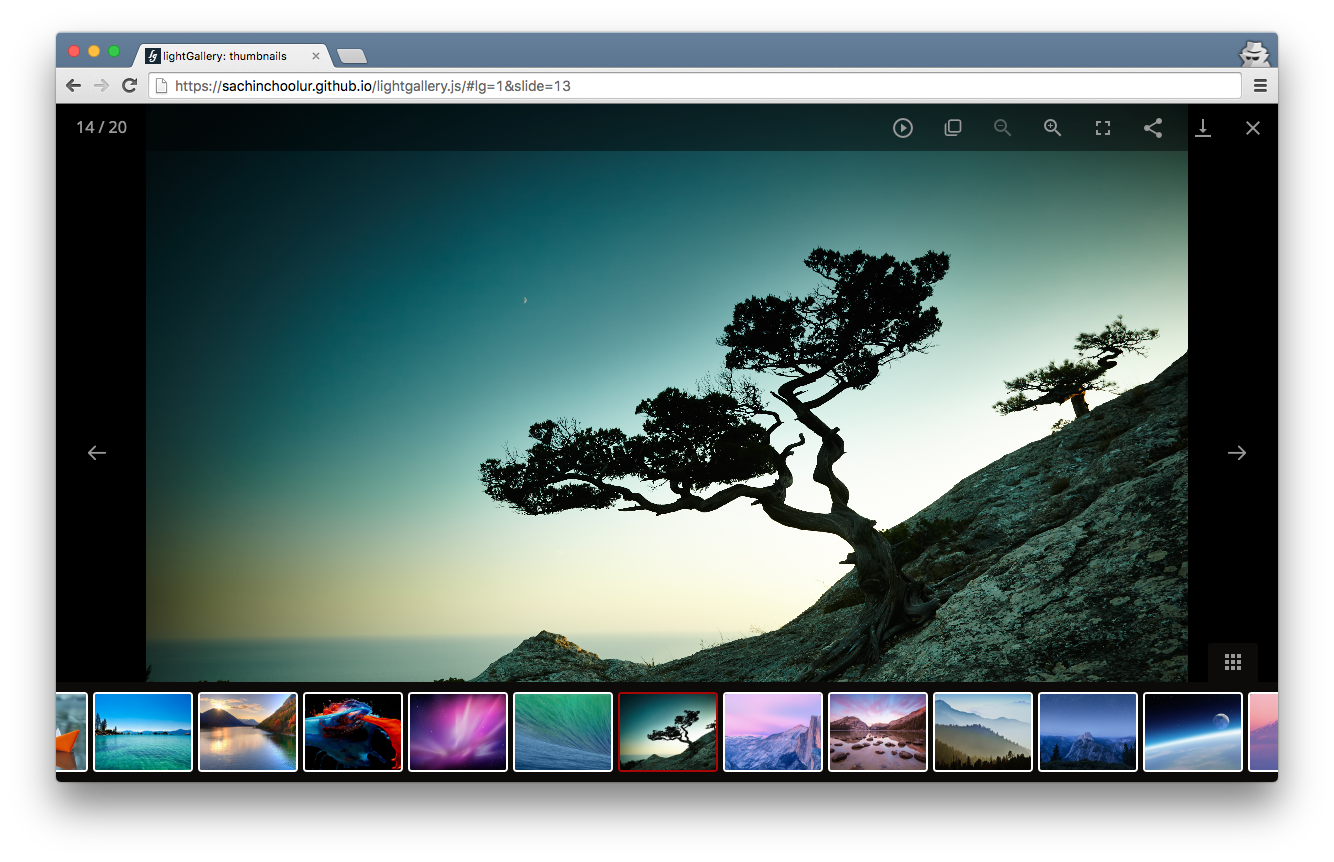
Demo
Main features
- Fully responsive.
- Modular architecture with built in plugins.
- Touch support for mobile devices.
- Mouse drag supports for desktops.
- Double-click/Double-tap to see actual size of the image.
- Animated thumbnails.
- Social media sharing.
- YouTube, Vimeo, Dailymotion, VK and HTML5 video support.
- 20+ Hardware-Accelerated CSS3 transitions.
- Dynamic mode.
- Full screen support.
- Supports zoom.
- Browser history API.
- Responsive images.
- HTML iframe support.
- Multiple instances on one page.
- Easily customizable via CSS (SCSS) and Settings.
- Smart image preloading and code optimization.
- Keyboard Navigation for desktop.
- Font icon support.
- Rotate, flip images.
- Accessibility support.
- And many more.
Browser support
lightgallery supports all major browsers including IE 9 and above.
Installation
Install with NPM
You can install lightgallery.js using the npm package manager.
npm install lightgallery.js
You can also find lightgallery.js on Yarn and Bower.
Yarn
yarn add lightgallery.js
Bower
bower install lightgallery.js --save
CDN
http://www.jsdelivr.com/projects/lightgallery.js
Download from GitHub
You can also directly download lightgallery from GitHub.
Include CSS and JavaScript files
First of all add lightgallery.css in the <head> of the document.
<head>
    <link rel="stylesheet" href="css/lightgallery.css">
</head>
Then include lightgallery.min.js into your document.
If you want to include any lightgallery plugin you can include it after lightgallery.min.js.
<body>
    ...

    <script src="js/lightgallery.min.js"></script>

    <!-- lightgallery plugins -->
    <script src="js/lg-thumbnail.min.js"></script>
    <script src="js/lg-fullscreen.min.js"></script>
</body>
Lightgallery also supports AMD, CommonJS and ES6 modules. When you use AMD make sure that lightgallery.js is loaded before lightgallery modules.
require(['./lightgallery.js'], function() {
    require(["./lg-zoom.js", "./lg-thumbnail.js"], function(){
        lightGallery(document.getElementById('lightgallery'));
    });
});
The markup
lightgallery does not force you to use any kind of markup. You can use whatever markup you want. But i suggest you to use the following markup. Here you can find the detailed examples of different kinds of markup.
<div id="lightgallery">
    <a href="https://github.com/sachinchoolur/lightgallery.js/blob/HEAD/img/img1.jpg">
        <img src="https://raw.githubusercontent.com/sachinchoolur/lightgallery.js/HEAD/img/thumb1.jpg">
    </a>
    <a href="https://github.com/sachinchoolur/lightgallery.js/blob/HEAD/img/img2.jpg">
        <img src="https://raw.githubusercontent.com/sachinchoolur/lightgallery.js/HEAD/img/thumb2.jpg">
    </a>
    ...
</div>
Call the plugin
Finally you need to initiate the gallery by adding the following code.
<script>
    lightGallery(document.getElementById('lightgallery'));
</script>
Support lightgallery
If you like lightgallery please support the project by staring the repository or tweet about this project.
Resources
Demos
- Thumbnails
- YouTube, Vimeo Video Gallery
- HTML5 Video Gallery
- Transitions
- Dynamic
- Events
- Methods
- Iframe. External websites, Google map etc.
- Captions
- Responsive images
- Gallery with fixed size
- HTML Markup
- Facebook comments
- Easing
- History/hash plugin
- Social media share
Built in modules
- Thumbnail - GItHub - Docs
- Autoplay - GItHub - Docs
- Video - GItHub - Docs
- Fullscreen - GItHub - Docs
- Pager - GItHub - Docs
- Zoom - GItHub - Docs
- Hash - GItHub - Docs
- Share - GItHub - Docs
- Rotate - GItHub - Docs
License
Commercial license
If you want to use lightgallery.js to develop commercial sites, themes, projects, and applications, the Commercial license is the appropriate license. With this option, your source code is kept proprietary. Purchase a lightgallery.js Commercial License at uplabs.com/posts/lightgallery-js
Open source license
If you are creating an open source application under a license compatible with the GNU GPL license v3, you may use this project under the terms of the GPLv3.