Animating Numbers vs General Motion in React
react-countup and react-spring are both animation libraries for React, but they solve different problems. react-countup is a specialized wrapper designed specifically for animating numeric values from a start point to an end point, often used for statistics or counters. react-spring is a general-purpose physics-based animation library that handles complex motion, transitions, and interactions across any CSS property or value. While react-countup focuses on ease of use for numbers, react-spring provides deep control over the animation lifecycle and physical behavior.
Npm Package Weekly Downloads Trend
Github Stars Ranking
Stat Detail


Animating Numbers vs General Motion in React
Both react-countup and react-spring bring motion to React applications, but they target different layers of the UI experience. react-countup is a specialist tool for counting numbers, while react-spring is a general engine for physical motion. Understanding their core differences helps you avoid over-engineering simple tasks or under-engineering complex interactions.
🎯 Core Purpose: Specialized Counters vs Physics Engine
react-countup is built specifically to animate numbers from a start value to an end value.
- It wraps the underlying
countUp.jslibrary to make it React-friendly. - It handles the math, timing, and formatting for you.
// react-countup: Dedicated number animation
import CountUp from 'react-countup';

function StatCard() {
  return <CountUp end={1000} duration={2.5} separator="," />;
}
react-spring is a physics-based animation library for any animatable value.
- It uses spring physics to calculate movement rather than fixed durations.
- You can animate numbers, but also positions, opacity, scales, and colors.
// react-spring: General physics animation
import { useSpring, animated } from '@react-spring/web';

function StatCard() {
  const props = useSpring({ to: { val: 1000 }, from: { val: 0 } });
  return <animated.span>{props.val.to(n => n.toFixed(0))}</animated.span>;
}
⚙️ Implementation: Props vs Hooks
react-countup offers both a component and a hook for flexibility.
- The component is declarative and works well for static layouts.
- The hook gives you control over the ref and manual start/stop actions.
// react-countup: Component vs Hook
import CountUp, { useCountUp } from 'react-countup';

// Component approach
<CountUp end={500} />

// Hook approach
function ManualCounter() {
  const { countUpRef, start } = useCountUp({ end: 500 });
  return <button onClick={start}><span ref={countUpRef} /></button>;
}
react-spring relies heavily on hooks to manage animation state.
- You define the spring configuration inside the component body.
- The returned values are animated objects that bind to DOM elements.
// react-spring: Hook-based configuration
import { useSpring } from '@react-spring/web';

function InteractiveCounter() {
  const [toggle, setToggle] = React.useState(false);
  const props = useSpring({
    to: { val: toggle ? 100 : 0 },
    from: { val: 0 }
  });
  return <button onClick={() => setToggle(!toggle)}>Toggle</button>;
}
🔢 Formatting and Localization
react-countup has built-in support for formatting numbers.
- You can add prefixes, suffixes, and decimal separators directly via props.
- This saves you from writing custom interpolation logic for currency or stats.
// react-countup: Built-in formatting
<CountUp
  end={1234.56}
  prefix="$"
  suffix=" USD"
  decimals={2}
  separator=","
/>
// Output: $1,234.56 USD
react-spring requires manual formatting for text content.
- The animated value is a number, so you must convert it to a string.
- You need to write your own logic for currency symbols or commas.
// react-spring: Manual formatting
import { useSpring, animated } from '@react-spring/web';

const props = useSpring({ to: { val: 1234.56 }, from: { val: 0 } });

return (
  <animated.span>
    ${props.val.to(n => n.toFixed(2).replace(/\d(?=(\d{3})+\.)/g, '$&,'))} USD
  </animated.span>
);
🌊 Physics and Control
react-countup uses standard easing functions over a fixed duration.
- You set a
durationin seconds and aneasingfunction string. - It is predictable but lacks physical realism like bounce or tension.
// react-countup: Fixed duration easing
<CountUp
  end={100}
  duration={3}
  easingFn={(t, b, c, d) => t / d * c + b}
/>
react-spring uses mass, tension, and friction to define motion.
- Animations feel more natural because they mimic real-world physics.
- You can interrupt animations mid-flight without breaking the flow.
// react-spring: Physics configuration
const props = useSpring({
  to: { val: 100 },
  from: { val: 0 },
  config: { mass: 1, tension: 170, friction: 26 }
});
🧩 Integration with Layout
react-countup is isolated to the text content it renders.
- It does not affect layout properties like width, height, or position.
- You must wrap it in other tools if you need the container to animate too.
// react-countup: Text content only
<div className="card">
  <CountUp end={100} /> {/* Only number animates */}
</div>
react-spring can animate the number and the layout simultaneously.
- You can bind the same spring to opacity, scale, and the number value.
- This creates cohesive motion where elements grow and count up together.
// react-spring: Unified motion
const props = useSpring({
  to: { val: 100, opacity: 1, scale: 1 },
  from: { val: 0, opacity: 0, scale: 0.5 }
});

return (
  <animated.div style={{ opacity: props.opacity, scale: props.scale }}>
    {props.val.to(n => n.toFixed(0))}
  </animated.div>
);
📊 Summary: Key Differences
| Feature | react-countup | react-spring |
|---|---|---|
| Primary Use | 🔢 Number counters | 🎨 General motion & physics |
| Setup | ✅ Props-based (Component or Hook) | 🪝 Hook-based configuration |
| Formatting | 🛠️ Built-in (prefix, suffix, etc.) | ✍️ Manual interpolation required |
| Motion Model | ⏱️ Fixed duration & easing | 🌊 Physics (tension, friction, mass) |
| Layout Animation | ❌ Text content only | ✅ Any CSS property + values |
| Interruption | ⚠️ Restarts or resets | ✅ Smooth interruption mid-flight |
💡 The Big Picture
react-countup is like a digital odometer 🚗—it does one job perfectly and requires very little setup. Use it for dashboards, pricing tables, or any place where you just need a number to tick up reliably.
react-spring is like a physics lab 🧪—it gives you the tools to build complex, interactive motion systems. Use it when the number animation is part of a larger interactive experience, like a game, a gesture-driven interface, or a highly polished marketing site.
Final Thought: If you only need to count up, react-countup saves time. If you need the count to feel alive and connected to other movements, react-spring is worth the extra code.
How to Choose: react-countup vs react-spring
- react-countup:
Choose
react-countupif your primary goal is animating numeric values like statistics, prices, or scores. It handles formatting, easing, and decimal logic out of the box without extra configuration. This package is ideal when you need a quick, reliable counter without building custom animation logic. It reduces boilerplate significantly for standard number transitions. - react-spring:
Choose
react-springif you need complex motion systems involving physics, gestures, or layout transitions. It allows you to animate numbers alongside other UI elements using a unified physics engine. This library is best for interactive interfaces where motion needs to feel natural and respond to user input. It offers greater flexibility but requires more setup for simple number counters.
Popular Comparisons
README for react-countup
React CountUp






A configurable React component wrapper around CountUp.js.
Click here to view on CodeSandbox.
Previous docs
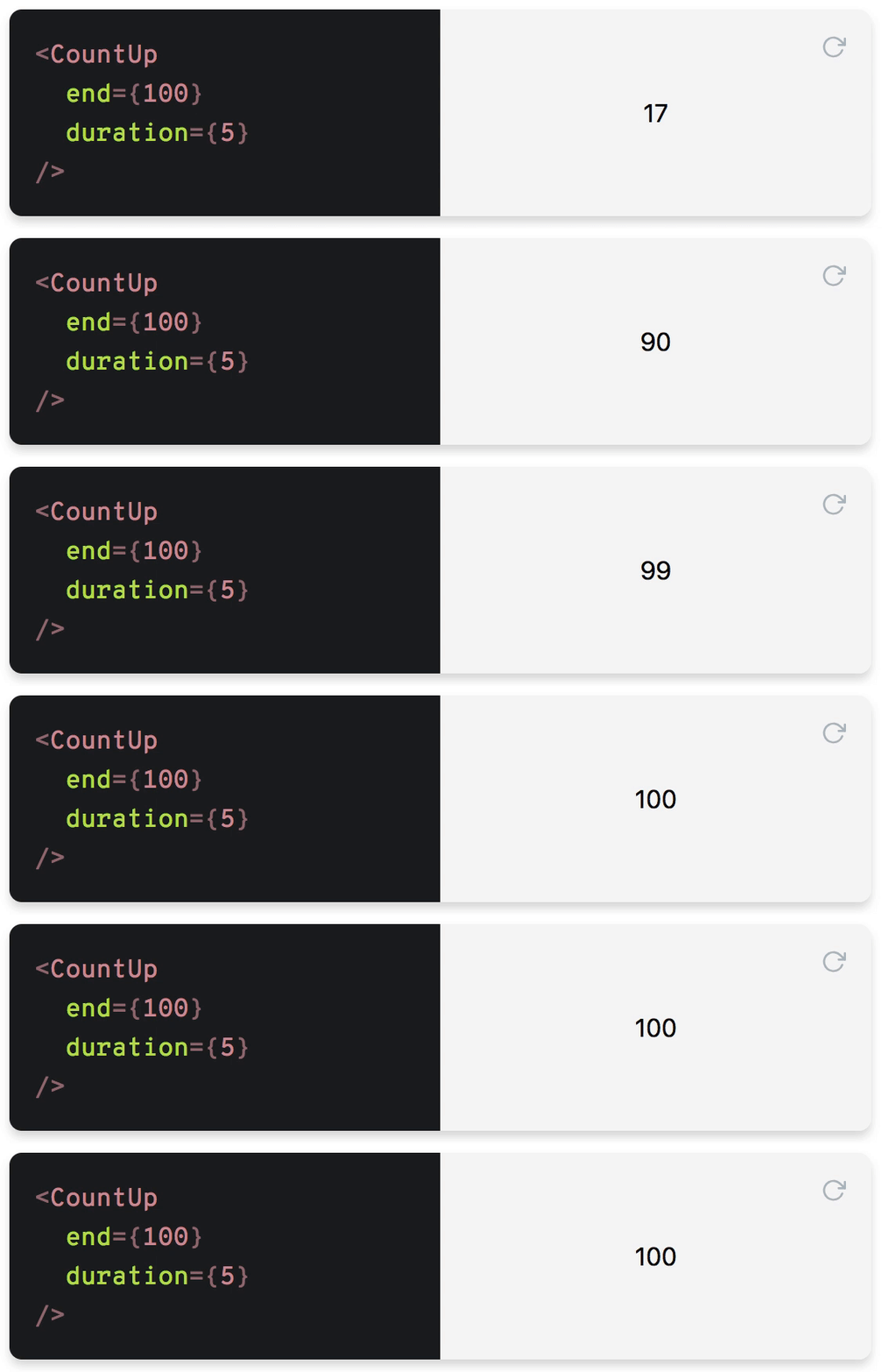
Table of Contents
- Installation
- Usage
- API
- Props
className: stringdecimal: stringdecimals: numberdelay: ?numberduration: numberend: numberprefix: stringredraw: booleanpreserveValue: booleanseparator: stringstart: numberplugin: CountUpPluginstartOnMount: booleansuffix: stringuseEasing: booleanuseGrouping: booleanuseIndianSeparators: booleaneasingFn: (t: number, b: number, c: number, d: number) => numberformattingFn: (value: number) => stringenableScrollSpy: booleanscrollSpyDelay: numberscrollSpyOnce: booleanonEnd: ({ pauseResume, reset, start, update }) => voidonStart: ({ pauseResume, reset, update }) => voidonPauseResume: ({ reset, start, update }) => voidonReset: ({ pauseResume, start, update }) => voidonUpdate: ({ pauseResume, reset, start }) => void
- Render props
- Props
- Protips
- License
Installation
yarn add react-countup
Usage
import CountUp from 'react-countup';
Simple example
<CountUp end={100} />
This will start a count up transition from 0 to 100 on render.
Render prop example
<CountUp
  start={-875.039}
  end={160527.012}
  duration={2.75}
  separator=" "
  decimals={4}
  decimal=","
  prefix="EUR "
  suffix=" left"
  onEnd={() => console.log('Ended! 👏')}
  onStart={() => console.log('Started! 💨')}
>
  {({ countUpRef, start }) => (
    <div>
      <span ref={countUpRef} />
      <button onClick={start}>Start</button>
    </div>
  )}
</CountUp>
The transition won't start on initial render as it needs to be triggered manually here.
Tip: If you need to start the render prop component immediately, you can set delay={0}.
More examples
Manually start with render prop
<CountUp start={0} end={100}>
  {({ countUpRef, start }) => (
    <div>
      <span ref={countUpRef} />
      <button onClick={start}>Start</button>
    </div>
  )}
</CountUp>
Autostart with render prop
Render start value but start transition on first render:
<CountUp start={0} end={100} delay={0}>
  {({ countUpRef }) => (
    <div>
      <span ref={countUpRef} />
    </div>
  )}
</CountUp>
Note that delay={0} will automatically start the count up.
Delay start
<CountUp delay={2} end={100} />
Hook
Simple example
import { useCountUp } from 'react-countup';

const SimpleHook = () => {
  useCountUp({ ref: 'counter', end: 1234567 });
  return <span id="counter" />;
};
Complete example
import { useCountUp } from 'react-countup';

const CompleteHook = () => {
  const countUpRef = React.useRef(null);
  const { start, pauseResume, reset, update } = useCountUp({
    ref: countUpRef,
    start: 0,
    end: 1234567,
    delay: 1000,
    duration: 5,
    onReset: () => console.log('Resetted!'),
    onUpdate: () => console.log('Updated!'),
    onPauseResume: () => console.log('Paused or resumed!'),
    onStart: ({ pauseResume }) => console.log(pauseResume),
    onEnd: ({ pauseResume }) => console.log(pauseResume),
  });
  return (
    <div>
      <div ref={countUpRef} />
      <button onClick={start}>Start</button>
      <button onClick={reset}>Reset</button>
      <button onClick={pauseResume}>Pause/Resume</button>
      <button onClick={() => update(2000)}>Update to 2000</button>
    </div>
  );
};
API
Props
className: string
CSS class name of the span element.
Note: This won't be applied when using CountUp with render props.
decimal: string
Specifies decimal character.
Default: .
decimals: number
Amount of decimals to display.
Default: 0
delay: number
Delay in seconds before starting the transition.
Default: null
Note:
delay={0}will automatically start the count up.
duration: number
Duration in seconds.
Default: 2
end: number
Target value.
prefix: string
Static text before the transitioning value.
redraw: boolean
Forces count up transition on every component update.
Default: false
preserveValue: boolean
Save previously ended number to start every new animation from it.
Default: false
separator: string
Specifies character of thousands separator.
start: number
Initial value.
Default: 0
plugin: CountUpPlugin
Define plugin for alternate animations
startOnMount: boolean
Use for start counter on mount for hook usage.
Default: true
suffix: string
Static text after the transitioning value.
useEasing: boolean
Enables easing. Set to false for a linear transition.
Default: true
useGrouping: boolean
Enables grouping with separator.
Default: true
useIndianSeparators: boolean
Enables grouping using indian separation, f.e. 1,00,000 vs 100,000
Default: false
easingFn: (t: number, b: number, c: number, d: number) => number
Easing function. Click here for more details.
Default: easeInExpo
formattingFn: (value: number) => string
Function to customize the formatting of the number.
To prevent component from unnecessary updates this function should be memoized with useCallback
enableScrollSpy: boolean
Enables start animation when target is in view.
scrollSpyDelay: number
Delay (ms) after target comes into view
scrollSpyOnce: boolean
Run scroll spy only once
onEnd: ({ pauseResume, reset, start, update }) => void
Callback function on transition end.
onStart: ({ pauseResume, reset, update }) => void
Callback function on transition start.
onPauseResume: ({ reset, start, update }) => void
Callback function on pause or resume.
onReset: ({ pauseResume, start, update }) => void
Callback function on reset.
onUpdate: ({ pauseResume, reset, start }) => void
Callback function on update.
Render props
countUpRef: () => void
Ref to hook the countUp instance to
pauseResume: () => void
Pauses or resumes the transition
reset: () => void
Resets to initial value
start: () => void
Starts or restarts the transition
update: (newEnd: number?) => void
Updates transition to the new end value (if given)
Protips
Trigger of transition
By default, the animation is triggered if any of the following props has changed:
durationendstart
If redraw is set to true your component will start the transition on every component update.
Run if in focus
You need to check if your counter in viewport, react-visibility-sensor can be used for this purpose.
import React from 'react';
import CountUp from 'react-countup';
import VisibilitySensor from 'react-visibility-sensor';
import './styles.css';

export default function App() {
  return (
    <div className="App">
      <div className="content" />
      <VisibilitySensor partialVisibility offset={{ bottom: 200 }}>
        {({ isVisible }) => (
          <div style={{ height: 100 }}>
            {isVisible ? <CountUp end={1000} /> : null}
          </div>
        )}
      </VisibilitySensor>
    </div>
  );
}
Note: For latest react-countup releases there are new options
enableScrollSpyandscrollSpyDelaywhich enable scroll spy, so that as user scrolls to the target element, it begins counting animation automatically once it has scrolled into view.
import './styles.css';
import CountUp, { useCountUp } from 'react-countup';

export default function App() {
  useCountUp({
    ref: 'counter',
    end: 1234567,
    enableScrollSpy: true,
    scrollSpyDelay: 1000,
  });

  return (
    <div className="App">
      <div className="content" />
      <CountUp end={100} enableScrollSpy />
      <br />
      <span id="counter" />
    </div>
  );
}
Set accessibility properties for occupation period
You can use callback properties to control accessibility:
import React from 'react';
import CountUp, { useCountUp } from 'react-countup';

export default function App() {
  useCountUp({ ref: 'counter', end: 10, duration: 2 });
  const [loading, setLoading] = React.useState(false);

  const onStart = () => {
    setLoading(true);
  };

  const onEnd = () => {
    setLoading(false);
  };

  const containerProps = {
    'aria-busy': loading,
  };

  return (
    <>
      <CountUp
        end={123457}
        duration="3"
        onStart={onStart}
        onEnd={onEnd}
        containerProps={containerProps}
      />
      <div id="counter" aria-busy={loading} />
    </>
  );
}
Plugin usage
import { CountUp } from 'countup.js';
import { Odometer } from 'odometer_countup';

export default function App() {
  useCountUp({
    ref: 'counter',
    end: 1234567,
    enableScrollSpy: true,
    scrollSpyDelay: 1000,
    plugin: Odometer,
  });

  return (
    <div className="App">
      <span id="counter" />
    </div>
  );
}
License
MIT