Architectural Decision Guide: Enterprise Data Grids vs. Lightweight Tables vs. Spreadsheet Editors
ag-grid, gridjs, and handsontable are three distinct solutions for displaying and manipulating tabular data in web applications, each targeting a different tier of complexity. ag-grid is a high-performance, feature-rich enterprise data grid designed for handling massive datasets with complex requirements like server-side row models, advanced filtering, and Excel-style exporting. gridjs is a lightweight, plugin-based table library focused on simplicity, offering core features like sorting, pagination, and search with a small footprint, ideal for standard data display needs. handsontable is a JavaScript Data Grid that replicates the look and feel of a spreadsheet (like Excel), specializing in data entry, cell editing, formula calculation, and copy-paste operations for financial or data-heavy input forms.
Npm Package Weekly Downloads Trend
Github Stars Ranking
Stat Detail


ag-grid vs. gridjs vs. handsontable: Choosing the Right Data Interface
Selecting the right component for tabular data is a critical architectural decision. The wrong choice can lead to performance bottlenecks when scaling data, poor user experience during editing, or bloated bundle sizes for simple views. ag-grid, gridjs, and handsontable solve different problems. Let's break down their technical realities to help you decide.
🏗️ Core Philosophy: Grid Engine vs. Simple Table vs. Spreadsheet
ag-grid is built as a rendering engine first. It treats the grid as a complex application state machine. It uses virtualization (rendering only visible rows) by default and provides a robust API for controlling every pixel of the UI. It assumes you are dealing with serious data volumes.
// ag-grid: Explicit column definitions and robust grid options
const gridOptions = {
  columnDefs: [
    { field: 'make', headerName: 'Car Make' },
    { field: 'model', headerName: 'Car Model' }
  ],
  rowData: myData,
  // Enables virtualization automatically for large datasets
  domLayout: 'normal'
};

new agGrid.Grid(gridDiv, gridOptions);
gridjs focuses on being a "zero-config" table that becomes powerful only when you need it. It renders standard HTML tables enhanced with JavaScript. It does not enforce a complex configuration object structure, making it easy to drop into existing projects.
// gridjs: Simple configuration with intuitive keys
new gridjs.Grid({
  columns: ['Make', 'Model', 'Year'],
  data: [
    ['Tesla', 'Model Y', 2023],
    ['Ford', 'F-150', 2022]
  ],
  search: true,
  pagination: {
    limit: 10
  }
}).render(document.getElementById('wrapper'));
handsontable mimics a spreadsheet application. Its core philosophy is "cells." Every cell is an independent editor with its own validation rules, data types, and context menu. It is designed for interaction, not just display.
// handsontable: Cell-focused configuration with data types
const container = document.getElementById('example');
const hot = new Handsontable(container, {
  data: [
    { make: 'Tesla', model: 'Model Y', year: 2023 }
  ],
  columns: [
    { data: 'make', type: 'text' },
    { data: 'model', type: 'text' },
    { data: 'year', type: 'numeric', validator: (value) => value >= 2000 }
  ],
  licenseKey: 'non-commercial-and-evaluation' // Required for setup
});
🚀 Handling Large Data: Virtualization Strategies
When your dataset grows from 100 rows to 100,000, the rendering strategy determines if your app crashes or flies.
ag-grid offers the most sophisticated virtualization. It supports a "Row Model" architecture where you can choose between client-side (all data in memory) and server-side (fetching blocks of data as the user scrolls). This allows it to handle millions of rows smoothly.
// ag-grid: Server-side row model for infinite scrolling
const gridOptions = {
  rowModelType: 'serverSide',
  serverSideDatasource: {
    getRows: function(params) {
      // Fetch only the rows needed for the current viewport
      api.getDataFromServer(params.request).then(response => {
        params.success({
          rowData: response.rows,
          rowCount: response.totalCount
        });
      });
    }
  }
};
gridjs handles large data primarily through pagination. While it is fast, it generally expects the data to be available or manageable in the browser for its core operations. It does not have a built-in "infinite scroll" server-side model as robust as ag-grid's enterprise features. You typically feed it a page of data.
// gridjs: Pagination handles large data by splitting views
new gridjs.Grid({
  data: myLargeDataset, // Ideally pre-sliced or paginated via plugin
  pagination: {
    limit: 20,
    summary: false
  },
  // Custom server-side logic often requires writing a custom plugin
  // or handling data fetching before passing to the grid
});
handsontable uses virtualization but is optimized for editable cells. It can handle large datasets, but the overhead of maintaining editable states, validators, and clipboard buffers for thousands of cells is higher than a read-only grid. For massive read-only datasets, it is less efficient than ag-grid.
// handsontable: Virtualization is on by default but tuned for editing
const hot = new Handsontable(container, {
  data: largeDataset,
  rowHeights: 23, // Fixed heights help virtualization performance
  viewportRowRenderingOffset: 10, // Configurable buffer for rendering
  // Performance drops if complex validators are applied to every cell in a huge set
});
✏️ Editing and Data Entry Capabilities
This is the biggest differentiator. Are you displaying data or collecting it?
ag-grid provides excellent cell editing. You can swap editors (dropdowns, date pickers) and validate data. However, its interaction model is still a "grid," not a "spreadsheet." Copy-paste works, but complex formula propagation is not its primary focus unless you buy the enterprise version with specific Excel-like features.
// ag-grid: Configurable cell editors
const gridOptions = {
  columnDefs: [
    {
      field: 'role',
      editable: true,
      cellEditor: 'agSelectCellEditor',
      cellEditorParams: {
        values: ['Admin', 'User', 'Guest']
      }
    }
  ]
};
gridjs is primarily read-only. While you can inject custom HTML into cells to create buttons or inputs, it does not have a built-in "edit mode" or cell navigation system (arrow keys to move between cells). Building a data entry form on top of gridjs requires significant custom work.
// gridjs: Custom content via templates, not native editing
new gridjs.Grid({
  columns: [
    {
      name: 'Action',
      formatter: (cell) => gridjs.html(`<button>Edit ${cell}</button>`)
    }
  ],
  // No native 'editable: true' property for grid-wide editing
});
handsontable excels here. It supports keyboard navigation (Tab, Enter, Arrows), multi-cell selection, copy-paste from Excel, and even basic formula calculations (e.g., =SUM(A1:A5)). If your users live in Excel, they will feel at home here immediately.
// handsontable: Native spreadsheet behaviors
const hot = new Handsontable(container, {
  data: myData,
  formulas: { engine: HyperFormula }, // Enable Excel-like formulas
  contextMenu: true, // Right-click menu for row/col operations
  bindRowsWithHeaders: true,
  // Users can press Ctrl+C/V to copy from Excel and paste directly
});
🎨 Customization and Styling
ag-grid uses a theming system based on CSS variables and specific structural classes. It is powerful but can be heavy to override if you need a completely unique look that breaks the grid metaphor. It offers separate themes (Alpine, Balham, Material).
/* ag-grid: Overriding theme variables */
:root {
  --ag-background-color: #f0f0f0;
  --ag-foreground-color: #333;
}
/* Requires importing the specific theme CSS file */
gridjs is incredibly easy to style because it renders standard HTML tables with predictable class names. It feels more like styling a regular webpage component than configuring a complex widget.
/* gridjs: Standard CSS targeting */
.gridjs-head { background-color: #007bff; color: white; }
.gridjs td { padding: 12px; }
/* Works naturally with Tailwind or Bootstrap without extra adapters */
handsontable has a very specific DOM structure to support its spreadsheet features (overlays for sticky headers, floating editors). Styling it requires understanding its internal layers. It looks like a spreadsheet by default, and changing that fundamental look can be challenging.
/* handsontable: Targeting specific internal layers */
.handsontable .htLeft { text-align: left; }
.handsontable .highlight { background-color: yellow; }
/* Custom themes often require deep CSS overrides */
🌐 Real-World Architecture Scenarios
Scenario 1: Financial Trading Dashboard
You need to display 50,000+ real-time stock updates. Users need to sort, filter, and group data instantly. Latency is critical.
- ✅ Best Choice:
ag-grid - Why: Its server-side row model and optimized virtualization ensure the UI stays responsive even with massive data streams. The enterprise version offers specific financial tools like pivoting and advanced aggregation.
Scenario 2: Internal Admin User List
You need a table to show registered users. Admins need to search by name, paginate results, and click a row to view details. No inline editing required.
- ✅ Best Choice:
gridjs - Why: It provides search, sorting, and pagination out of the box with minimal code. The bundle size is small, and it integrates easily into existing React/Vue/Angular apps without a steep learning curve.
Scenario 3: Budget Planning Tool
Finance teams need to upload a budget, adjust numbers directly in the browser, use formulas to calculate totals, and copy-paste data from an Excel file they received via email.
- ✅ Best Choice:
handsontable - Why: The spreadsheet-like interaction is non-negotiable here. Recreating Excel's copy-paste and formula behavior in
ag-gridorgridjswould take months of development.handsontableprovides this day one.
📊 Summary: Key Differences
| Feature | ag-grid | gridjs | handsontable |
|---|---|---|---|
| Primary Use | Enterprise Data Display & Analysis | Simple Data Display | Data Entry & Spreadsheets |
| Data Volume | Millions (Server-side support) | Thousands (Pagination) | Thousands (Virtualized) |
| Editing | Cell Editing (Configurable) | Read-Only (Custom HTML only) | Full Spreadsheet Editing |
| Excel Compatibility | High (Enterprise) | None | Native (Copy/Paste/Formulas) |
| Learning Curve | Steep | Low | Medium |
| License | MIT (Core) / Commercial (Ent) | Apache 2.0 | Non-Comm / Commercial |
💡 The Big Picture
ag-grid is the heavy lifter. If your data is complex, huge, or requires professional-grade analysis features, this is the industry standard. It costs more (for enterprise features) and takes longer to learn, but it scales where others fail.
gridjs is the swift utility. When you just need a table that looks good and works well without dragging down your performance budget, gridjs is the modern, clean choice. It respects the web platform and stays out of your way.
handsontable is the specialist. It is not just a grid; it is a spreadsheet engine for the web. If your users need to work with data (input, calculate, rearrange) rather than just view it, handsontable is the only logical choice among the three.
Final Thought: Don't over-engineer. If you need a spreadsheet, buy/build a spreadsheet (handsontable). If you need a dashboard for big data, get a grid engine (ag-grid). If you just need a nice table, keep it light (gridjs).
How to Choose: ag-grid vs gridjs vs handsontable
- ag-grid:
Choose
ag-gridwhen building complex enterprise dashboards or admin panels that must handle hundreds of thousands of rows without lagging. It is the correct choice if you need deep customization, server-side data loading, pivoting, or strict accessibility compliance out of the box. Avoid it for simple static lists where its comprehensive feature set would be unnecessary overhead. - gridjs:
Choose
gridjsfor projects requiring a clean, responsive table with essential features like sorting, pagination, and search, but without the bloat of a full enterprise grid. It is ideal for marketing sites, documentation, or internal tools where development speed and bundle size are priorities over complex data manipulation. Do not use it if you need spreadsheet-like editing or virtualization for massive datasets. - handsontable:
Choose
handsontableif your application requires users to input, edit, and calculate data directly in the grid, mimicking an Excel experience. It is the standard for financial modeling, inventory management, or any scenario where copy-pasting from spreadsheets and cell-level validation are critical. Avoid it if you only need to display read-only data, as simpler libraries will offer better performance and lower cost for that specific use case.
Popular Comparisons
README for ag-grid




ag-Grid
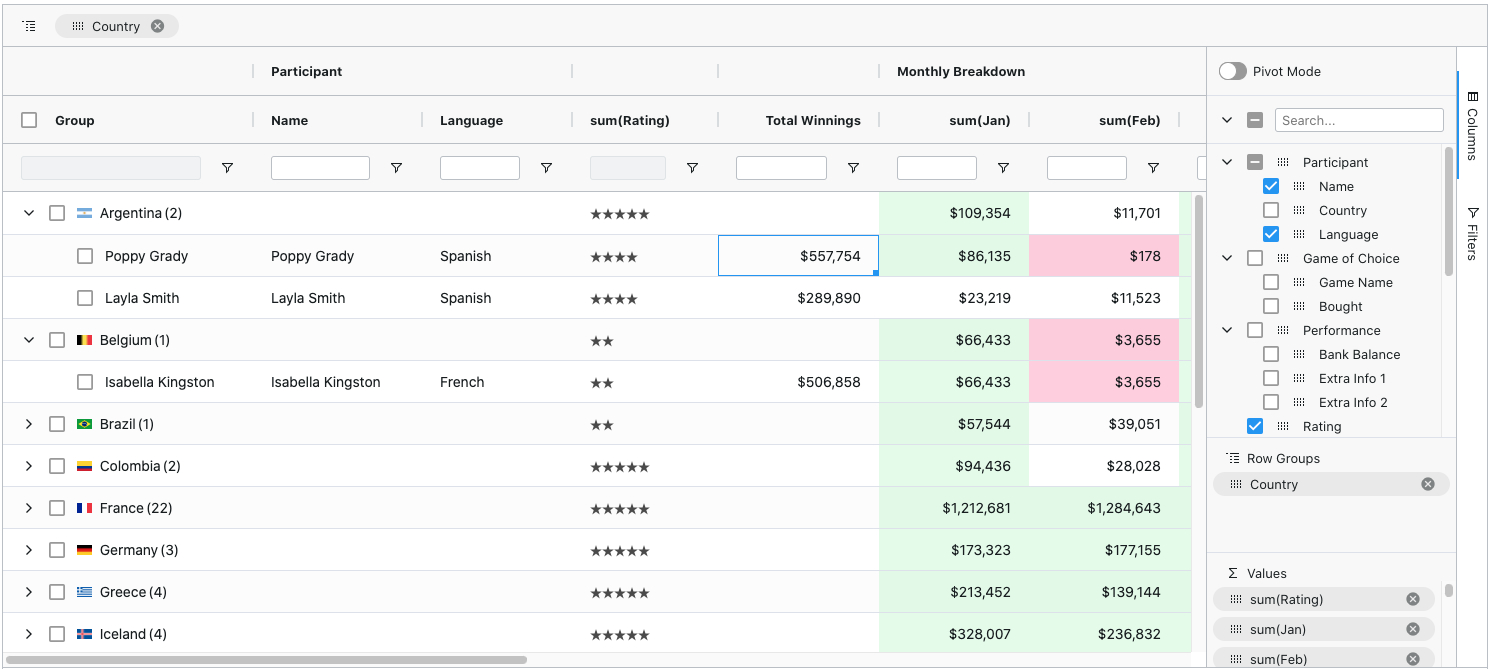
ag-Grid is a fully-featured and highly customizable JavaScript data grid. It delivers outstanding performance, has no 3rd party dependencies and integrates smoothly with all major JavaScript frameworks. Here's how our grid looks like with multiple filters and grouping enabled:
Features
Besides the standard set of features you'd expect from any grid:
- Column Interactions (resize, reorder, and pin columns)
- Pagination
- Sorting
- Row Selection
Here are some of the features that make ag-Grid stand out:
- Grouping / Aggregation*
- Custom Filtering
- In-place Cell Editing
- Records Lazy Loading *
- Server-Side Records Operations *
- Live Stream Updates
- Hierarchical Data Support & Tree View *
- Customizable Appearance
- Customizable Cell Contents
- Excel-like Pivoting *
- State Persistence
- Keyboard navigation
- Data Export to CSV
- Data Export to Excel *
- Row Reordering
- Copy / Paste
- Column Spanning
- Pinned Rows
- Full Width Rows
* The features marked with an asterisk are available in the enterprise version only.
Check out developers documentation for a complete list of features or visit our official docs for tutorials and feature demos.
Looking for a framework specific solution?
- Get Started with AngularJS
- Get Started with Angular
- Get Started with React
- Get Started with Vue
- Get Started with WebComponents
Usage Overview
Install dependencies
$ npm i --save ag-grid
Add a placeholder to HTML
<div id="myGrid" style="height: 150px;width: 600px" class="ag-theme-balham"></div>
Import the grid and styles
import {Grid} from "ag-grid/main";

import "ag-grid/dist/styles/ag-grid.css";
import "ag-grid/dist/styles/ag-theme-balham.css";
Set configuration
const gridOptions = {
	columnDefs: [
		{headerName: 'Make', field: 'make'},
		{headerName: 'Model', field: 'model'},
		{headerName: 'Price', field: 'price'}
	],
	rowData: [
		{make: 'Toyota', model: 'Celica', price: 35000},
		{make: 'Ford', model: 'Mondeo', price: 32000},
		{make: 'Porsche', model: 'Boxter', price: 72000}
	]
};
Initialize the grid
let eGridDiv = document.querySelector('#myGrid');
new Grid(eGridDiv, this.gridOptions);
For more information on how to integrate the grid into your project see TypeScript - Building with Webpack 2.
Issue Reporting
If you have found a bug, please report them at this repository issues section. If you're using Enterprise version please use the private ticketing system to do that. For more information on support check out our dedicated page.
Asking Questions
Look for similar problems on StackOverflow using the ag-grid tag. If nothing seems related, post a new message there. Do not use GitHub issues to ask questions.
Contributing
ag-Grid is developed by a team of co-located developers in London. If you want to join the team check out our jobs listing or send your application to info@ag-grid.com.
License
This project is licensed under the MIT license. See the LICENSE file for more info.