Modern Date Manipulation in JavaScript Applications
dayjs and moment are JavaScript libraries designed to simplify working with dates and times. They provide tools for parsing, validating, manipulating, and formatting date objects, which are notoriously difficult to handle with native JavaScript alone. moment was the industry standard for many years but has entered maintenance mode. dayjs emerged as a lightweight, immutable alternative with a nearly identical API, aiming to solve the performance and bundle size issues associated with moment.
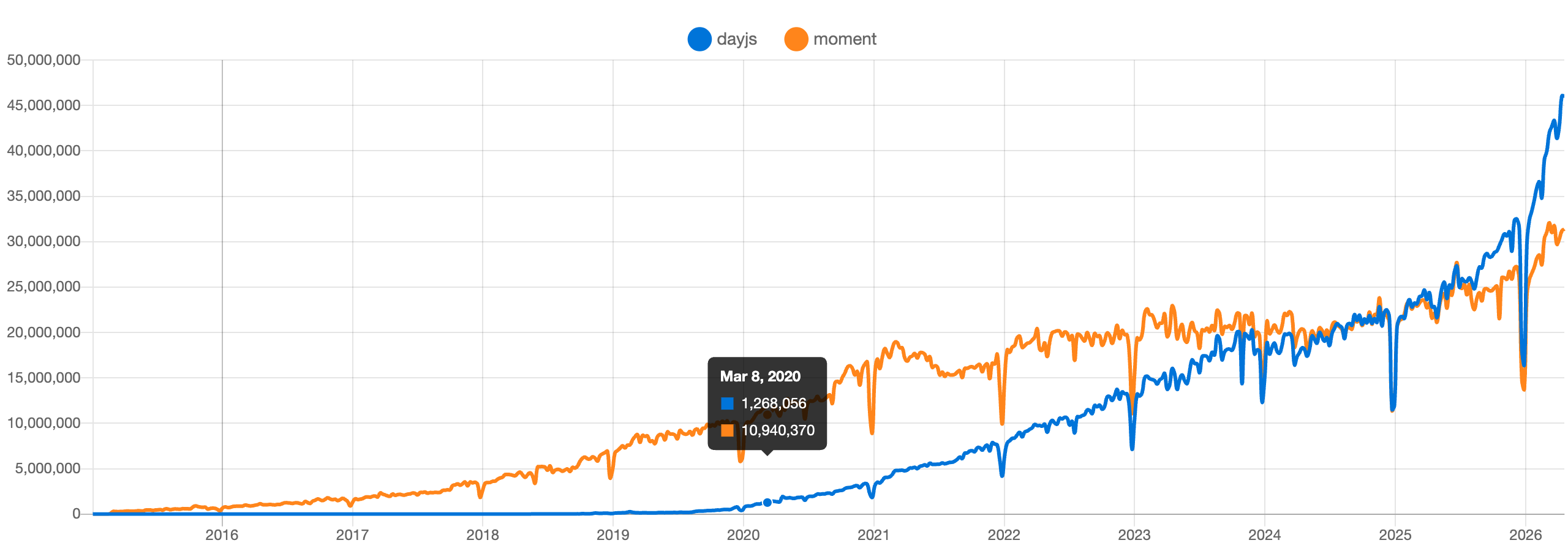
Npm Package Weekly Downloads Trend
Stat Detail


Day.js vs Moment.js: Architecture, Immutability, and Maintenance
Both dayjs and moment solve the same fundamental problem: native JavaScript Date objects are difficult to work with. They lack easy formatting, reliable parsing, and intuitive manipulation methods. While moment defined the standard for over a decade, dayjs has become the preferred choice for modern development. Let's compare how they handle core engineering challenges.
🛑 Maintenance Status: Active Development vs Maintenance Mode
This is the most critical factor for architectural decisions today.
dayjs is actively developed.
- New features and bug fixes are released regularly.
- The community is growing, and it is recommended by the
momentteam itself for new projects.
// dayjs: Actively maintained
import dayjs from 'dayjs';
// Safe to use in production for new applications
console.log(dayjs().format());
moment is in maintenance mode.
- No new features are being added.
- The team explicitly advises against using it for new projects due to bundle size and architectural limitations.
// moment: Maintenance mode only
import moment from 'moment';
// Avoid for new development; use only for legacy support
console.log(moment().format());
🔄 Data Handling: Immutable vs Mutable
How the library handles state changes affects how you write logic and debug errors.
dayjs uses immutable objects.
- Every manipulation returns a new instance.
- The original date object never changes, preventing accidental side effects.
// dayjs: Immutable
const original = dayjs('2023-01-01');
const nextDay = original.add(1, 'day');

console.log(original.format()); // 2023-01-01 (Unchanged)
console.log(nextDay.format());  // 2023-01-02 (New instance)
moment uses mutable objects.
- Methods like
addorsubtractchange the original object. - You must clone the object manually if you want to keep the original value.
// moment: Mutable
const original = moment('2023-01-01');
const nextDay = original.clone().add(1, 'day');

// If you forget .clone(), original changes too
const mutated = moment('2023-01-01');
mutated.add(1, 'day');
console.log(mutated.format()); // 2023-01-02 (Original changed)
📦 Architecture: Plugin System vs Monolithic
The way features are included impacts your application's bundle size.
dayjs is modular with a plugin system.
- The core is tiny (around 2KB).
- You only import features you need, like UTC or Timezone support.
// dayjs: Plugin-based
import dayjs from 'dayjs';
import utc from 'dayjs/plugin/utc';

dayjs.extend(utc); // Enable UTC only if needed
console.log(dayjs().utc().format());
moment is monolithic with optional addons.
- The core library is large (over 60KB without tree-shaking).
- Features like locales and timezone support often come bundled or require heavy addons.
// moment: Monolithic
import moment from 'moment';
import 'moment-timezone'; // Heavy addon for timezone support

console.log(moment.tz('America/New_York').format());
📅 Parsing and Formatting
Both libraries offer similar APIs for reading and displaying dates, which makes migration easier.
dayjs parses strings similarly to moment.
- Supports ISO strings by default.
- Custom formats require the
customParseFormatplugin.
// dayjs: Parsing
import dayjs from 'dayjs';
import customParseFormat from 'dayjs/plugin/customParseFormat';
dayjs.extend(customParseFormat);

const date = dayjs('01-25-2023', 'MM-DD-YYYY');
console.log(date.format('YYYY-MM-DD')); // 2023-01-25
moment handles custom formats out of the box.
- More flexible by default without extra plugins.
- Syntax is nearly identical to
dayjs.
// moment: Parsing
import moment from 'moment';

const date = moment('01-25-2023', 'MM-DD-YYYY');
console.log(date.format('YYYY-MM-DD')); // 2023-01-25
🌍 Timezone Handling
Handling timezones correctly is essential for global applications.
dayjs requires the timezone plugin.
- Keeps core small but adds a step to enable functionality.
- API is clean once the plugin is loaded.
// dayjs: Timezone
import dayjs from 'dayjs';
import timezone from 'dayjs/plugin/timezone';
dayjs.extend(timezone);

console.log(dayjs().tz('America/New_York').format());
moment uses moment-timezone.
- A separate, heavy library that must be installed.
- API is well-established but adds significant weight.
// moment: Timezone
import moment from 'moment-timezone';

console.log(moment().tz('America/New_York').format());
🤝 Similarities: Shared Ground Between Day.js and Moment
Despite the architectural differences, the developer experience is intentionally similar.
1. 📝 Chainable API
- Both allow chaining methods for readable code.
- Makes complex date logic easy to follow.
// dayjs: Chaining
dayjs().add(1, 'month').subtract(1, 'day').format();

// moment: Chaining
moment().add(1, 'month').subtract(1, 'day').format();
2. 🔍 Query Methods
- Both provide boolean checks like
isBefore,isAfter,isSame. - Syntax is almost identical.
// dayjs: Comparison
dayjs().isAfter('2023-01-01');

// moment: Comparison
moment().isAfter('2023-01-01');
3. 🌐 Locale Support
- Both support internationalization.
dayjsloads locales via plugins;momentincludes them or loads on demand.
// dayjs: Locale
import 'dayjs/locale/es';
dayjs.locale('es');

// moment: Locale
moment.locale('es');
📊 Summary: Key Differences
| Feature | dayjs | moment |
|---|---|---|
| Status | ✅ Active Development | ⚠️ Maintenance Mode |
| Mutability | 🛡️ Immutable (Safe) | 🔄 Mutable (Risk of side effects) |
| Bundle Size | 🪶 Tiny (~2KB core) | 🐘 Large (~60KB+) |
| Extensibility | 🧩 Plugin System | 📦 Monolithic + Addons |
| Parsing | 🔌 Plugin for custom formats | ✅ Built-in custom formats |
| Recommendation | 🚀 Use for New Projects | 🕰️ Legacy Only |
💡 The Big Picture
dayjs is the modern standard 🚀. It fixes the architectural flaws of moment by enforcing immutability and keeping the bundle size small through plugins. It is the right choice for any new frontend or Node.js application where performance and maintainability matter.
moment is a legacy tool 🕰️. It served the community well for years, but its mutable nature and heavy size make it unsuitable for modern web development. Only use it if you are stuck maintaining older code that cannot be refactored yet.
Final Thought: The API similarity makes migrating from moment to dayjs straightforward. If you are starting fresh, there is no technical reason to choose moment over dayjs in 2024 and beyond.
How to Choose: dayjs vs moment
- dayjs:
Choose
dayjsfor all new projects. It offers a modern, immutable architecture that prevents accidental side effects, and its plugin system keeps the core bundle small. It is actively maintained and designed to be a drop-in replacement for mostmomentuse cases without the baggage. - moment:
Choose
momentonly if you are maintaining an existing legacy codebase that already depends on it. Do not start new projects withmomentbecause it is in maintenance mode, meaning no new features or major improvements will be added, and it is significantly heavier than modern alternatives.
Popular Comparisons
README for dayjs
English | 简体中文 | 日本語 | Português Brasileiro | 한국어 | Español (España) | Русский | Türkçe | සිංහල | עברית

Fast 2kB alternative to Moment.js with the same modern API






Day.js is a minimalist JavaScript library that parses, validates, manipulates, and displays dates and times for modern browsers with a largely Moment.js-compatible API. If you use Moment.js, you already know how to use Day.js.
dayjs().startOf('month').add(1, 'day').set('year', 2018).format('YYYY-MM-DD HH:mm:ss');
- 🕒 Familiar Moment.js API & patterns
- 💪 Immutable
- 🔥 Chainable
- 🌐 I18n support
- 📦 2kb mini library
- 👫 All browsers supported
Getting Started
Documentation
You can find more details, API, and other docs on day.js.org website.
Installation
npm install dayjs --save
API
It's easy to use Day.js APIs to parse, validate, manipulate, and display dates and times.
dayjs('2018-08-08') // parse

dayjs().format('{YYYY} MM-DDTHH:mm:ss SSS [Z] A') // display

dayjs().set('month', 3).month() // get & set

dayjs().add(1, 'year') // manipulate

dayjs().isBefore(dayjs()) // query
I18n
Day.js has great support for internationalization.
But none of them will be included in your build unless you use them.
import 'dayjs/locale/es' // load on demand

dayjs.locale('es') // use Spanish locale globally

dayjs('2018-05-05').locale('zh-cn').format() // use Chinese Simplified locale in a specific instance
Plugin
A plugin is an independent module that can be added to Day.js to extend functionality or add new features.
import advancedFormat from 'dayjs/plugin/advancedFormat' // load on demand

dayjs.extend(advancedFormat) // use plugin

dayjs().format('Q Do k kk X x') // more available formats
Downloads
Sponsors
Support this project by becoming a sponsor. Your logo will show up here with a link to your website.
[Become a sponsor via Github] [Become a sponsor via OpenCollective]







Contributors
This project exists thanks to all the people who contribute.
Please give us a 💖 star 💖 to support us. Thank you.
And thank you to all our backers! 🙏

License
Day.js is licensed under a MIT License.