Selecting User Input Components in React Native
@react-native-picker/picker and react-native-dropdown-picker both handle single-selection inputs in React Native apps, but they solve the problem in fundamentally different ways. @react-native-picker/picker is a community-maintained wrapper around the native iOS and Android picker components, offering a look and feel that matches the operating system. react-native-dropdown-picker is a fully customizable JavaScript-based component that draws its own dropdown interface, allowing for consistent styling across platforms but requiring more manual state management.
Npm Package Weekly Downloads Trend
Github Stars Ranking
Stat Detail


Native Pickers vs Custom Dropdowns in React Native
Both @react-native-picker/picker and react-native-dropdown-picker handle single-selection inputs in React Native apps, but they work differently under the hood. One relies on the operating system's built-in controls, while the other draws its own interface using JavaScript. Let's compare how they tackle common development problems.
🖥️ Core Rendering Engine: Native Views vs JavaScript
@react-native-picker/picker renders actual native UI components.
- On iOS, it uses
UIPickerView. - On Android, it uses
SpinnerorDialogdepending on the mode. - This ensures the component feels exactly like other system apps.
// @react-native-picker/picker: Native rendering
import { Picker } from '@react-native-picker/picker';

<Picker
  selectedValue={selectedValue}
  onValueChange={(itemValue) => setSelectedValue(itemValue)}
>
  <Picker.Item label="Apple" value="apple" />
  <Picker.Item label="Banana" value="banana" />
</Picker>
react-native-dropdown-picker draws the UI using React Native views.
- It builds the dropdown list using
View,Text, andTouchableOpacity. - This allows full control over colors, fonts, and layout.
- It looks the same on both iOS and Android unless you style it differently.
// react-native-dropdown-picker: JS rendering
import DropDownPicker from 'react-native-dropdown-picker';

<DropDownPicker
  open={open}
  value={value}
  items={items}
  setOpen={setOpen}
  setValue={setValue}
  setItems={setItems}
/>
🧠 State Management: Simple Props vs Complex Hooks
@react-native-picker/picker uses a simple controlled model.
- You only track the selected value.
- The internal list state is managed by the component itself.
- Less boilerplate code is required for basic usage.
// @react-native-picker/picker: Simple state
const [selectedValue, setSelectedValue] = useState('apple');

<Picker selectedValue={selectedValue} onValueChange={setSelectedValue}>
  <Picker.Item label="Apple" value="apple" />
</Picker>
react-native-dropdown-picker requires multiple state variables.
- You must track the open state, the selected value, and the list of items.
- This gives you dynamic control over the list but adds complexity.
- Forgetting one setter can break the dropdown behavior.
// react-native-dropdown-picker: Complex state
const [open, setOpen] = useState(false);
const [value, setValue] = useState(null);
const [items, setItems] = useState([
  { label: 'Apple', value: 'apple' },
  { label: 'Banana', value: 'banana' }
]);

<DropDownPicker open={open} value={value} items={items} setOpen={setOpen} setValue={setValue} setItems={setItems} />
🎨 Customization and Styling: Limited vs Full Control
@react-native-picker/picker has limited styling options.
- You can change colors and fonts to a degree.
- You cannot easily change the dropdown arrow or the modal background.
- The component respects system dark mode automatically.
// @react-native-picker/picker: Limited style props
<Picker
  style={{ height: 50, width: 200 }}
  dropdownIconColor="blue"
  dropdownIconRippleColor="red"
>
  <Picker.Item label="Apple" value="apple" color="green" />
</Picker>
react-native-dropdown-picker allows deep customization.
- You can style the container, label, arrow, and list items.
- You can add icons to items or change the checkmark style.
- This is better for matching strict brand guidelines.
// react-native-dropdown-picker: Deep customization
<DropDownPicker
  open={open}
  value={value}
  items={items}
  setOpen={setOpen}
  setValue={setValue}
  setItems={setItems}
  containerStyle={{ height: 40 }}
  style={{ backgroundColor: '#fafafa' }}
  dropDownContainerStyle={{ backgroundColor: '#eee' }}
/>
📱 Platform Behavior: System Dialogs vs Consistent Modals
@react-native-picker/picker adapts to each platform.
- iOS shows a wheel picker at the bottom or inline.
- Android shows a spinner or a system dialog modal.
- Users get the interaction they expect on their device.
// @react-native-picker/picker: Platform specific mode
<Picker
  mode="dialog" // Android only: forces dialog mode
  selectedValue={selectedValue}
  onValueChange={setSelectedValue}
>
  <Picker.Item label="Apple" value="apple" />
</Picker>
react-native-dropdown-picker behaves consistently everywhere.
- The dropdown opens the same way on iOS and Android.
- You avoid surprises where users see different UIs on different phones.
- You must handle z-index issues manually on Android sometimes.
// react-native-dropdown-picker: Consistent behavior
<DropDownPicker
  open={open}
  value={value}
  items={items}
  setOpen={setOpen}
  setValue={setValue}
  setItems={setItems}
  zIndex={3000} // Manual z-index management required
  zIndexInverse={1000}
/>
🌱 When Not to Use These
These components are great for single selection, but consider alternatives when:
- You need multi-select functionality: Use
@react-native-picker/picker(limited) or a dedicated multi-select library instead. - You need searchable lists with thousands of items:
react-native-dropdown-pickersupports search, but@react-native-picker/pickerdoes not. - Your app requires accessibility compliance: Native pickers often have better built-in screen reader support than custom JS components.
📌 Summary Table
| Feature | @react-native-picker/picker | react-native-dropdown-picker |
|---|---|---|
| Rendering | 📱 Native OS Components | 🎨 JavaScript Views |
| State Management | 🟢 Simple (Value only) | 🟠 Complex (Open, Value, Items) |
| Customization | 🔒 Limited to system styles | 🔓 Full control over UI |
| Platform Feel | 🍏 iOS / 🤖 Android differ | 🌍 Consistent across platforms |
| Search Support | ❌ No | ✅ Yes |
| Maintenance | 🛡️ Official Community Module | 🛠️ Third-Party Library |
💡 Final Recommendation
@react-native-picker/picker is like the standard tool kit 🔧—it works out of the box, feels native, and rarely breaks when you update React Native. Ideal for internal tools, settings screens, and forms where speed and stability matter more than unique branding.
react-native-dropdown-picker is like a custom design kit 🎨—perfect for consumer-facing apps where every pixel must match your brand guide. It shines when you need search functionality or a specific interaction model that native components do not support.
Final Thought: Despite their differences, both packages aim to solve the same problem: letting users choose one option from a list. Choose based on whether you prioritize native stability or design flexibility.
How to Choose: @react-native-picker/picker vs react-native-dropdown-picker
- @react-native-picker/picker:
Choose
@react-native-picker/pickerwhen you want the standard native experience, need maximum stability with OS updates, and do not require heavy visual customization. It is the safest bet for forms that need to feel like part of the OS and works well for simple selection tasks where platform consistency is less critical than native performance. - react-native-dropdown-picker:
Choose
react-native-dropdown-pickerwhen your design system requires a specific look that differs from the native picker, or when you need features like search inside the dropdown. It is suitable for projects where brand consistency across iOS and Android outweighs native feel, and your team can manage the additional state complexity.
Popular Comparisons
README for @react-native-picker/picker
@react-native-picker/picker





| Android | iOS | PickerIOS |
|---|---|---|
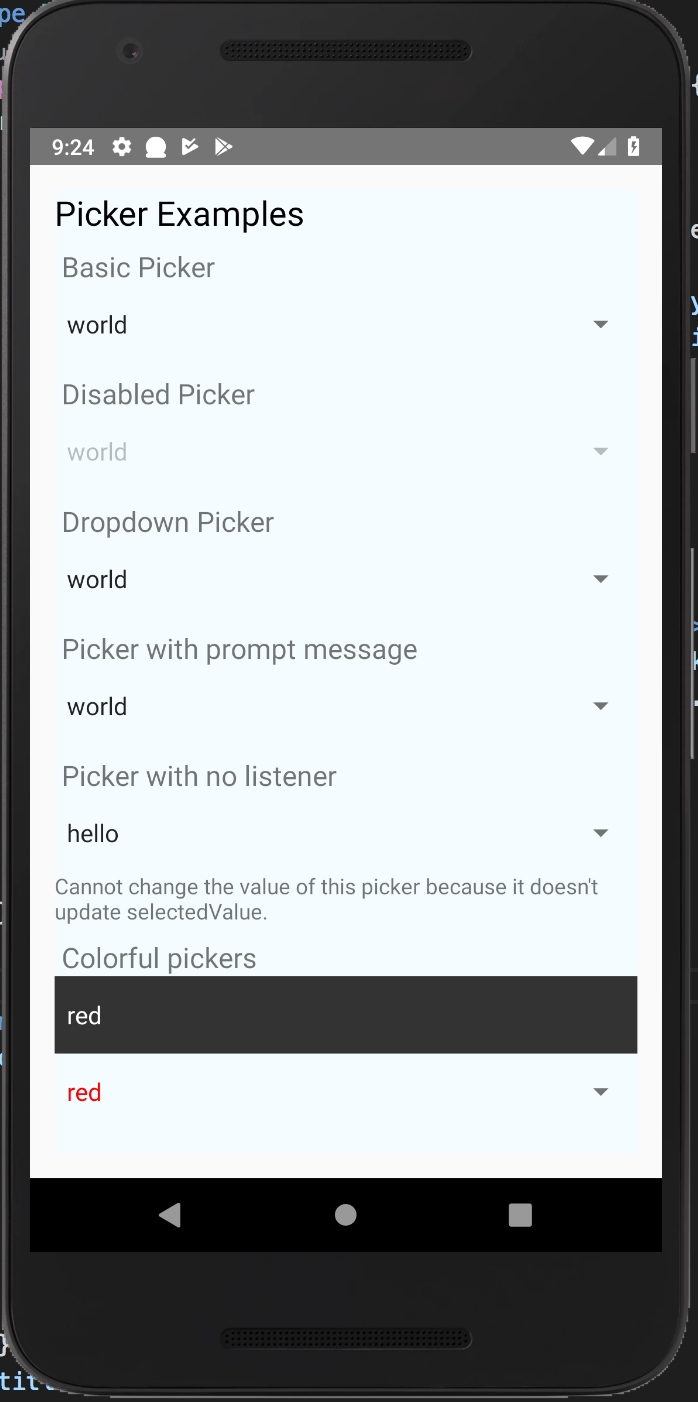 | 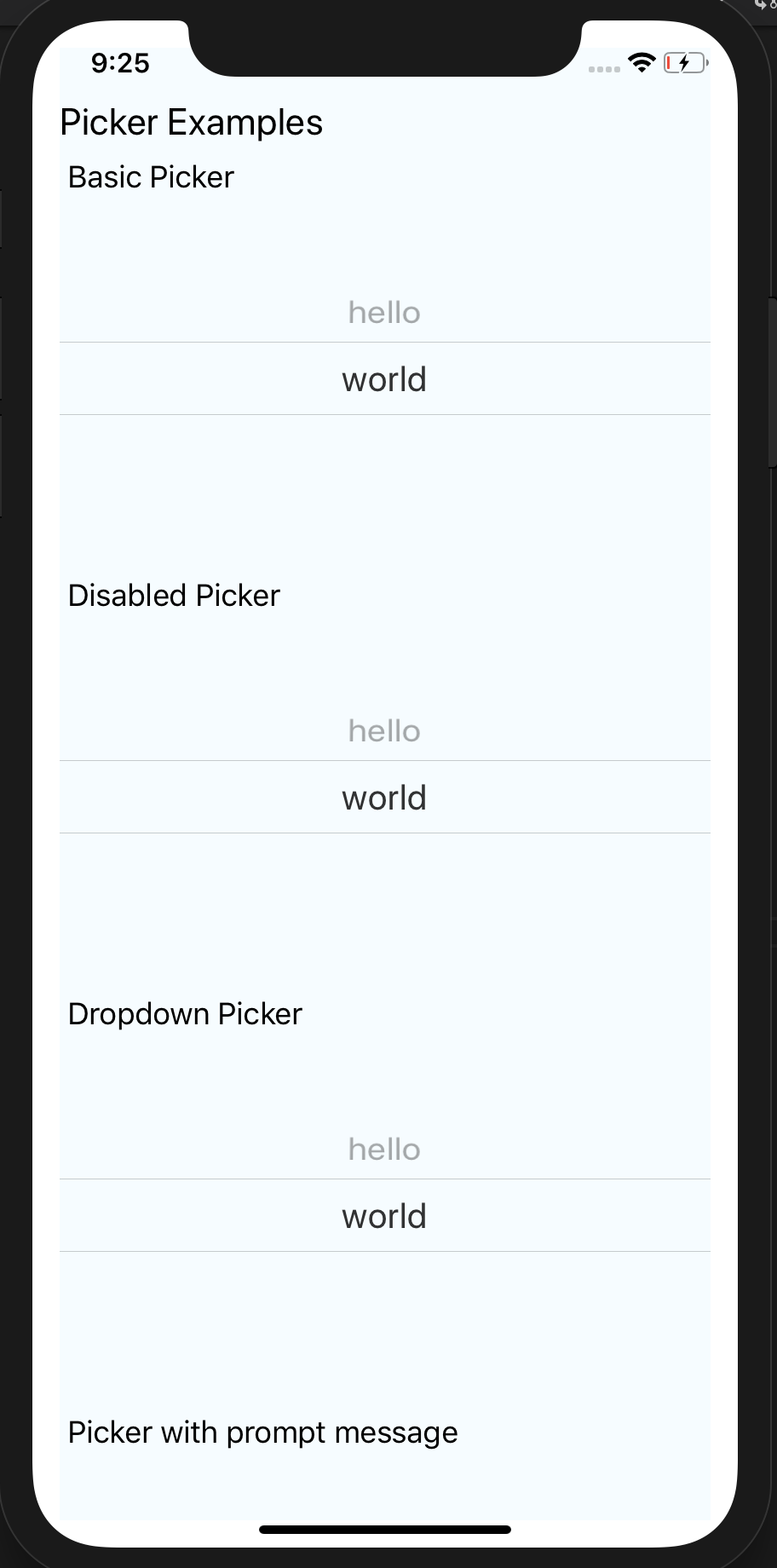 | 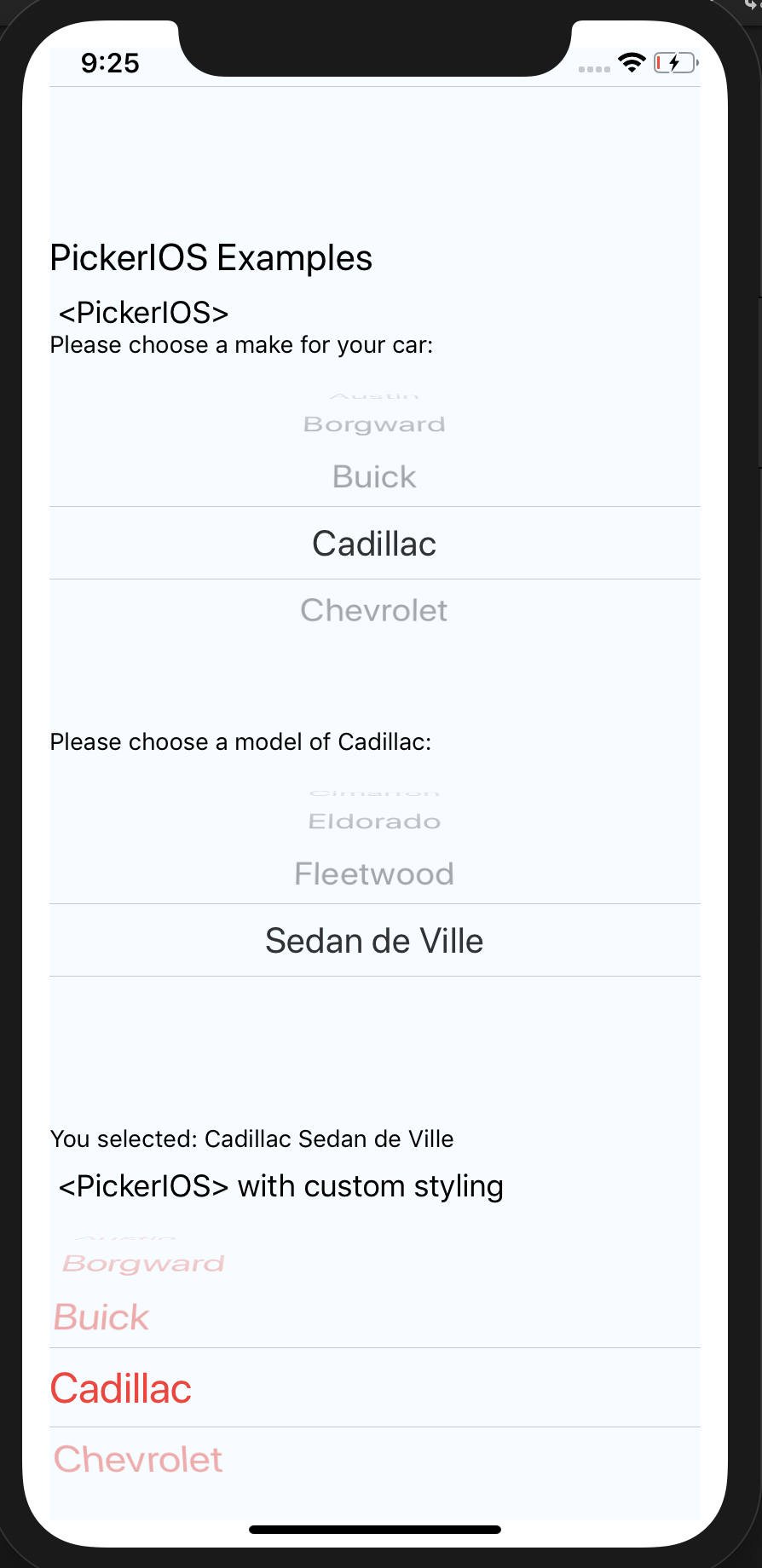 |
| Windows | MacOS |
|---|---|
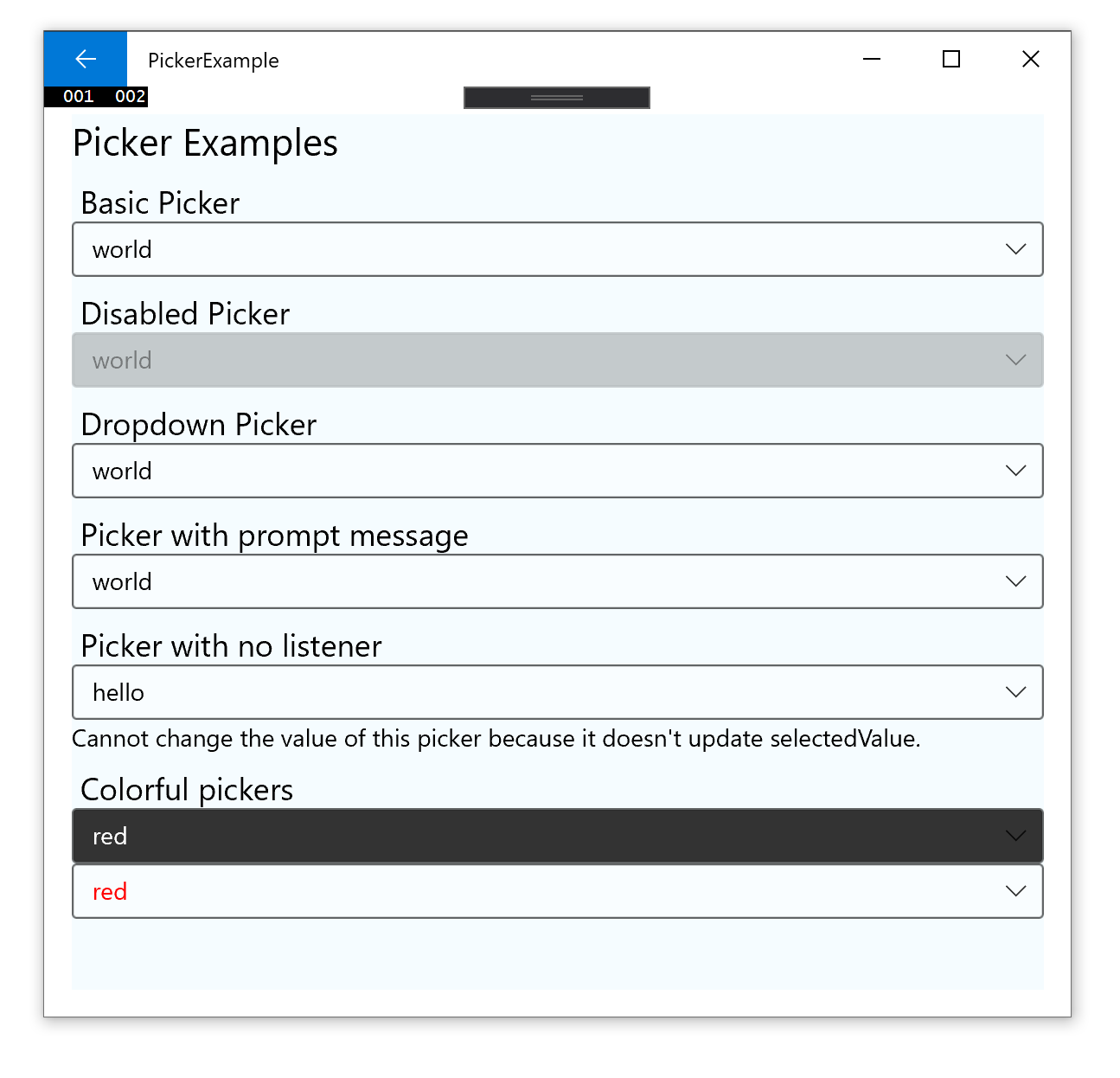 | 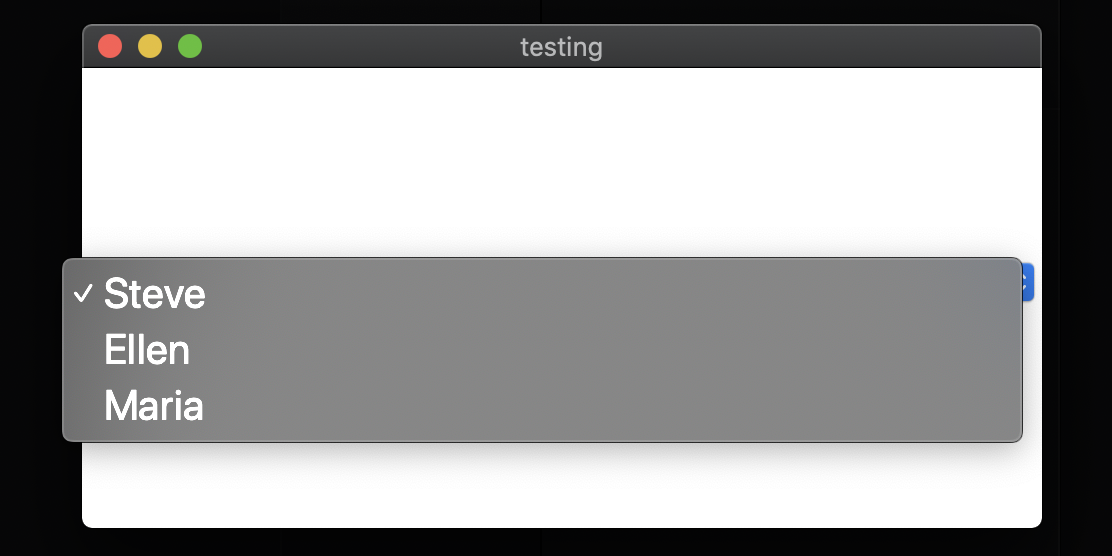 |
Supported Versions
| @react-native-picker/picker | react-native | react-native-windows |
|---|---|---|
| >= 2.0.0 | 0.61+ | 0.64+ |
| >= 1.16.0 | 0.61+ | 0.61+ |
| >= 1.2.0 | 0.60+ or 0.59+ with Jetifier | N/A |
| >= 1.0.0 | 0.57 | N/A |
Getting started
$ npm install @react-native-picker/picker --save
or
$ yarn add @react-native-picker/picker
For React Native v0.60 and above (Autolinking)
As react-native@0.60 and above supports autolinking there is no need to run the linking process.
Read more about autolinking here. This is supported by react-native-windows@0.64 and above.
iOS
CocoaPods on iOS needs this extra step:
npx pod-install
Android
No additional step is required.
Windows (expand for details)
Windows
Usage in Windows without autolinking requires the following extra steps:
Add the ReactNativePicker project to your solution.
- Open the solution in Visual Studio 2019
- Right-click Solution icon in Solution Explorer > Add > Existing Project
Select
D:\dev\RNTest\node_modules\@react-native-picker\picker\windows\ReactNativePicker\ReactNativePicker.vcxproj
windows/myapp.sln
Add a reference to ReactNativePicker to your main application project. From Visual Studio 2019:
Right-click main application project > Add > Reference...
Check ReactNativePicker from Solution Projects.
app.cpp
Add #include "winrt/ReactNativePicker.h" to the headers included at the top of the file.
Add PackageProviders().Append(winrt::ReactNativePicker::ReactPackageProvider()); before InitializeComponent();.
MacOS
CocoaPods on MacOS needs this extra step (called from the MacOS directory)
pod install
React Native below 0.60 (Link and Manual Installation)
The following steps are only necessary if you are working with a version of React Native lower than 0.60
Mostly automatic installation
$ react-native link @react-native-picker/picker
Manual installation
iOS
- In XCode, in the project navigator, right click
Libraries➜Add Files to [your project's name] - Go to
node_modules➜@react-native-picker/pickerand addRNCPicker.xcodeproj - In XCode, in the project navigator, select your project. Add
libRNCPicker.ato your project'sBuild Phases➜Link Binary With Libraries - Run your project (
Cmd+R)<
Android
- Open application file (
android/app/src/main/java/[...]/MainApplication.java)
- Add
import com.reactnativecommunity.picker.RNCPickerPackage;to the imports at the top of the file - Add
new RNCPickerPackage()to the list returned by thegetPackages()method
- Append the following lines to
android/settings.gradle:include ':@react-native-picker_picker' project(':@react-native-picker_picker').projectDir = new File(rootProject.projectDir, '../node_modules/@react-native-picker/picker/android') - Insert the following lines inside the dependencies block in
android/app/build.gradle:implementation project(path: ':@react-native-picker_picker')
MacOS
- In XCode, in the project navigator, right click
Libraries➜Add Files to [your project's name] - Go to
node_modules➜@react-native-picker/pickerand addRNCPicker.xcodeproj - In XCode, in the project navigator, select your project. Add
libRNCPicker.ato your project'sBuild Phases➜Link Binary With Libraries - Run your project (
Cmd+R)<
RTL Support
you need to add android:supportsRtl="true" to AndroidManifest.xml
   <application
      ...
      android:supportsRtl="true">
Usage
Import Picker from @react-native-picker/picker:
import {Picker} from '@react-native-picker/picker';
Create state which will be used by the Picker:
const [selectedLanguage, setSelectedLanguage] = useState();
Add Picker like this:
<Picker
  selectedValue={selectedLanguage}
  onValueChange={(itemValue, itemIndex) =>
    setSelectedLanguage(itemValue)
  }>
  <Picker.Item label="Java" value="java" />
  <Picker.Item label="JavaScript" value="js" />
</Picker>
If you want to open/close picker programmatically on android (available from version 1.16.0+), pass ref to Picker:
const pickerRef = useRef();

function open() {
  pickerRef.current.focus();
}

function close() {
  pickerRef.current.blur();
}

return <Picker
  ref={pickerRef}
  selectedValue={selectedLanguage}
  onValueChange={(itemValue, itemIndex) =>
    setSelectedLanguage(itemValue)
  }>
  <Picker.Item label="Java" value="java" />
  <Picker.Item label="JavaScript" value="js" />
</Picker>
Props
Reference
Props
onValueChange
Callback for when an item is selected. This is called with the following parameters:
itemValue: thevalueprop of the item that was selecteditemPosition: the index of the selected item in this picker
| Type | Required |
|---|---|
| function | No |
selectedValue
Value matching value of one of the items. Can be a string or an integer.
| Type | Required |
|---|---|
| any | No |
style
| Type | Required |
|---|---|
| pickerStyleType | No |
testID
Used to locate this view in end-to-end tests.
| Type | Required |
|---|---|
| string | No |
enabled
If set to false, the picker will be disabled, i.e. the user will not be able to make a selection.
| Type | Required | Platform |
|---|---|---|
| bool | No | Android, Web, Windows |
mode
On Android, specifies how to display the selection items when the user taps on the picker:
- 'dialog': Show a modal dialog. This is the default.
- 'dropdown': Shows a dropdown anchored to the picker view
| Type | Required | Platform |
|---|---|---|
| enum('dialog', 'dropdown') | No | Android |
dropdownIconColor
On Android, specifies color of dropdown triangle. Input value should be value that is accepted by react-native processColor function.
| Type | Required | Platform |
|---|---|---|
| ColorValue | No | Android |
dropdownIconRippleColor
On Android, specifies ripple color of dropdown triangle. Input value should be value that is accepted by react-native processColor function.
| Type | Required | Platform |
|---|---|---|
| ColorValue | No | Android |
prompt
Prompt string for this picker, used on Android in dialog mode as the title of the dialog.
| Type | Required | Platform |
|---|---|---|
| string | No | Android |
itemStyle
Style to apply to each of the item labels.
| Type | Required | Platform |
|---|---|---|
| text styles | No | iOS, Windows |
numberOfLines
On Android & iOS, used to truncate the text with an ellipsis after computing the text layout, including line wrapping, such that the total number of lines does not exceed this number. Default is '1'
| Type | Required | Platform |
|---|---|---|
| number | No | Android, iOS |
onBlur
| Type | Required | Platform |
|---|---|---|
| function | No | Android |
onFocus
| Type | Required | Platform |
|---|---|---|
| function | No | Android |
selectionColor
| Type | Required | Platform |
|---|---|---|
| ColorValue | No | iOS |
Methods
blur (Android only, lib version 1.16.0+)
Programmatically closes picker
focus (Android only, lib version 1.16.0+)
Programmatically opens picker
PickerItemProps
Props that can be applied to individual Picker.Item
label
Displayed value on the Picker Item
| Type | Required |
|---|---|
| string | Yes |
value
Actual value on the Picker Item
| Type | Required |
|---|---|
| number,string | Yes |
color
Displayed color on the Picker Item
| Type | Required |
|---|---|
| ColorValue | No |
fontFamily
Displayed fontFamily on the Picker Item
| Type | Required |
|---|---|
| string | No |
style
Style to apply to individual item labels.
| Type | Required | Platform |
|---|---|---|
| ViewStyleProp | No | Android |
enabled
If set to false, the specific item will be disabled, i.e. the user will not be able to make a selection
@default: true
| Type | Required | Platform |
|---|---|---|
| boolean | No | Android |
contentDescription
Sets the content description to the Picker Item
| Type | Required | Platform |
|---|---|---|
| string | No | Android |
PickerIOS
Props
Reference
Props
itemStyle
| Type | Required |
|---|---|
| text styles | No |
onValueChange
| Type | Required |
|---|---|
| function | No |
selectedValue
| Type | Required |
|---|---|
| any | No |
selectionColor
| Type | Required | Platform |
|---|---|---|
| ColorValue | No | iOS |
themeVariant
| Type | Required |
|---|---|
| enum('light', 'dark') | No |