Rich Text Editing Solutions for Modern Web Apps
ckeditor, froala-editor, quill, and tinymce are all JavaScript libraries designed to provide rich text editing capabilities within web applications. They allow users to format text, insert media, and manage content structure through a visual interface, similar to word processors. While they share the core goal of enabling content creation, they differ significantly in architecture, licensing models, customization depth, and how they handle document data. ckeditor (specifically version 5) and tinymce are mature, feature-complete suites often used in enterprise CMS environments. froala-editor is a commercial-focused editor known for its clean API and design. quill is an open-source, modular editor that prioritizes simplicity and API-driven content manipulation, often favored in product-led growth applications.
Npm Package Weekly Downloads Trend
Github Stars Ranking
Stat Detail


Rich Text Editors: CKEditor, Froala, Quill, and TinyMCE Compared
When adding a rich text editor to a web application, you are not just picking a UI component — you are choosing how your application stores and manages content. ckeditor, froala-editor, quill, and tinymce are the leading contenders, but they solve the problem in different ways. Let's look at how they handle initialization, content data, customization, and real-world integration.
🛠️ Initialization and Setup
How you get the editor on the page varies by library. Some rely on CDN scripts, while others offer npm packages that require bundler configuration.
ckeditor (version 5) uses a modular architecture. You often need to import a specific build or assemble your own.
// ckeditor: Classic build import
import ClassicEditor from '@ckeditor/ckeditor5-build-classic';

ClassicEditor
    .create( document.querySelector( '#editor' ) )
    .then( editor => {
        console.log( 'Editor initialized', editor );
    } )
    .catch( error => {
        console.error( error );
    } );
froala-editor requires jQuery in many standard setups, though modern versions support vanilla JS. It initializes directly on a selector.
// froala-editor: Basic init
import 'froala-editor/js/froala_editor.pkgd.min.js';

new FroalaEditor('#editor', {
    key: 'YOUR_LICENSE_KEY',
    toolbarButtons: ['bold', 'italic', 'underline']
});
quill is lightweight and initializes with a simple configuration object. It does not require jQuery.
// quill: Simple setup
import Quill from 'quill';

const quill = new Quill('#editor', {
    theme: 'snow',
    modules: {
        toolbar: [
            ['bold', 'italic', 'underline']
        ]
    }
});
tinymce offers a cloud script or an npm package. The npm approach gives more control over versioning.
// tinymce: NPM initialization
import tinymce from 'tinymce/tinymce';
import 'tinymce/themes/silver/theme';
import 'tinymce/icons/default/icons';

tinymce.init({
    selector: '#editor',
    plugins: 'lists link',
    toolbar: 'bold italic'
});
📄 Data Handling: HTML vs Delta vs Model
The way these editors store content is the most critical architectural decision. It affects how you save data to your database and how you render it later.
ckeditor works with an internal model that converts to HTML for output. It focuses on semantic HTML output.
// ckeditor: Getting data
editor.getData().then( data => {
    // Returns HTML string: '<p>Hello World</p>'
    console.log( data );
});

// ckeditor: Setting data
editor.setData( '<p>New content</p>' );
froala-editor primarily works with HTML strings. It is designed to be WYSIWYG, meaning what you see is what you get in the DOM.
// froala-editor: Getting data
const html = editor.html.get();
// Returns HTML string

// froala-editor: Setting data
editor.html.set('<p>New content</p>');
quill uses a custom JSON format called "Delta" internally, though it can output HTML. Delta is better for tracking changes programmatically.
// quill: Getting content (Delta)
const delta = quill.getContents();
// Returns object: { ops: [{ insert: 'Hello' }] }

// quill: Getting content (HTML)
const html = quill.root.innerHTML;

// quill: Setting content
quill.setContents(delta);
tinymce is HTML-centric. It processes content through its schema engine to clean and standardize HTML.
// tinymce: Getting data
const content = tinymce.activeEditor.getContent();
// Returns HTML string

// tinymce: Setting data
tinymce.activeEditor.setContent('<p>New content</p>');
🎨 Customization and Toolbars
Developers often need to change which buttons appear or add custom functionality. The flexibility here varies.
ckeditor uses a configuration object to define toolbar items. It supports custom plugins but requires a build step for deep changes.
// ckeditor: Toolbar config
ClassicEditor
    .create( document.querySelector( '#editor' ), {
        toolbar: [ 'heading', '|', 'bold', 'italic', 'link' ]
    } );
froala-editor allows detailed toolbar customization via arrays. It is known for having a very clean default UI.
// froala-editor: Toolbar config
new FroalaEditor('#editor', {
    toolbarButtons: {
        moreText: {
            buttons: ['bold', 'italic', 'underline']
        }
    }
});
quill handles toolbar configuration through the modules object. You can even use a custom HTML container for the toolbar.
// quill: Toolbar config
const quill = new Quill('#editor', {
    modules: {
        toolbar: [
            [{ 'header': [1, 2, false] }],
            ['bold', 'italic', 'link']
        ]
    }
});
tinymce uses a string-based or array-based configuration for the toolbar. It supports extensive plugin integration.
// tinymce: Toolbar config
tinymce.init({
    selector: '#editor',
    toolbar: 'undo redo | formatselect | bold italic',
    menubar: 'file edit view insert'
});
🔌 Extensibility and Plugins
When the built-in features are not enough, you need to know how easy it is to add more.
ckeditor has a massive ecosystem. Adding a plugin often requires installing an npm package and adding it to the build configuration.
// ckeditor: Adding plugin (conceptual build config)
// In webpack.config.js or similar
// You must include the plugin in the build bundle
import Table from '@ckeditor/ckeditor5-table';

// Then enable in config
config.plugins = [ Table, ... ];
froala-editor offers many plugins, but most are part of the paid license. You include them via imports.
// froala-editor: Importing plugins
import 'froala-editor/js/plugins/align.min.js';
import 'froala-editor/js/plugins/lists.min.js';

// Initialize after imports
new FroalaEditor('#editor');
quill relies on modules. You can register custom formats or blot (their term for content nodes) to extend functionality.
// quill: Registering a custom format
import Quill from 'quill';
const Block = Quill.import('blots/block');

class MyBlot extends Block {}
MyBlot.blotName = 'my-blot';
MyBlot.tagName = 'div';

Quill.register(MyBlot);
tinymce has a large marketplace of plugins. Some are free, some are premium. You list them in the plugins option.
// tinymce: Enabling plugins
tinymce.init({
    selector: '#editor',
    plugins: 'table code image',
    toolbar: 'table code image'
});
⚠️ Licensing and Cost Considerations
This is often the deciding factor for engineering managers.
ckeditor: Offers an open-source GPL version, but commercial features (like collaboration or export to PDF) require a paid license. The npm packageckeditor5is free, but check specific feature licenses.froala-editor: Commercial only. You must buy a license for production use. There is no free tier for commercial apps.quill: Fully open-source (BSD-3-Clause). No licensing fees for any feature.tinymce: Open-source core (GPL), but premium plugins and cloud hosting require a subscription. The npm packagetinymceis the community version.
🌐 Real-World Integration Scenarios
Scenario 1: Enterprise CMS
You need track changes, comments, and robust table editing.
- ✅ Best choice:
ckeditorortinymce(Premium) - Why? These features are built-in and stable.
quillwould require significant custom development to match this.
Scenario 2: SaaS Comment Section
You need a lightweight editor for user comments with basic formatting.
- ✅ Best choice:
quill - Why? It is free, lightweight, and the Delta format makes it easy to store and render comments efficiently without heavy HTML sanitization issues.
Scenario 3: Marketing Site Builder
You need a polished UI that looks good immediately with minimal CSS work.
- ✅ Best choice:
froala-editor - Why? The default styling is modern and clean. It reduces the time designers spend tweaking the editor's look.
Scenario 4: Legacy Migration
You are moving an old system that relies heavily on raw HTML content.
- ✅ Best choice:
tinymce - Why? It has excellent paste handling and HTML filtering, making it forgiving of messy content coming from Word or other editors.
📊 Summary: Key Differences
| Feature | ckeditor | froala-editor | quill | tinymce |
|---|---|---|---|---|
| License | GPL / Commercial | Commercial Only | Open Source (BSD) | GPL / Commercial |
| Data Format | HTML (Model-based) | HTML | Delta (JSON) + HTML | HTML |
| Setup Complexity | High (Build system) | Medium | Low | Low/Medium |
| UI Customization | Complex | Easy | Moderate | Easy |
| Best For | Enterprise/Collab | Polished SaaS | Product-led/Free | General Purpose |
💡 The Big Picture
ckeditor is the heavy lifter 🏋️. It handles complex document structures and collaboration better than the rest, but it demands more setup time.
froala-editor is the premium choice 💎. If you have budget and want a great UI without tweaking CSS, this is the path of least resistance.
quill is the developer favorite 🛠️. It is free, flexible, and treats content as data (Delta), which fits modern JavaScript app architectures well.
tinymce is the reliable standard 📰. It has been around for a long time, handles messy HTML well, and offers a good balance of features for most use cases.
Final Thought: Do not choose based on feature lists alone. Choose based on how you want to store content (HTML vs Delta) and your budget for licensing. A mismatch here causes technical debt later.
How to Choose: ckeditor vs froala-editor vs quill vs tinymce
- ckeditor:
Choose
ckeditorif you need a robust, enterprise-grade editor with strong collaboration features and extensive plugin support. It is ideal for complex content management systems where data integrity and advanced formatting (like tables and track changes) are critical. Be prepared for a steeper learning curve due to its modular build system. - froala-editor:
Choose
froala-editorif you prefer a commercial solution with a polished UI out of the box and straightforward integration. It works well for projects where budget allows for a license and you want to minimize time spent on styling or fixing cross-browser quirks. It is a strong fit for SaaS applications needing a reliable WYSIWYG experience. - quill:
Choose
quillif you need a lightweight, open-source editor that is easy to customize via its API. It is best for applications where you need to control the content format (like Delta operations) programmatically rather than just displaying HTML. Avoid it if you require complex features like advanced table editing or track changes without building them yourself. - tinymce:
Choose
tinymceif you want a balance between ease of use and powerful features with a long history of stability. It is suitable for projects that need a familiar Word-like interface and strong support for pasting from external sources. The cloud hosting option simplifies deployment, but self-hosting is also well-supported.
Popular Comparisons
README for ckeditor
CKEditor 4 


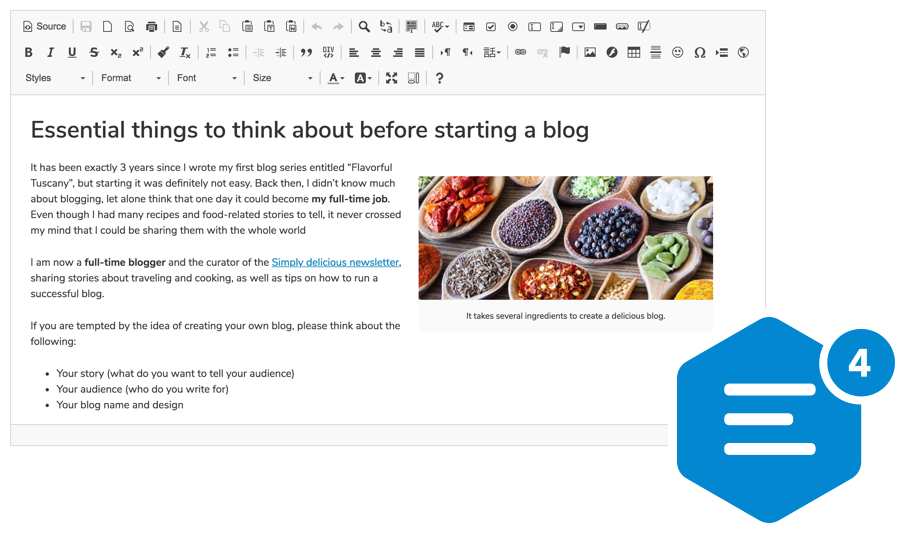
A highly configurable WYSIWYG HTML editor with hundreds of features, from creating rich text content with captioned images, videos, tables, or media embeds to pasting from Word and drag&drop image upload.
Supports a broad range of browsers, including legacy ones.
Getting Started
npm install --save ckeditor
Use it on your website:
<div id="editor">
    <p>This is the editor content.</p>
</div>
<script src="./node_modules/ckeditor/ckeditor.js"></script>
<script>
    CKEDITOR.replace( 'editor' );
</script>
You can also load CKEditor 4 using CDN.
Features
- Over 500 plugins in the Add-ons Repository.
- Pasting from Microsoft Word and Excel.
- Drag&drop image uploads.
- Media embeds to insert videos, tweets, maps, slideshows.
- Powerful clipboard integration.
- Content quality control with Advanced Content Filter.
- Extensible widget system.
- Custom table selection.
- Accessibility conforming to WCAG and Section 508.
- Over 60 localizations available with full RTL support.
Presets
The CKEditor 4 npm package comes in the standard-all preset, so it includes all official CKEditor plugins, with those from the standard package active by default.
Further Resources
- CKEditor 4 demo
- Documentation
- API documentation
- Configuration reference
- CKEditor SDK with more samples
If you are looking for CKEditor 5, here's a link to the relevant npm package: https://www.npmjs.com/package/ckeditor5
Browser Support
 IE / Edge |  Firefox |  Chrome | Chrome (Android) |  Safari |  iOS Safari |  Opera |
|---|---|---|---|---|---|---|
| IE8, IE9, IE10, IE11, Edge | latest version | latest version | latest version | latest version | latest version | latest version |
Find out more in the Browser Compatibility guide.
Contribute
If you would like to help maintain the project, follow the Contribution instructions.
License
Copyright (c) 2003-2018, CKSource - Frederico Knabben. All rights reserved.
For licensing, see LICENSE.md or https://ckeditor.com/legal/ckeditor-oss-license