Architectural Patterns in Rich Text Editing: Block-Based vs. ContentEditable
@editorjs/editorjs, ckeditor, quill, and tinymce are the leading solutions for integrating rich text editing into web applications, but they solve the problem with fundamentally different data models. @editorjs/editorjs utilizes a block-based architecture where content is stored as clean JSON, separating data from presentation entirely. In contrast, ckeditor, quill, and tinymce rely on the browser's contenteditable API to manipulate HTML directly, offering a more traditional "what you see is what you get" (WYSIWYG) experience. While ckeditor and tinymce are feature-heavy suites often used for enterprise document processing, quill focuses on being a lightweight, extensible library for standard text editing needs.
Npm Package Weekly Downloads Trend
Github Stars Ranking
Stat Detail


Architectural Patterns in Rich Text Editing: Block-Based vs. ContentEditable
When integrating rich text editing into a modern frontend application, the choice of library dictates not just the user interface, but the entire data flow of your content system. The four major contenders—@editorjs/editorjs, ckeditor, quill, and tinymce—split into two distinct architectural camps. Understanding this split is critical because it determines whether your backend stores clean JSON structures or sanitized HTML strings.
🏗️ Core Architecture: Blocks vs. HTML Strings
The most profound difference lies in how these libraries represent data internally. This decision impacts how you save, load, and render content on other devices.
@editorjs/editorjs rejects the traditional HTML approach. It treats every paragraph, list, or image as an independent "Block." The editor outputs a pure JSON object, keeping your database free of HTML tags and presentation logic.
// editorjs: Outputs structured JSON
const output = await editor.save();
/*
{
  "time": 1550476186479,
  "blocks": [
    {
      "type": "header",
      "data": {
        "text": "Welcome to our blog",
        "level": 2
      }
    },
    {
      "type": "paragraph",
      "data": {
        "text": "This is clean data without HTML tags."
      }
    }
  ]
}
*/
ckeditor, quill, and tinymce all rely on the browser's contenteditable attribute. They manipulate the DOM directly and typically output HTML strings (though some can serialize to JSON, HTML is their native tongue).
// ckeditor: Gets HTML content
const data = await editor.getData();
// Returns: "<h2>Welcome to our blog</h2><p>This is HTML content.</p>"

// quill: Gets HTML content
const html = quill.root.innerHTML;
// Returns: "<h2>Welcome to our blog</h2><p>This is HTML content.</p>"

// tinymce: Gets HTML content
const content = tinymce.get('my-editor').getContent();
// Returns: "<h2>Welcome to our blog</h2><p>This is HTML content.</p>"
🛠️ Initialization and Configuration
Setting up these editors reveals their philosophical differences. @editorjs/editorjs requires you to explicitly define which tools (blocks) are available, promoting a modular mindset. The others often come with a default toolbar that works out of the box.
@editorjs/editorjs demands a configuration object where you map tool names to their classes. This gives you fine-grained control over the bundle size and features.
// editorjs: Explicit tool registration
const editor = new EditorJS({
  holder: 'editorjs',
  tools: {
    header: Header,
    list: List,
    image: SimpleImage,
    quote: Quote
  },
  data: {
    blocks: [
      { type: 'header', data: { text: 'Hello World', level: 2 } }
    ]
  }
});
ckeditor uses a declarative class-based setup. You import the specific build or customize the editor via a configuration object that defines the toolbar layout.
// ckeditor: Classic build initialization
ClassicEditor
  .create(document.querySelector('#editor'), {
    toolbar: [ 'heading', '|', 'bold', 'italic', 'link', 'bulletedList', 'numberedList' ],
    heading: {
      options: [
        { model: 'paragraph', title: 'Paragraph', class: 'ck-heading_paragraph' },
        { model: 'heading1', view: 'h1', title: 'Heading 1', class: 'ck-heading_heading1' }
      ]
    }
  })
  .catch(error => console.error(error));
quill focuses on simplicity. You define a theme (like 'snow' for the default white toolbar) and pass a configuration object for modules.
// quill: Simple module configuration
const quill = new Quill('#editor', {
  theme: 'snow',
  modules: {
    toolbar: [
      [{ 'header': [1, 2, false] }],
      ['bold', 'italic', 'link'],
      [{ 'list': 'ordered'}, { 'list': 'bullet' }]
    ]
  }
});
tinymce often uses a global script tag or an npm import that scans the DOM for elements with a specific selector. Its configuration is highly granular, allowing deep customization of menus and plugins.
// tinymce: Init with selector and plugins
tinymce.init({
  selector: '#editor',
  plugins: 'lists link image table code help wordcount',
  toolbar: 'undo redo | formatselect | bold italic | alignleft aligncenter alignright | bullist numlist',
  content_style: 'body { font-family:Helvetica,Arial,sans-serif; font-size:14px }'
});
📝 Handling Content Changes
Listening for changes is essential for auto-saving drafts or validating input. The event systems vary slightly in what they pass to your callback.
@editorjs/editorjs provides an onChange callback that fires whenever the content changes. It doesn't pass the data directly to avoid performance hits; you must call save() inside the handler if you need the payload immediately.
// editorjs: onChange callback
const editor = new EditorJS({
  holder: 'editorjs',
  onChange: async (api, event) => {
    console.log('Content changed');
    // Must explicitly save to get data
    const output = await api.saver.save();
    saveToDatabase(output);
  }
});
ckeditor, quill, and tinymce use standard event emitters. They often provide the data or event context directly, making real-time validation straightforward.
// ckeditor: Change event
editor.model.document.on('change:data', () => {
  const data = editor.getData();
  validateContent(data);
});

// quill: Text-change event
quill.on('text-change', (delta, oldDelta, source) => {
  if (source === 'user') {
    const html = quill.root.innerHTML;
    autoSave(html);
  }
});

// tinymce: Keyup or Change event
tinymce.get('editor').on('change', (e) => {
  const content = e.target.getContent();
  updatePreview(content);
});
🧩 Extensibility: Custom Blocks vs. Blots vs. Plugins
No editor covers 100% of use cases out of the box. How you extend them determines long-term maintainability.
@editorjs/editorjs requires you to write a custom class implementing a specific interface (render, save, validate) to create a new block type. This is more work but ensures strict data consistency.
// editorjs: Custom Tool Class
class WarningTool {
  static get toolbox() {
    return { title: 'Warning', icon: '<svg>...</svg>' };
  }

  render() {
    this.wrapper = document.createElement('div');
    this.wrapper.classList.add('warning-block');
    return this.wrapper;
  }

  save(blockContent) {
    return { message: blockContent.innerText };
  }
}
quill uses a concept called "Blots" to extend content. You define a new blot class that extends Block or Inline, allowing you to insert custom DOM nodes that Quill manages safely.
// quill: Custom Blot
const Block = Quill.import('blots/block');

class VideoBlot extends Block {
  static create(url) {
    let node = super.create();
    node.setAttribute('src', url);
    node.setAttribute('width', '100%');
    return node;
  }
}

VideoBlot.blotName = 'video';
VideoBlot.tagName = 'iframe';
Quill.register(VideoBlot);
ckeditor and tinymce rely on plugin architectures. You typically write a plugin that hooks into the editor's lifecycle to add buttons, dialogs, or processing rules.
// tinymce: Custom Plugin Registration
tinymce.PluginManager.add('myplugin', function(editor) {
  editor.addButton('mybutton', {
    text: 'My Button',
    onclick: function() {
      editor.insertContent('Hello from custom plugin!');
    }
  });
});

// ckeditor: Custom Plugin (simplified structure)
export default function MyPlugin(editor) {
  editor.ui.componentFactory.add('myButton', () => {
    const button = createButton({
      label: 'My Button',
      execute: () => {
        editor.model.change(writer => {
          writer.insertText('Hello from CKEditor!', editor.model.document.selection);
        });
      }
    });
    return button;
  });
}
🌐 Shared Capabilities: Common Ground
Despite their architectural differences, all four libraries solve the same fundamental problems: sanitization, formatting, and media embedding.
1. 🛡️ XSS Protection and Sanitization
All libraries automatically sanitize input to prevent Cross-Site Scripting (XSS) attacks when rendering content. They strip dangerous tags like <script> by default.
// All libraries handle this internally upon output
// Example: User inputs <script>alert('hack')</script>
// Output in editorjs/ckeditor/quill/tinymce: Safe text or stripped tag
2. 🖼️ Image Handling
Each provides mechanisms to handle images, though the implementation varies from base64 encoding to server upload callbacks.
// quill: Image handler configuration
quill.getModule('toolbar').addHandler('image', () => {
  const input = document.createElement('input');
  input.setAttribute('type', 'file');
  input.click();
  input.onchange = () => { /* upload logic */ };
});

// tinymce: Images upload handler
images_upload_handler: (blobInfo, progress) => new Promise((resolve, reject) => {
  // Upload blobInfo.blob() to server
  resolve('url_to_image');
})
3. 📱 Mobile Responsiveness
All modern versions support touch interactions and responsive layouts, ensuring the editor works on tablets and phones.
/* Common CSS pattern for all editors to ensure responsiveness */
.editor-container {
  width: 100%;
  max-width: 800px;
  margin: 0 auto;
}
📊 Summary: Key Differences
| Feature | @editorjs/editorjs | ckeditor | quill | tinymce |
|---|---|---|---|---|
| Data Output | ✅ Clean JSON | ⚠️ HTML (Default) | ⚠️ HTML (Default) | ⚠️ HTML (Default) |
| Architecture | Block-Based | ContentEditable | ContentEditable | ContentEditable |
| Learning Curve | 📈 High (Custom tools) | 📈 High (Complex API) | 📉 Low (Simple API) | 📉 Low (Familiar UI) |
| Bundle Size | 🟢 Modular (Pay for what you use) | 🔴 Large (Feature rich) | 🟢 Small | 🟡 Medium |
| Best For | Headless CMS, Apps | Enterprise Docs | Blogs, Comments | Legacy Migration, General Use |
💡 The Big Picture
Choosing the right editor is not about which one has the most features; it is about which data model fits your application architecture.
@editorjs/editorjs is the modern choice for developers building API-first applications. If your frontend is React, Vue, or Angular, and your backend is Node or Go, storing clean JSON prevents the nightmare of parsing and sanitizing HTML later. It forces a separation of concerns that pays off in large-scale systems.
ckeditor is the powerhouse for document-centric applications. If your users need to create complex reports with tables, footnotes, and track changes, nothing else compares. It is heavy, but it replaces a word processor, not just a text box.
quill strikes a balance for standard web content. It is free, open-source, and easy to embed. If you need a rich text area for user comments or simple blog posts and don't want to deal with licensing or complex setups, Quill is the pragmatic choice.
tinymce remains the industry standard for general-purpose editing. Its familiarity reduces training time for non-technical users, and its plugin ecosystem covers almost every edge case imaginable. It is the safe bet for enterprise intranets and content management systems where stability is paramount.
Final Thought: If you are building a new product today and control both the editor and the renderer, strongly consider the block-based approach of Editor.js. If you are replacing a legacy textarea or need complex document features, TinyMCE or CKEditor will save you months of development time.
How to Choose: @editorjs/editorjs vs ckeditor vs quill vs tinymce
- @editorjs/editorjs:
Choose
@editorjs/editorjsif your application requires structured data output (JSON) rather than raw HTML, such as for headless CMS architectures or mobile app rendering. It is the best fit when you need to treat content as modular blocks that can be rearranged, validated, or rendered differently across platforms without parsing messy HTML strings. - ckeditor:
Choose
ckeditor(specifically CKEditor 5) for complex enterprise applications that demand advanced document features like track changes, comments, collaborative editing, or strict accessibility compliance. It is ideal when you need a robust, MS Word-like experience with a strong typing system and extensive plugin ecosystem, and you are comfortable managing a heavier dependency. - quill:
Choose
quillwhen you need a lightweight, free, and open-source editor for standard blogging or comment features without the overhead of a massive suite. It is suitable for projects that require a simple API, easy theming, and the ability to extend functionality with custom blots, provided you do not need complex table handling or multi-column layouts out of the box. - tinymce:
Choose
tinymceif you need a battle-tested, drop-in replacement for legacy textarea elements that offers a perfect balance of power and ease of integration. It is the go-to choice for projects requiring reliable table editing, image handling, and paste filtering with minimal configuration, especially when migrating from older systems or needing strong support for non-technical content creators.
Popular Comparisons
README for @editorjs/editorjs

editorjs.io | documentation | changelog


About
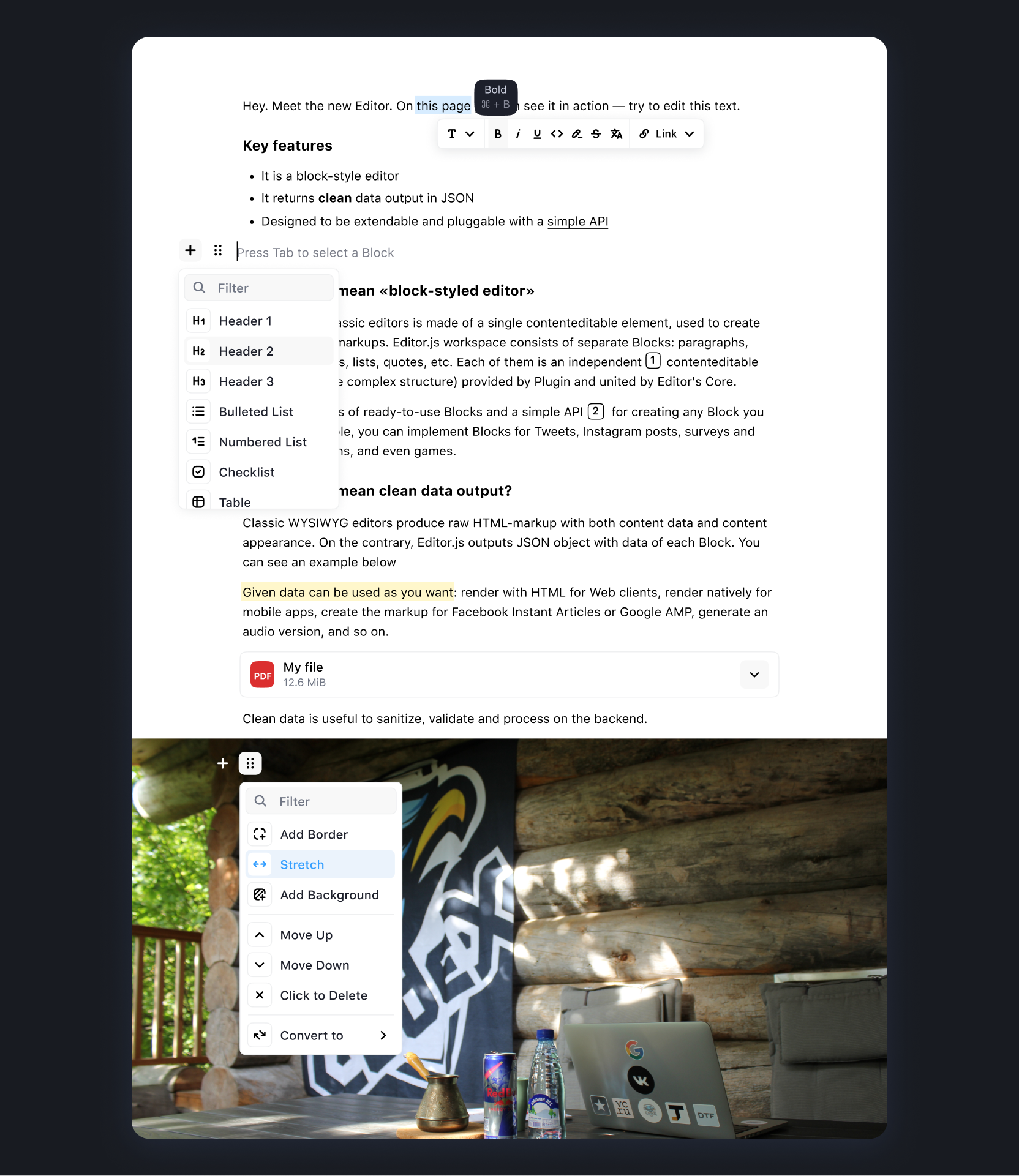
Editor.js is an open-source text editor offering a variety of features to help users create and format content efficiently. It has a modern, block-style interface that allows users to easily add and arrange different types of content, such as text, images, lists, quotes, etc. Each Block is provided via a separate plugin making Editor.js extremely flexible.
Editor.js outputs a clean JSON data instead of heavy HTML markup. Use it in Web, iOS, Android, AMP, Instant Articles, speech readers, AI chatbots — everywhere. Easy to sanitize, extend and integrate with your logic.
- 😍 Modern UI out of the box
- 💎 Clean JSON output
- ⚙️ Well-designed API
- 🛍 Various Tools available
- 💌 Free and open source
Installation
It's quite simple:
- Install Editor.js
- Install tools you need
- Initialize Editor's instance
Install using NPM, Yarn, or CDN:
npm i @editorjs/editorjs
Choose and install tools:
- Heading
- Quote
- Image
- Simple Image (without backend requirement)
- Nested List
- Checklist
- Link embed
- Embeds (YouTube, Twitch, Vimeo, Gfycat, Instagram, Twitter, etc)
- Table
- Delimiter
- Warning
- Code
- Raw HTML
- Attaches
- Marker
- Inline Code
See the 😎 Awesome Editor.js list for more tools.
Initialize the Editor:
<div id="editorjs"></div>
import EditorJS from '@editorjs/editorjs'

const editor = new EditorJS({
  tools: {
   // ... your tools
  }
})
See details about Installation and Configuration at the documentation.
Saving Data
Call editor.save() and handle returned Promise with saved data.
const data = await editor.save()
Example
Take a look at the example.html to view more detailed examples.
Roadmap
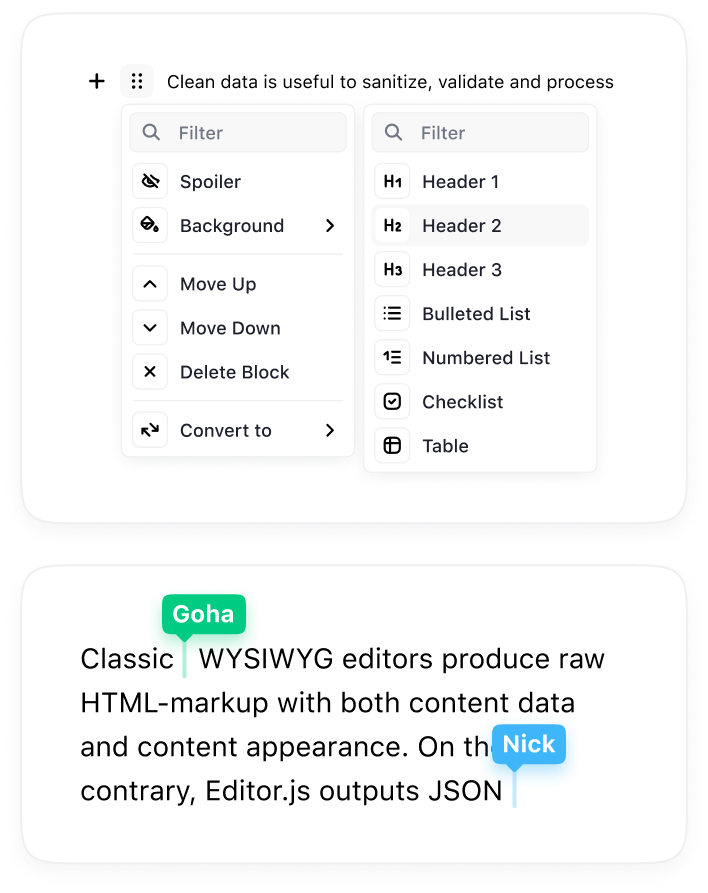
- Unified Toolbars
- Block Tunes moved left
- Toolbox becomes vertical
- Ability to display several Toolbox buttons by the single Tool
- Block Tunes become vertical
- Block Tunes support nested menus
- Block Tunes support separators
- Conversion Menu added to the Block Tunes
- Unified Toolbar supports hints
- Conversion Toolbar uses Unified Toolbar
- Inline Toolbar uses Unified Toolbar
- Collaborative editing
- Implement Inline Tools JSON format
- Operations Observer, Executor, Manager, Transformer
- Implement Undo/Redo Manager
- Implement Tools API changes
- Implement Server and communication
- Update basic tools to fit the new API
- Other features
- Blocks drag'n'drop
- New cross-block selection
- New cross-block caret moving
- Ecosystem improvements
- CodeX Icons — the way to unify all tools and core icons
- New Homepage and Docs
- @editorjs/create-tool for Tools bootstrapping
- Editor.js DevTools — stand for core and tools development
- Editor.js Design System
- Editor.js Preset Env
- Editor.js ToolKit
- New core bundle system
- New documentation and guides

Like Editor.js?
You can support project improvement and development of new features with a donation to our team.
Donate via OpenCollective
Donate via Crypto
Donate via Patreon
Why donate
Donations to open-source products have several advantages for your business:
- If your business relies on Editor.js, you'll probably want it to be maintained
- It helps Editor.js to evolve and get the new features
- We can support contributors and the community around the project. You'll receive well organized docs, guides, etc.
- We need to pay for our infrastructure and maintain public resources (domain names, homepages, docs, etc). Supporting it guarantees you to access any resources at the time you need them.
- You can advertise by adding your brand assets and mentions on our public resources
Sponsors
Support us by becoming a sponsor. Your logo will show up here with a link to your website.


Backers
Thank you to all our backers

Contributors
This project exists thanks to all the people who contribute.

Need something special?
Hire CodeX experts to resolve technical challenges and match your product requirements.
- Resolve a problem that has high value for you
- Implement a new feature required by your business
- Help with integration or tool development
- Provide any consultation
Contact us via team@codex.so and share your details
Community
About CodeX
CodeX is a team of digital specialists around the world interested in building high-quality open source products on a global market. We are open for young people who want to constantly improve their skills and grow professionally with experiments in cutting-edge technologies.
| 🌐 | Join 👋 | ||
|---|---|---|---|
| codex.so | codex.so/join | @codex_team | @codex_team |