Architectural Comparison of React Notification Libraries for Production Systems
react-notifications, react-s-alert, react-toast-notifications, and react-toastify are all libraries designed to display transient feedback messages (toasts, alerts, notifications) in React applications. While they share the same goal, their architectural approaches differ significantly. react-toastify is the modern industry standard, offering a declarative yet flexible API with extensive customization. react-toast-notifications (part of the react-window ecosystem by Brian Vaughn) focuses on a headless, context-driven approach ideal for complex state management. In contrast, react-notifications and react-s-alert are legacy packages that rely on older React patterns (like string refs or deprecated lifecycle methods), lack active maintenance, and should generally be avoided in new greenfield projects in favor of the more robust, actively maintained alternatives.
Npm Package Weekly Downloads Trend
Github Stars Ranking
Stat Detail


React Notification Libraries: A Deep Dive into Architecture and Maintenance
Choosing a notification library seems trivial until you hit edge cases: stacking thousands of toasts, handling server-side rendering (SSR), or managing async promise states. The four packages in question—react-notifications, react-s-alert, react-toast-notifications, and react-toastify—represent two distinct eras of React development. Two are modern, robust tools; two are legacy artifacts. Let's break down how they actually work under the hood.
⚠️ Maintenance Status: The First Filter
Before looking at APIs, we must address longevity. In frontend architecture, a dead library is a technical debt bomb.
react-notifications and react-s-alert are effectively abandoned. They haven't seen meaningful updates in years. They rely on older React lifecycles (componentWillMount, string refs) that trigger warnings in React 16+ and break in React 18 strict mode. Using them today invites instability.
// react-notifications (Legacy Pattern)
// Uses old ref strings and deprecated lifecycle methods internally
this.refs.notificationSystem.addNotification({
  message: 'Old API',
  level: 'success'
});
react-toastify and react-toast-notifications are actively maintained. They support React 18, concurrent features, and modern hook-based patterns. They are safe for long-term architectural commitments.
// react-toastify (Modern Pattern)
// Uses functional updates and supports React 18 concurrent rendering
toast.promise(saveData(), {
  pending: 'Saving...',
  success: 'Saved!',
  error: 'Failed'
});
🏗️ Initialization: Global Imperative vs. Context Provider
How you bootstrap the library dictates how you manage state across your app.
react-toastify uses a hybrid approach. You place a <ToastContainer /> once in your root, but you trigger toasts imperatively from anywhere using a global toast object. This is convenient but relies on a singleton-like pattern.
// react-toastify: Setup
import { ToastContainer, toast } from 'react-toastify';

function App() {
  return (
    <>
      <ToastContainer position="top-right" />
      <Dashboard />
    </>
  );
}

// Usage anywhere
const handleClick = () => toast('Hello World');
react-toast-notifications is strictly provider-based. It forces you to wrap your app in <ToastProvider>. You must consume the addToast function via context or hooks. This is more verbose but aligns better with React's data flow principles.
// react-toast-notifications: Setup
import { ToastProvider, useToasts } from 'react-toast-notifications';

function App() {
  return (
    <ToastProvider>
      <Dashboard />
    </ToastProvider>
  );
}

// Usage via hook
function Dashboard() {
  const { addToast } = useToasts();
  const handleClick = () => addToast('Hello World', { appearance: 'success' });
}
react-notifications requires a specific component <NotificationSystem /> with a ref attached to access the API. This pattern is fragile in modern React.
// react-notifications: Setup
import { NotificationSystem } from 'react-notifications';

// Usage requires accessing the ref directly
this.notificationSystem.addNotification({ ... });
react-s-alert similarly relies on a global <Alert /> component and a static method call Alert.success(). It lacks the modularity of modern context APIs.
// react-s-alert: Setup
import Alert from 'react-s-alert';

// Usage
Alert.success('Message here');
⚡ Handling Async Operations: Promises and States
Real-world apps need to show "Loading," then "Success" or "Error." How much boilerplate does each library force you to write?
react-toastify excels here with built-in promise support. It automatically swaps the toast content based on the promise state.
// react-toastify: Native Promise Support
const notify = () => {
  const promise = fetch('/api/data').then(res => res.json());

  toast.promise(promise, {
    pending: 'Loading data...',
    success: 'Data loaded!',
    error: 'Failed to load'
  });
};
react-toast-notifications requires manual management. You must trigger the "loading" toast, await the promise, then update or replace it. This gives control but adds code.
// react-toast-notifications: Manual Promise Handling
const { addToast, updateToast } = useToasts();

const notify = async () => {
  const id = addToast('Loading data...', { appearance: 'info' });
  try {
    await fetch('/api/data');
    updateToast(id, { content: 'Data loaded!', appearance: 'success' });
  } catch (e) {
    updateToast(id, { content: 'Failed', appearance: 'error' });
  }
};
react-notifications and react-s-alert offer no native promise helpers. You must write the try/catch logic and manually call add/remove methods for every state change, increasing the risk of orphaned toasts if errors aren't caught perfectly.
// react-s-alert: Manual Handling
const notify = async () => {
  Alert.info('Loading...');
  try {
    await apiCall();
    Alert.success('Done');
  } catch (err) {
    Alert.error('Failed');
  }
};
🎨 Customization: Components vs. Strings
Can you render a complex form or a button inside a toast?
react-toastify allows passing React elements directly as the first argument. It also supports a render prop for advanced custom components.
// react-toastify: Custom Component
const CustomToast = ({ closeToast }) => (
  <div>
    <p>Custom content</p>
    <button onClick={closeToast}>Close</button>
  </div>
);

toast(<CustomToast />);
react-toast-notifications treats the first argument of addToast as the content, which can be any renderable React node. It feels very natural for component injection.
// react-toast-notifications: Custom Component
addToast(
  ({ close }) => (
    <div>
      <span>Custom Node</span>
      <button onClick={close}>X</button>
    </div>
  ),
  { appearance: 'info' }
);
react-notifications and react-s-alert primarily expect strings or simple HTML. While some versions allow React elements, the typing is often loose, and styling custom components requires fighting against their internal CSS structure, which is often hardcoded or uses outdated class naming conventions.
// react-notifications: Limited Customization
// Often restricted to message/title strings
this.refs.system.addNotification({
  message: 'Simple string only in many cases',
  title: 'Title'
});
🧩 Stacking and Positioning
When 50 errors fire at once, does the UI crash?
react-toastify handles stacking automatically with CSS transforms. It limits the visible count and queues the rest. You can configure limit to cap visible toasts.
// react-toastify: Stack Limiting
<ToastContainer limit={3} />
// Only shows 3, queues the rest
react-toast-notifications provides robust placement props (placement: 'top-center') and handles stacking via its provider logic. It is highly configurable but requires explicit setup for limits.
// react-toast-notifications: Placement
<ToastProvider placement="top-center">
  {/* Children */}
</ToastProvider>
react-s-alert and react-notifications use absolute positioning with fixed z-indexes. In complex layouts with modals or portals, these toasts often render behind other content unless you manually tweak global CSS, a common pain point in legacy integrations.
📊 Summary: Key Differences
| Feature | react-toastify | react-toast-notifications | react-notifications | react-s-alert |
|---|---|---|---|---|
| Status | ✅ Active | ✅ Active | ❌ Deprecated | ❌ Deprecated |
| API Style | Imperative (Global) | Context/Hook Based | Ref-based | Static Global |
| Promise Support | 🚀 Built-in | 🛠️ Manual | ❌ None | ❌ None |
| React 18 Ready | Yes | Yes | No | No |
| Custom Content | Excellent | Excellent | Limited | Limited |
| Bundle Weight | Moderate | Low | Low | Low |
💡 The Big Picture
react-toastify is the pragmatic choice for 95% of teams. It removes boilerplate for promises, works out of the box, and has a community large enough to solve any edge case you encounter. It strikes the perfect balance between "magic" and control.
react-toast-notifications is the architect's choice for highly structured, context-heavy applications. If you dislike global singletons and want your toast state to flow strictly through React's context tree, this is your library. It pairs exceptionally well with other react-window ecosystem tools.
react-notifications and react-s-alert belong in the museum. They represent an older way of building React apps that fought against the grain of modern data flow. Unless you are maintaining a legacy system where refactoring is impossible, do not install them. The cost of migrating away from them later far outweighs the initial setup time of a modern alternative.
Final Thought: In 2024 and beyond, notification libraries aren't just about showing messages; they are about managing async state and rendering performance. Choose tools that evolve with React, not those that hold it back.
How to Choose: react-notifications vs react-s-alert vs react-toast-notifications vs react-toastify
- react-notifications:
Avoid choosing
react-notificationsfor any new production project. This library is effectively deprecated, lacking updates for modern React versions (18+), and relies on outdated patterns that may cause hydration mismatches or performance issues. Only consider it if you are maintaining a legacy codebase that cannot be refactored immediately. - react-s-alert:
Do not select
react-s-alertfor new development. Likereact-notifications, it is unmaintained and uses antiquated React APIs. It offers no distinct advantage over modern alternatives and poses a security and stability risk due to the lack of patches for potential vulnerabilities or compatibility breaks with newer React releases. - react-toast-notifications:
Select
react-toast-notificationsif your application already relies on thereact-windowecosystem or if you specifically need a provider-based, context-heavy architecture that separates toast state logic from rendering completely. It is best suited for complex dashboards where toast queues need to be managed globally with fine-grained control over positioning and stacking. - react-toastify:
Choose
react-toastifyfor almost all new projects requiring a balance of ease-of-use and power. It is the safest bet for teams needing a drop-in solution that supports promises, custom components, and auto-dismissal without complex setup. Its active maintenance and massive ecosystem make it the de facto standard for modern React apps.
Popular Comparisons
README for react-notifications
React Notifications
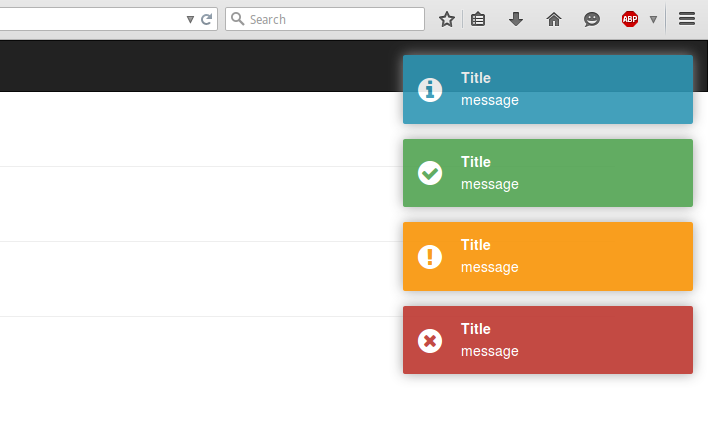
Installation
npm install --save react-notifications
Usage
Note
Use only one 'NotificationContainer' component in the app.
CSS
Webpack:
import 'react-notifications/lib/notifications.css';
Other
<link rel="stylesheet" type="text/css" href="path/to/notifications.css">
JS
import React from 'react';
import {NotificationContainer, NotificationManager} from 'react-notifications';

class Example extends React.Component {
  createNotification = (type) => {
    return () => {
      switch (type) {
        case 'info':
          NotificationManager.info('Info message');
          break;
        case 'success':
          NotificationManager.success('Success message', 'Title here');
          break;
        case 'warning':
          NotificationManager.warning('Warning message', 'Close after 3000ms', 3000);
          break;
        case 'error':
          NotificationManager.error('Error message', 'Click me!', 5000, () => {
            alert('callback');
          });
          break;
      }
    };
  };

  render() {
    return (
      <div>
        <button className='btn btn-info'
          onClick={this.createNotification('info')}>Info
        </button>
        <hr/>
        <button className='btn btn-success'
          onClick={this.createNotification('success')}>Success
        </button>
        <hr/>
        <button className='btn btn-warning'
          onClick={this.createNotification('warning')}>Warning
        </button>
        <hr/>
        <button className='btn btn-danger'
          onClick={this.createNotification('error')}>Error
        </button>

        <NotificationContainer/>
      </div>
    );
  }
}

export default Example;
UMD
<link rel="stylesheet" type="text/css" href="path/to/react-notifications/dist/react-notifications.css">
<script src="path/to/react-notifications/dist/react-notifications.js"></script>
const NotificationContainer = window.ReactNotifications.NotificationContainer;
const NotificationManager = window.ReactNotifications.NotificationManager;
NotificationContainer Props
| Name | Type | Default | Required |
|---|---|---|---|
| enterTimeout | number | 400 | false |
| leaveTimeout | number | 400 | false |
NotificationManager API
- NotificationManager.info(message, title, timeOut, callback, priority);
- NotificationManager.success(message, title, timeOut, callback, priority);
- NotificationManager.warning(message, title, timeOut, callback, priority);
- NotificationManager.error(message, title, timeOut, callback, priority);
| Name | Type | Description |
|---|---|---|
| message | string | The message string |
| title | string | The title string |
| timeOut | integer | The popup timeout in milliseconds |
| callback | function | A function that gets fired when the popup is clicked |
| priority | boolean | If true, the message gets inserted at the top |
Example
View demo or example folder.
Contributing
When contributing to this reposity, please first open an issue and discuss intended changes with maintainers. If there is already an issue open for the feature you are looking to develop, please just coordinate with maintainers before assigning issue to yourself.
Branches
master is the main branch from which we publish packages. next is the branch from which we will publish the next release. All issue branches should be branched from master, unless specifically told by the maintainers to use a different branch. All pull requests should be submitted to merge with next in order to make the next release.
Workflow
- Fork repo
- Create an issue branch
- Commit your changes
- Open a PR against
next. - Link the Issue to your PR.
Pull Request Guidelines
- PRs should be submitted to merge with
next. - PRs should be small in scope, work on 1 issue in a single PR.
- Link the Issue you are working to your PR.
You can add as many commits to your PR as you would like. All commits will be squashed into a single commit when merging PR.