Enterprise UI Component Libraries for React
antd, flowbite-react, material-ui, react-bootstrap, and semantic-ui-react are popular component libraries that provide pre-built UI elements for React applications. antd focuses on enterprise-grade components with dense data displays. material-ui (MUI) implements Google's Material Design with a robust theming system. react-bootstrap wraps the classic Bootstrap CSS framework for React. flowbite-react builds components on top of Tailwind CSS utilities. semantic-ui-react offers a human-friendly HTML syntax but is currently considered legacy due to lack of active maintenance.
Npm Package Weekly Downloads Trend
Github Stars Ranking
Stat Detail


Enterprise UI Component Libraries: Architecture and Trade-offs
Choosing a UI library is a foundational decision that affects development speed, maintainability, and design consistency. antd, flowbite-react, material-ui, react-bootstrap, and semantic-ui-react all solve the same problem — providing reusable components — but they differ in styling strategies, component depth, and long-term support. Let's compare how they handle real-world engineering tasks.
🎨 Styling Strategy: CSS-in-JS vs Utilities vs Preprocessors
How you customize components depends on the underlying styling engine. This affects how you override defaults and theme your app.
antd uses a hybrid approach. Version 5 moved to CSS-in-JS for dynamic theming, replacing the older Less variables.
// antd: ConfigProvider for theming
import { ConfigProvider, Button } from 'antd';

<ConfigProvider theme={{ token: { colorPrimary: '#00b96b' } }}>
  <Button type="primary">Click</Button>
</ConfigProvider>
flowbite-react relies on Tailwind CSS. You customize via Tailwind config or direct className props.
// flowbite-react: Tailwind based
import { Button } from 'flowbite-react';

<Button color="blue" className="hover:bg-blue-700">
  Click
</Button>
material-ui uses Emotion (CSS-in-JS) for styling and theming.
// material-ui: ThemeProvider
import { ThemeProvider, createTheme, Button } from '@mui/material';

const theme = createTheme({ palette: { primary: { main: '#00b96b' } } });

<ThemeProvider theme={theme}>
  <Button variant="contained">Click</Button>
</ThemeProvider>
react-bootstrap depends on standard Bootstrap CSS files. Customization happens via SASS variables or CSS overrides.
// react-bootstrap: CSS dependency
import { Button } from 'react-bootstrap';
import 'bootstrap/dist/css/bootstrap.min.css';

<Button variant="primary">Click</Button>
semantic-ui-react uses Less preprocessing (legacy). Customization requires a build step to compile theme files.
// semantic-ui-react: Less variables (Legacy)
import { Button } from 'semantic-ui-react';

<Button primary>Click</Button>
📊 Data Display: Tables and Grids
Enterprise apps often need complex tables. Libraries differ in how much logic they bake into the table component.
antd provides a powerful Table component with sorting, pagination, and filtering built-in.
// antd: Rich Table component
import { Table } from 'antd';

<Table columns={columns} dataSource={data} pagination={{ pageSize: 10 }} />
flowbite-react offers a basic Table structure. You manage logic (sorting, pagination) yourself.
// flowbite-react: Basic Table
import { Table } from 'flowbite-react';

<Table>
  <Table.Head><Table.HeadCell>Name</Table.HeadCell></Table.Head>
  <Table.Body><Table.Row><Table.Cell>Data</Table.Cell></Table.Row></Table.Body>
</Table>
material-ui provides a flexible Table but requires manual composition for advanced features.
// material-ui: Composable Table
import { Table, TableBody, TableCell, TableHead, TableRow } from '@mui/material';

<Table><TableHead><TableRow><TableCell>Name</TableCell></TableRow></TableHead><TableBody><TableRow><TableCell>Data</TableCell></TableRow></TableBody></Table>
react-bootstrap wraps standard HTML tables with Bootstrap classes. Logic is manual.
// react-bootstrap: Standard HTML Table
import { Table } from 'react-bootstrap';

<Table striped><tbody><tr><td>Data</td></tr></tbody></Table>
semantic-ui-react has a declarative Table but lacks modern features like virtual scrolling.
// semantic-ui-react: Declarative Table (Legacy)
import { Table } from 'semantic-ui-react';

<Table><Table.Header><Table.Row><Table.HeaderCell>Name</Table.HeaderCell></Table.Row></Table.Header><Table.Body><Table.Row><Table.Cell>Data</Table.Cell></Table.Row></Table.Body></Table>
🧩 Component Composition and Layout
Building forms and layouts requires consistent spacing and grid systems.
antd uses a flex-based Grid system (Row, Col).
// antd: Grid System
import { Row, Col } from 'antd';

<Row><Col span={12}>Left</Col><Col span={12}>Right</Col></Row>
flowbite-react encourages using Tailwind grid utilities directly.
// flowbite-react: Tailwind Grid
<div className="grid grid-cols-2">
  <div>Left</div>
  <div>Right</div>
</div>
material-ui offers a Grid component (v5) or Box with sx props.
// material-ui: Grid Component
import { Grid } from '@mui/material';

<Grid container><Grid item xs={6}>Left</Grid><Grid item xs={6}>Right</Grid></Grid>
react-bootstrap uses the Bootstrap grid system.
// react-bootstrap: Bootstrap Grid
import { Row, Col } from 'react-bootstrap';

<Row><Col md={6}>Left</Col><Col md={6}>Right</Col></Row>
semantic-ui-react uses a Grid component similar to Flexbox.
// semantic-ui-react: Grid (Legacy)
import { Grid } from 'semantic-ui-react';

<Grid columns={2}><Grid.Column>Left</Grid.Column><Grid.Column>Right</Grid.Column></Grid>
⚠️ Maintenance and Future Proofing
Long-term support is critical for enterprise projects. Some libraries are actively developed while others are stagnant.
antd is actively maintained with frequent releases and a large community in the enterprise sector.
flowbite-react is growing rapidly alongside Tailwind CSS, with regular updates and new components.
material-ui is highly stable with a dedicated team and long-term support plans for major versions.
react-bootstrap is stable and tracks Bootstrap releases, but innovation is tied to the core Bootstrap project.
semantic-ui-react is NOT recommended for new projects. The underlying CSS is unmaintained, and the React wrapper receives minimal updates. Migrating away from it is a common task for modern teams.
🤝 Similarities: Shared Ground
Despite their differences, these libraries share core goals and patterns.
1. ⚛️ React Component Model
All libraries export standard React components that accept props and children.
// All libraries use standard React props
<Button onClick={() => console.log('clicked')}>Click</Button>
2. 🌐 Accessibility Support
Most modern libraries (AntD, MUI, Flowbite) prioritize ARIA attributes and keyboard navigation.
// Example: Focus management is handled internally
<Input aria-label="Username" />
3. 🎨 Theming Capabilities
All provide some way to change colors, though the mechanism varies (JS vs CSS).
// All support primary color customization
// Via ConfigProvider, ThemeProvider, or CSS variables
4. 📱 Responsive Design
All components are designed to work on mobile and desktop, using breakpoints or fluid layouts.
// All support responsive props or classes
// <Col xs={12} md={6} /> or className="md:w-1/2"
5. 🛠️ TypeScript Support
All packages provide TypeScript definitions for better developer experience.
// All support typed props
const MyComponent: React.FC = () => { ... }
📊 Summary: Key Similarities
| Feature | Shared by All Libraries |
|---|---|
| Core Tech | ⚛️ React Components |
| Language | 📘 TypeScript Support |
| Responsiveness | 📱 Mobile & Desktop Ready |
| Accessibility | ♿ ARIA & Keyboard Nav (Varies) |
| Ecosystem | 📦 NPM Installable |
🆚 Summary: Key Differences
| Feature | antd | flowbite-react | material-ui | react-bootstrap | semantic-ui-react |
|---|---|---|---|---|---|
| Styling | CSS-in-JS (v5) | Tailwind CSS | Emotion (CSS-in-JS) | Bootstrap CSS | Less (Legacy) |
| Data Grids | 🏆 Built-in Advanced | ⚠️ Basic | ⚠️ Manual Composition | ⚠️ Manual | ⚠️ Basic |
| Maintenance | ✅ Active | ✅ Active | ✅ Active | ✅ Stable | ❌ Legacy |
| Customization | ConfigProvider | Tailwind Config | ThemeProvider | SASS / CSS | Less Variables |
| Best For | Enterprise Dashboards | Modern Startups | Design Systems | Bootstrap Migrations | Legacy Maintenance |
💡 The Big Picture
antd is the heavy lifter 🏋️ — best for complex admin panels where you need powerful tables and forms without building them from scratch.
flowbite-react is the modern utility 🛠️ — perfect for teams already using Tailwind who want speed and flexibility without heavy CSS-in-JS overhead.
material-ui is the polished standard 🎨 — ideal for consumer apps needing a refined look, strong accessibility, and a vast component catalog.
react-bootstrap is the safe bet 🛡️ — great for maintaining consistency with existing Bootstrap projects or teams preferring standard CSS.
semantic-ui-react is the legacy system 🏚️ — avoid for new work. Use only if maintaining old code, and plan a migration path.
Final Thought: Your choice depends on your design system needs and long-term maintenance plans. For new enterprise projects, antd or material-ui offer the most stability. For modern web apps, flowbite-react provides the best flexibility. Avoid semantic-ui-react unless absolutely necessary.
How to Choose: antd vs flowbite-react vs material-ui vs react-bootstrap vs semantic-ui-react
- antd:
Choose
antdif you are building complex admin dashboards or enterprise tools that require rich data grids, advanced forms, and dense information layouts. It is ideal for teams that need a comprehensive set of components out of the box without building custom tables or wizards. - flowbite-react:
Choose
flowbite-reactif your project already uses Tailwind CSS and you want pre-built components that blend seamlessly with utility classes. It is suitable for modern startups or projects that prioritize design flexibility and small bundle sizes over heavy enterprise features. - material-ui:
Choose
material-uiif you want a polished, Material Design look with strong accessibility support and a massive ecosystem. It works well for consumer-facing apps, design systems, and teams that need deep customization via CSS-in-JS without relying on utility classes. - react-bootstrap:
Choose
react-bootstrapif you need to migrate an existing Bootstrap project to React or prefer standard CSS over CSS-in-JS. It is a safe choice for internal tools where consistency with the classic Bootstrap look and feel is required. - semantic-ui-react:
Do NOT choose
semantic-ui-reactfor new projects. It is effectively legacy software with minimal maintenance. Only use it if you are maintaining an older codebase that already depends on it, and plan to migrate to a supported alternative soon.
Popular Comparisons
README for antd

Ant Design
An enterprise-class UI design language and React UI library.





Changelog · Report Bug · Request Feature · English · 中文
❤️ Sponsors 
 |  |  |  |
|---|
✨ Features
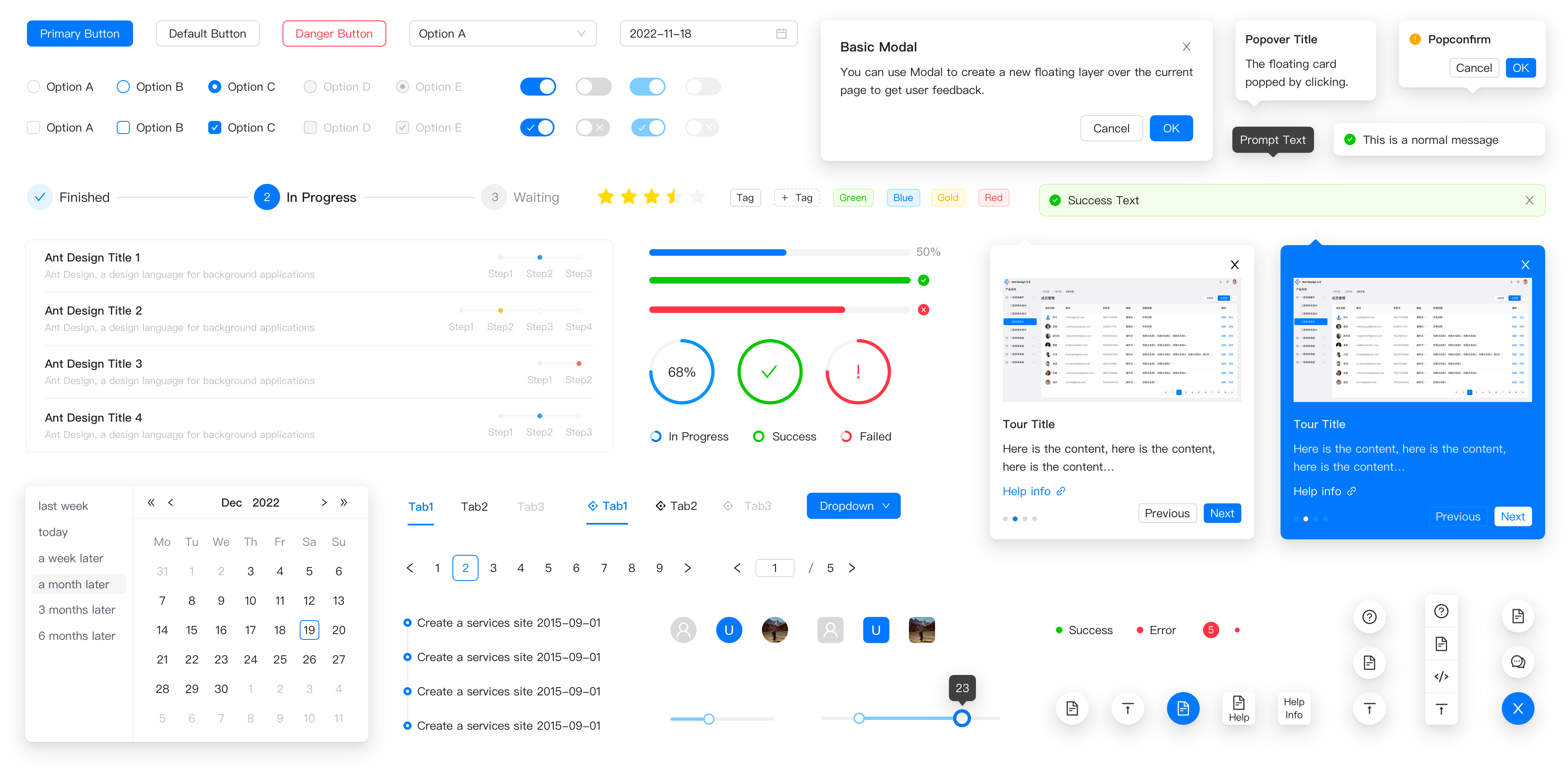
- 🌈 Enterprise-class UI designed for web applications.
- 📦 A set of high-quality React components out of the box.
- 🛡 Written in TypeScript with predictable static types.
- ⚙️ Whole package of design resources and development tools.
- 🌍 Internationalization support for dozens of languages.
- 🎨 Powerful theme customization based on CSS-in-JS.
🖥 Environment Support
- Modern browsers
- Server-side Rendering
- Electron
 Edge |  Firefox |  Chrome |  Safari |  Electron |
|---|---|---|---|---|
| Edge | last 2 versions | last 2 versions | last 2 versions | last 2 versions |
📦 Install
npm install antd
yarn add antd
pnpm add antd
bun add antd
🔨 Usage
import { Button, DatePicker } from 'antd';

export default () => (
  <>
    <Button type="primary">PRESS ME</Button>
    <DatePicker placeholder="select date" />
  </>
);
🔗 Links
- Home page
- Components Overview
- Sponsor
- Change Log
- rc-components
- 🆕 Ant Design X
- Ant Design Pro
- Pro Components
- Ant Design Mobile
- Ant Design Mini
- Ant Design Charts
- Ant Design Web3
- Landing Pages
- Ant Motion
- Scaffold Market
- Developer Instruction
- Versioning Release Note
- FAQ
- Online Playground for bug reports
- Customize Theme
- How to Apply for Being A Collaborator
⌨️ Development
Use opensumi.run, a free online pure front-end dev environment.

Or clone locally:
$ git clone git@github.com:ant-design/ant-design.git
$ cd ant-design
$ npm install
$ npm start
Open your browser and visit http://127.0.0.1:8001, see more at Development.
🤝 Contributing 
|
|

|
Let's build a better antd together.
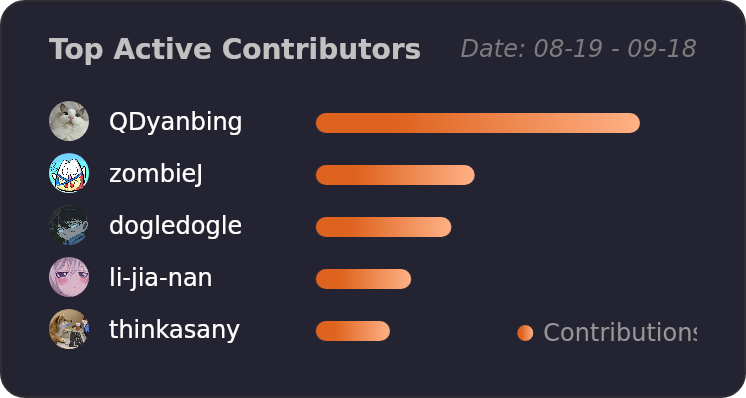
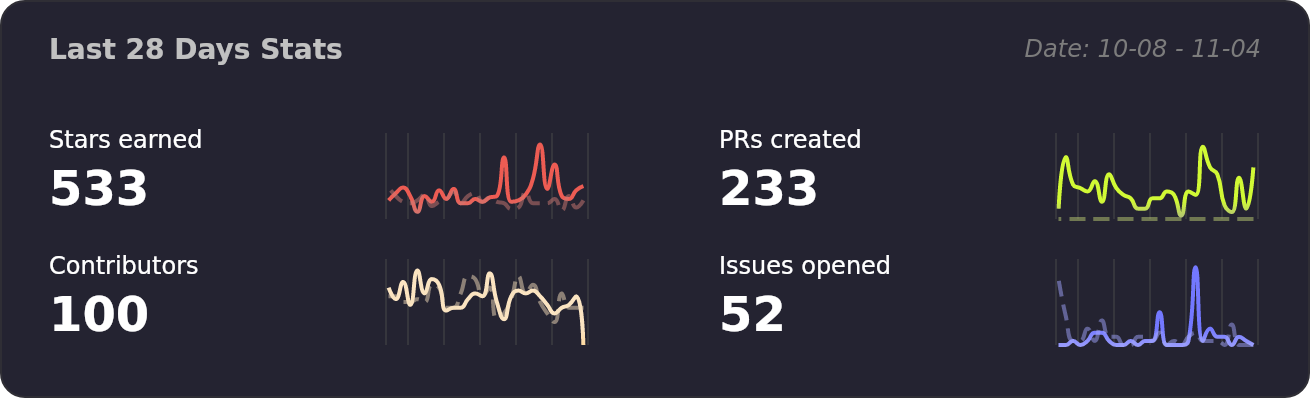
We warmly invite contributions from everyone. Before you get started, please take a moment to review our Contribution Guide. Feel free to share your ideas through Pull Requests or GitHub Issues. If you're interested in enhancing our codebase, explore the Development Instructions and enjoy your coding journey! :)
For collaborators, adhere to our Pull Request Principle and utilize our Pull Request Template when creating a Pull Request.
Issue funding
We use Issuehunt to up-vote and promote specific features that you would like to see and implement. Check our backlog and help us:

❤️ Backers 
