Rich Text Editing Architecture for Modern Web Applications
draft-js, quill, slate, and tiptap are libraries designed to handle rich text editing in web applications. They manage the complexity of content editable regions, cursor selection, and data serialization. draft-js is a legacy React-specific solution originally built by Meta. quill is a standalone, opinionated editor with a built-in UI. slate is a fully customizable framework for building editors in React. tiptap is a headless wrapper around ProseMirror that supports multiple frameworks like Vue and React.
Npm Package Weekly Downloads Trend
Github Stars Ranking
Stat Detail


Rich Text Editing Architecture: Draft.js vs Quill vs Slate vs Tiptap
Building a rich text editor from scratch is notoriously difficult due to browser inconsistencies in handling content editable regions. draft-js, quill, slate, and tiptap solve this by providing abstractions over the DOM. However, they differ significantly in architecture, flexibility, and maintenance status. Let's compare how they handle core engineering challenges.
🏗️ Architecture Model: Opinionated vs Headless
draft-js uses an immutable model backed by React state.
- It manages content as an internal tree structure.
- The UI components are tightly coupled with the logic.
// draft-js: Immutable EditorState
import { EditorState } from 'draft-js';

const state = EditorState.createEmpty();
const content = state.getCurrentContent();
quill operates on a Delta format independent of React.
- It manages its own DOM and state internally.
- You interact with it via an imperative API or wrappers.
// quill: Independent Delta model
import Quill from 'quill';

const quill = new Quill('#editor', { theme: 'snow' });
const delta = quill.getContents();
slate treats the editor as a controlled React component.
- You define the schema and render nodes yourself.
- It provides the logic, but you build the UI.
// slate: Controlled React components
import { createEditor } from 'slate';

const editor = createEditor();
// Rendered via <Slate><Editable /></Slate>
tiptap is a headless wrapper around ProseMirror.
- It separates logic from view completely.
- You use extensions to add features without styling constraints.
// tiptap: Headless extension setup
import { useEditor } from '@tiptap/react';

const editor = useEditor({ extensions: [StarterKit] });
// Rendered via <EditorContent editor={editor} />
🎨 Customization & Schema: Fixed vs Flexible
draft-js has a fixed schema with limited customization.
- Adding custom blocks requires complex decorators.
- Hard to modify core behavior without forks.
// draft-js: Custom block rendering
function blockRendererFn(contentBlock) {
  if (contentBlock.getType() === 'atomic') {
    return { component: MediaBlock, editable: false };
  }
}
quill allows customization through modules and themes.
- You can register custom formats or blots.
- Easier than Draft.js but still constrained by its core model.
// quill: Registering a custom blot
import Quill from 'quill';
const Block = Quill.import('blots/block');

class CustomBlock extends Block {}
Quill.register(CustomBlock);
slate offers complete schema flexibility.
- You define every node type and rule.
- Ideal for unique data structures like nested comments.
// slate: Custom node rendering
const renderElement = props => {
  switch (props.element.type) {
    case 'quote': return <QuoteElement {...props} />;
    default: return <DefaultElement {...props} />;
  }
};
tiptap uses an extension system for customization.
- You enable features like tables or images via plugins.
- You can write custom extensions in TypeScript easily.
// tiptap: Custom extension
const Highlight = Extension.create({
  name: 'highlight',
  addOptions() { return { color: null }; }
});
⚛️ Framework Integration: React vs Universal
draft-js is built exclusively for React.
- It relies on React state and lifecycle methods.
- Cannot be used with Vue or Svelte without major hacks.
// draft-js: React specific import
import { Editor } from 'draft-js';

function MyEditor() {
  return <Editor editorState={state} onChange={setState} />;
}
quill is framework agnostic.
- It works with vanilla JS, React, Vue, or Angular.
- React wrappers are community-maintained or official.
// quill: Vanilla JS initialization
const quill = new Quill('#editor', { theme: 'snow' });
// Can be wrapped in any framework component
slate is built exclusively for React.
- It uses React hooks and context heavily.
- Deep integration means better control but lock-in.
// slate: React hooks usage
import { Slate, Editable, withReact } from 'slate-react';

function App() {
  const [editor] = useState(() => withReact(createEditor()));
  return <Slate editor={editor}><Editable /></Slate>;
}
tiptap supports multiple frameworks officially.
- There are dedicated packages for React, Vue, and Svelte.
- Logic remains consistent across different stacks.
// tiptap: React specific hook
import { useEditor, EditorContent } from '@tiptap/react';

function App() {
  const editor = useEditor({ extensions: [] });
  return <EditorContent editor={editor} />;
}
💾 Data Serialization: JSON vs HTML
draft-js exports to a custom raw JSON format.
- You must convert it to HTML for display elsewhere.
- The format is verbose and specific to Draft.js.
// draft-js: Export to raw JSON
import { convertToRaw } from 'draft-js';

const rawContent = convertToRaw(contentState);
// Requires converter to get HTML string
quill exports to Delta JSON or HTML.
- Delta is its native format for storing changes.
- HTML export is available but can lose some fidelity.
// quill: Get Delta or HTML
const delta = quill.getContents(); // JSON
const html = quill.root.innerHTML; // HTML string
slate stores data as a plain JSON tree.
- You decide how to serialize it to HTML.
- Gives full control over storage format.
// slate: Get JSON value
const value = editor.children; // Plain JSON array
// Use serialize function to convert to HTML
tiptap supports JSON and HTML out of the box.
- It can parse HTML input and output JSON.
- Great for interoperability with backend systems.
// tiptap: Get JSON or HTML
const json = editor.getJSON(); // JSON object
const html = editor.getHTML(); // HTML string
⚠️ Maintenance & Future Proofing
draft-js is effectively deprecated for new work.
- Meta is no longer actively developing new features.
- Security patches are rare and community support is fading.
// draft-js: Legacy warning
// npm install draft-js
// ⚠️ Not recommended for new projects
quill is actively maintained with version 2.0 released.
- Regular updates fix bugs and add small features.
- Stable choice for standard requirements.
// quill: Active maintenance
// npm install quill
// ✅ Stable and maintained
slate has frequent updates and a strong community.
- API changes can be breaking between versions.
- Requires careful version locking in production.
// slate: Frequent updates
// npm install slate slate-react
// ✅ Active but watch for breaking changes
tiptap is rapidly growing with enterprise backing.
- Very stable due to ProseMirror core.
- Excellent documentation and support channels.
// tiptap: Rapid growth
// npm install @tiptap/react
// ✅ Highly recommended for modern stacks
📊 Summary: Key Differences
| Feature | draft-js | quill | slate | tiptap |
|---|---|---|---|---|
| Status | ⚠️ Legacy | ✅ Stable | ✅ Active | ✅ Active |
| Framework | React Only | Any | React Only | React, Vue, Svelte |
| UI | Coupled | Built-in | Headless | Headless |
| Data | Custom Raw | Delta/HTML | JSON | JSON/HTML |
| Learning Curve | Medium | Low | High | Medium |
💡 The Big Picture
draft-js is a legacy tool 🕰️ — do not use it for new projects. It served a purpose in the past but is now outdated compared to modern solutions.
quill is a ready-to-use solution 📦 — perfect for standard needs where speed matters more than customization. Ideal for simple forms or blogs.
slate is a builder's kit 🛠️ — best for React teams who need to invent new editing behaviors. It requires more work but offers total control.
tiptap is the modern standard 🚀 — combines ProseMirror power with a developer-friendly API. Choose this for robust, future-proof applications across any framework.
Final Thought: For most new projects, tiptap offers the best balance of power and ease of use. If you need something quick and simple, quill works well. Avoid draft-js unless you are maintaining old code.
How to Choose: draft-js vs quill vs slate vs tiptap
- draft-js:
Avoid
draft-jsfor new projects. It is in maintenance mode and lacks modern features like collaborative editing or robust mobile support. Only choose this if you are maintaining an existing legacy codebase that already depends on it. - quill:
Choose
quillif you need a standard rich text editor with a built-in UI and quick setup. It is ideal for blogs, comment sections, or simple content fields where deep customization is not required. - slate:
Choose
slateif you need full control over the editor schema and behavior within a React application. It is best for complex tools like document editors or note-taking apps where you need to define custom nodes and logic. - tiptap:
Choose
tiptapfor a headless approach with ProseMirror stability. It is suitable for teams using Vue, React, or Svelte who need robust collaboration features without being locked into a specific UI theme.
Popular Comparisons
README for draft-js

Draft.js


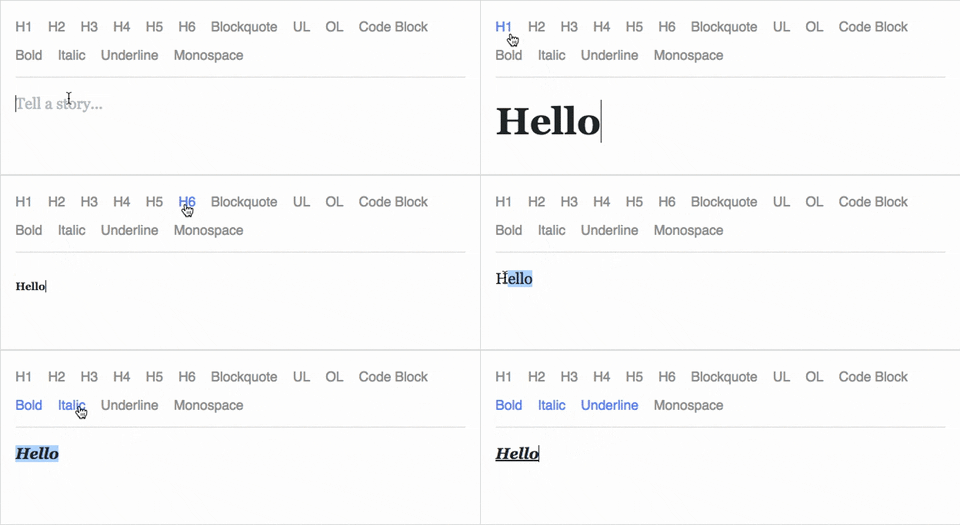
Draft.js is a JavaScript rich text editor framework, built for React and backed by an immutable model.
- Extensible and Customizable: We provide the building blocks to enable the creation of a broad variety of rich text composition experiences, from basic text styles to embedded media.
- Declarative Rich Text: Draft.js fits seamlessly into React applications, abstracting away the details of rendering, selection, and input behavior with a familiar declarative API.
- Immutable Editor State: The Draft.js model is built with immutable-js, offering an API with functional state updates and aggressively leveraging data persistence for scalable memory usage.
Learn how to use Draft.js in your own project.
API Notice
Before getting started, please be aware that we recently changed the API of
Entity storage in Draft. The latest version, v0.10.0, supports both the old
and new API. Following that up will be v0.11.0 which will remove the old API.
If you are interested in helping out, or tracking the progress, please follow
issue 839.
Getting Started
npm install --save draft-js react react-dom

or

yarn add draft-js react react-dom
Draft.js depends on React and React DOM which must also be installed.
Using Draft.js
import React from 'react';
import ReactDOM from 'react-dom';
import {Editor, EditorState} from 'draft-js';

class MyEditor extends React.Component {
  constructor(props) {
    super(props);
    this.state = {editorState: EditorState.createEmpty()};
    this.onChange = (editorState) => this.setState({editorState});
    this.setEditor = (editor) => {
      this.editor = editor;
    };
    this.focusEditor = () => {
      if (this.editor) {
        this.editor.focus();
      }
    };
  }

  componentDidMount() {
    this.focusEditor();
  }

  render() {
    return (
      <div style={styles.editor} onClick={this.focusEditor}>
        <Editor
          ref={this.setEditor}
          editorState={this.state.editorState}
          onChange={this.onChange}
        />
      </div>
    );
  }
}

const styles = {
  editor: {
    border: '1px solid gray',
    minHeight: '6em'
  }
};

ReactDOM.render(
  <MyEditor />,
  document.getElementById('container')
);
Since the release of React 16.8, you can use Hooks as a way to work with EditorState without using a class.
import React from 'react';
import ReactDOM from 'react-dom';
import {Editor, EditorState} from 'draft-js';

function MyEditor() {
  const [editorState, setEditorState] = React.useState(
    EditorState.createEmpty()
  );

  const editor = React.useRef(null);

  function focusEditor() {
    editor.current.focus();
  }

  React.useEffect(() => {
    focusEditor()
  }, []);

  return (
    <div onClick={focusEditor}>
      <Editor
        ref={editor}
        editorState={editorState}
        onChange={editorState => setEditorState(editorState)}
      />
    </div>
  );
}
Note that the editor itself is only as tall as its contents. In order to give users a visual cue, we recommend setting a border and a minimum height via the .DraftEditor-root CSS selector, or using a wrapper div like in the above example.
Because Draft.js supports unicode, you must have the following meta tag in the <head> </head> block of your HTML file:
<meta charset="utf-8" />
Further examples of how Draft.js can be used are provided below.
Examples
Visit http://draftjs.org/ to try out a basic rich editor example.
The repository includes a variety of different editor examples to demonstrate some of the features offered by the framework.
To run the examples, first build Draft.js locally. The Draft.js build is tested with Yarn v1 only. If you're using any other package manager and something doesn't work, try using yarn v1:
git clone https://github.com/facebook/draft-js.git
cd draft-js
yarn install
yarn run build
then open the example HTML files in your browser.
Draft.js is used in production on Facebook, including status and comment inputs, Notes, and messenger.com.
Browser Support
 IE / Edge |  Firefox |  Chrome |  Safari |  iOS Safari | Chrome for Android |
|---|---|---|---|---|---|
| IE11, Edge [1, 2] | last 2 versions | last 2 versions | last 2 versions | not fully supported [3] | not fully supported [3] |
[1] May need a shim or a polyfill for some syntax used in Draft.js (docs).
[2] IME inputs have known issues in these browsers, especially Korean (docs).
[3] There are known issues with mobile browsers, especially on Android (docs).
Resources and Ecosystem
Check out this curated list of articles and open-sourced projects/utilities: Awesome Draft-JS.
Discussion and Support
Join our Slack team!
Contribute
We actively welcome pull requests. Learn how to contribute.
License
Draft.js is MIT licensed.
Examples provided in this repository and in the documentation are separately licensed.